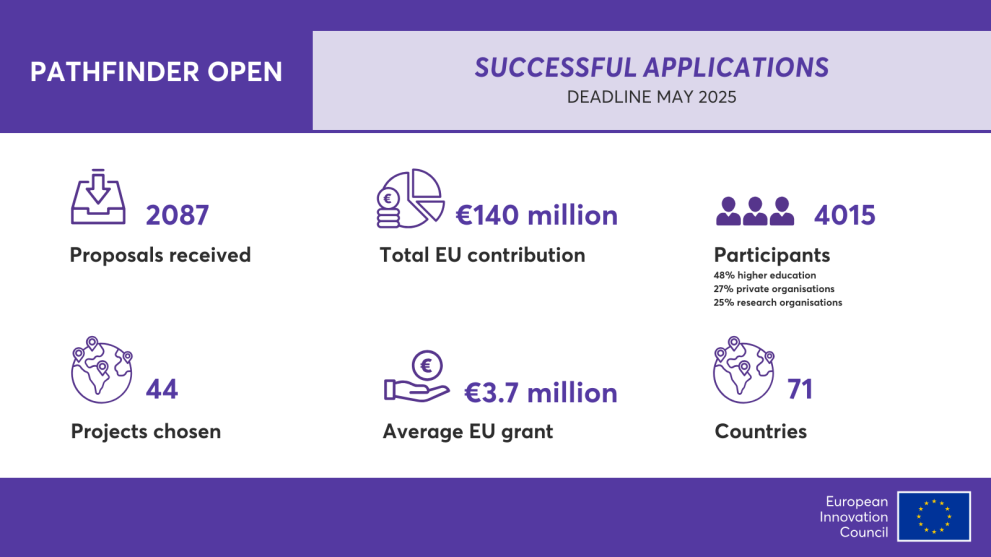
The European Innovation Council (EIC) has awarded €140 million to 44 groundbreaking research projects through its 2025 Pathfinder Open call, advancing technologies in quantum communication, health, and sustainable infrastructure. The selected projects, spanning universities, private companies, and research organizations, aim to create future markets with innovations like secure AI ecosystems for stroke care and quantum networks. This funding supports high-risk, high-reward ideas, providing grants and business acceleration services to transform scientific visions into real-world impact. The 2025 call saw record participation, with proposals from 71 countries, underscoring the global demand for cutting-edge research.
Breakthrough Technologies Funded by EIC in 2025
The European Innovation Council (EIC) recently announced over €140 million in funding for 44 pioneering research projects, selected from a record number of proposals received from 71 countries. These projects represent a commitment to radically new technologies with the potential to shape future markets, spanning fields like quantum technologies and advanced materials. The EIC aims to foster innovation by supporting collaborations between universities (48%), private companies (27%), and research organisations (25%).
Several projects showcase this forward-thinking approach, including Superspin, which seeks to link superconducting quantum computers with spin-based quantum memory. This ambitious undertaking will develop devices to convert quantum signals between microwave and optical regimes, enabling interaction between distant quantum systems. Meanwhile, Fiber3D is pioneering a novel fabrication method integrating optical fibre sensors directly into metal structures using 3D-printing techniques. This innovation promises real-time monitoring of critical infrastructure, like railways and hydrogen pipelines, significantly improving safety and maintenance.
Building on these advancements, CEREBRIS addresses crucial challenges in healthcare by developing a secure, federated AI ecosystem for stroke care. The project will leverage diverse patient data, including brain scans and neural signals, to improve diagnostics and rehabilitation outcomes while upholding patient privacy. These funded initiatives will also benefit from bespoke coaching, mentoring, and networking opportunities through the EIC Business Acceleration Services, accelerating their translation into real-world impact. Here are the projects in more detail below.
NIRFUS is a 36-month project led by Technische Universitaet Muenchen in Germany that develops intravascular near-infrared fluorescence and ultrasound coronary imaging technology. This innovative approach combines fluorescence and ultrasound imaging modalities to provide enhanced visualization of coronary arteries for improved cardiovascular diagnostics.
Fiber3D is a 48-month initiative by Centre National de la Recherche Scientifique CNRS in France focusing on multi-process strategies to embed optical fibers in 3D-printed metal parts. The project aims to integrate optical sensing capabilities directly into metal components during the additive manufacturing process.
THz-Skin is a 48-month project conducted by Ita-Suomen Yliopisto in Finland that develops THz-FIR colour imaging technology for analyzing skin conditions based on thermal emission patterns. This non-invasive diagnostic approach could revolutionize dermatological assessment and early detection of skin abnormalities.
FAST (Functionalised Activated Sapphire Thin-disk) is a 36-month project at the University of Southampton in the UK developing advanced laser technology using sapphire-based thin-disk configurations. The project aims to create more efficient and powerful laser systems for various industrial and scientific applications.
ULTRAPURE is a 36-month project led by Technische Universitaet Braunschweig in Germany creating integrated sources for ultrapure oscillations ranging from acoustical to light waves. This fundamental research could enable new precision measurement technologies and quantum sensing applications.
QuPIX is a 48-month initiative at Technische Universiteit Delft in the Netherlands developing quantum-enhanced perovskite crystal scintillators for innovative X-ray photon-counting in medical imaging. The project promises to significantly improve the resolution and sensitivity of medical X-ray systems while potentially reducing radiation exposure.
HEARTCORE is a 36-month project at Medizinische Hochschule Hannover in Germany creating a human-based advanced cardiac safety platform that integrates multilayer cardiac organoids, mesh MEA technology, and AI-based proarrhythmia risk assessment. This comprehensive platform aims to revolutionize drug safety testing for cardiac medications.
EUROPA is a 48-month project led by Institut Mines-Telecom in France developing a laser-driven universal radio-isotope production accelerator. This technology could provide a more efficient and accessible method for producing medical isotopes used in diagnostic imaging and cancer treatment.
VIBRANT is a 48-month initiative at Universitair Medisch Centrum Utrecht in the Netherlands focusing on vasculature instructed by bioprinting via volumetric and intravital multiphoton technologies. The project aims to create functional vascular networks in bioprinted tissues for regenerative medicine applications.
NanoFlash is a 48-month project at the University of Cambridge in the UK developing cell-targeted biophotonic nanoparticles for vision restoration. This groundbreaking approach could offer new therapeutic options for patients with degenerative eye diseases and vision loss.
AI-RITMIA is a 36-month project at Politecnico di Milano in Italy creating an AI-assisted personalized heart-on-chip platform as an advanced diagnostic tool for clinical significance assessment of inherited cardiomyopathies. The technology combines organ-on-chip systems with artificial intelligence for personalized cardiac disease diagnosis.
SuperICQ is a 48-month initiative by Teknologian Tutkimuskeskus VTT Oy in Finland developing superconducting integrated circuits for scalable quantum systems. This project addresses critical challenges in quantum computing hardware, working toward more practical and scalable quantum processors.
PROPANTHERA is a 36-month project at Fundacion Sector Publico Estatal Centro Nacional Investigaciones Oncologicas Carlos III in Spain pioneering retrograde atrophy induction as a paradigm shift in prostate and pancreatic cancer prevention and therapy. This novel approach could offer new strategies for treating these challenging cancers.
HoloMorPh is a 48-month project at Universita degli Studi di Napoli Federico II in Italy developing holographic surface morphing technology for ready-to-use planar photonic components. The project aims to create adaptable photonic devices that can dynamically change their optical properties.
INTEGRAL is a 36-month initiative at Munster Technological University in Ireland focusing on integrated photonics for signal processing and lasers toward the next generation optical coherence tomography. This technology could significantly improve medical imaging capabilities for non-invasive diagnostics.
PHOTONIX is a 36-month project at The Cyprus Institute developing photoconversion for novel integrated X-systems. The project explores new ways to convert and manipulate photons for advanced X-ray applications in medical and industrial imaging.
OutMARCH is a 48-month project at Universitair Medisch Centrum Utrecht in the Netherlands developing innovative membrane protein degrader modalities for cancer treatment. This approach targets previously undruggable proteins that drive cancer progression.
DRIVIN CAR is a 48-month initiative at Technische Universiteit Eindhoven in the Netherlands developing robust in vivo nanomedicine-based chimeric antigen receptor technology. The project aims to improve CAR-T cell therapy through advanced nanomedicine approaches.
FeROS is a 48-month project led by Centre National de la Recherche Scientifique CNRS in France developing prodrugs of antiparasitic redox-active compounds. This research could lead to more effective treatments for parasitic diseases with reduced side effects.
NEQIOS is a 60-month project at Universiteit Twente in the Netherlands, the longest duration in the portfolio, developing neuromorphic quantum-inspired optimization and simulation systems. This ambitious project bridges quantum computing concepts with neuromorphic architectures for advanced computational problems.
VacciNEXT is a 36-month initiative by Basinnov Life Sciences Unipessoal LDA in Portugal developing next generation therapeutic vaccines for targeted cancer treatment. The project focuses on personalized vaccine approaches to enhance immune responses against cancer.
Superspin is a 36-month project at Karlsruher Institut fuer Technologie in Germany creating remote entanglement between superconducting and spin qubits. This fundamental quantum physics research could enable new quantum communication and computing architectures.
MECH-QUBIT is a 48-month project at Fundacio Institut de Ciencies Fotoniques in Spain developing mechanical qubits with enhanced coherence. The project explores mechanical systems as a platform for quantum information processing with potentially longer coherence times.
HeartVision is a 48-month initiative at Universitetet i Tromsoe – Norges Arktiske Universitet in Norway illuminating new paths in heart failure therapy. The project likely uses advanced imaging or optical techniques to better understand and treat heart failure conditions.
CHEM-SCAN is a 48-month project at Universitaet Bielefeld in Germany developing high-resolution functional optical imaging of chemoresistance. This technology could help identify and overcome drug resistance in cancer treatment through advanced imaging techniques.
GAIA is a 36-month project at Fundacio per a la Universitat Oberta de Catalunya in Spain bridging sustainability and ubiquity in next-generation IoT systems. The initiative aims to make IoT devices more environmentally sustainable while maintaining widespread deployment capabilities.
ULYSSES is a 36-month project by Disruptive Technological Advances in Life Science S.R.L. Società Benefit in Italy developing ultrasensitive luminescence-based yeast sensors for specific early cancer sensing. This biosensor technology could enable earlier cancer detection through highly sensitive biological detection systems.
TICON is a 48-month initiative at IBM Research GmbH in Switzerland exploring topological semimetals for ultra-efficient electrical interconnects. The project could revolutionize computer chip design by reducing energy consumption in electronic connections.
SUSHI-PACK is a 48-month project by GreenOil srl in Italy creating sustainable and high-performance packaging from seaweed and used cooking oils. This eco-friendly initiative addresses plastic pollution by developing biodegradable packaging alternatives from waste materials.
ALERT is a 36-month project at Universita di Pisa in Italy developing multianalyte digital sensing with QR-code microneedles for minimally invasive early diagnosis of Alzheimer’s disease. This innovative diagnostic approach combines microneedle technology with digital sensing for painless disease detection.
CEREBRIS is a 48-month initiative at University College Dublin, National University of Ireland, employing multi AI-agents to revolutionize the management of neurological diseases. The project develops sophisticated AI systems for better diagnosis, treatment planning, and monitoring of neurological conditions.
STAY2ME is a 48-month project at Centre National de la Recherche Scientifique CNRS in France developing silicon through-holes by accumulative interplay of 2-micron short pulses. This advanced manufacturing technique could improve semiconductor device fabrication and 3D integration.
AMFactory is a 36-month project at Universite Catholique de Louvain in Belgium engineering bioreactor mass production of arbuscular mycorrhizal fungi for European farming. This biotechnology initiative aims to scale up production of beneficial fungi that enhance crop growth and sustainability.
SWIRFlex-DT is a 42-month initiative at Ethniko Idryma Erevnon in Greece developing advanced organic semiconductor materials for flexible SWIR photodetection. The project creates new materials for short-wave infrared detection in flexible electronic applications.
GREENDIGO is a 48-month project by NordicBlue in Denmark developing biosolutions for denim dyeing within planetary boundaries. This sustainable fashion initiative aims to reduce the environmental impact of denim production through biological dyeing processes.
bLOSSom is a 48-month project at Fundacion Centro Tecnoloxico de Telecomunicacions de Galicia in Spain creating self-sustained photonic systems through autonomous loss harvesting. The technology could enable more efficient optical communication systems by recycling energy losses.
RamanProSeq is a 36-month initiative at Oulun Yliopisto in Finland developing plasmonic nanopore technologies for automatic manipulation and Raman spectroscopic sequencing of single proteins. This advanced biotechnology could revolutionize protein analysis and drug discovery.
CarboNcare is a 48-month project at Charite – Universitaetsmedizin Berlin in Germany focusing on carbon-efficient bioproduction of chemicals from methanol. The project addresses sustainability in chemical manufacturing by developing more efficient biological production methods.
PHINDER is a 48-month project at Lulea Tekniska Universitet in Sweden creating picosecond-scale photonic heterogeneous integrated neuromorphic detectors. This technology combines ultra-fast photonics with neuromorphic computing for advanced signal processing applications.
ReWoW is a 36-month initiative at Universitat Autonoma de Barcelona in Spain revolutionizing the waste of waste by creating a new bioeconomy-based business for digestate. The project transforms agricultural waste products into valuable resources for sustainable agriculture.
Q-Vibe is a 42-month project at Politecnico di Milano in Italy developing quantum-enhanced vibrational microscopy. This advanced imaging technology uses quantum effects to improve the resolution and sensitivity of vibrational spectroscopy for material and biological analysis.
REMMIA is a 48-month project at Centre National de la Recherche Scientifique CNRS in France developing an innovative approach for recycling permanent magnets. This initiative addresses critical material sustainability in electronics and renewable energy technologies.
SECURE is a 36-month project at Ruprecht-Karls-Universitaet Heidelberg in Germany creating synthetic gene circuits for closed-loop therapy. The technology enables self-regulating biological systems that can automatically adjust therapeutic responses based on patient conditions.
AMSwitch is a 48-month initiative at Chalmers Tekniska Hogskola AB in Sweden developing an altermagnet switch. This project explores a new class of magnetic materials called altermagnets for potential applications in next-generation electronic devices and quantum computing.
Transforming Industries Through Radical Innovation
Building on this commitment to disruptive technologies, several funded projects directly address industrial challenges. Fiber3D, for instance, pioneers a novel fabrication method integrating optical fibre sensors directly into metal structures using advanced 3D-printing and spraying techniques. This innovation enables real-time monitoring of critical parameters like temperature and strain in infrastructure, dramatically improving safety and maintenance efficiency in sectors such as railways and hydrogen pipelines. The company announced this approach offers a significant leap beyond traditional monitoring systems, promising reduced downtime and extended operational lifespans.
Meanwhile, the CEREBRIS project tackles neurological disease through a secure, federated, and explainable AI ecosystem for stroke care. This initiative aims to learn from diverse patient data , including brain scans and neural signals , without requiring data sharing, thus protecting patient privacy. The project consortium intends to transform the entire stroke-care pathway, from early diagnosis to recovery, potentially reducing long-term disability and associated healthcare costs worldwide. According to project leads, this collaborative AI approach represents a paradigm shift in neurological care.
Superspin is focused on achieving a major milestone in quantum communication by linking a superconducting quantum computer with a spin-based quantum memory. The project will develop innovative devices to convert quantum signals between microwave and optical regimes, enabling interaction between distant quantum systems. This breakthrough is expected to provide a crucial building block for interconnected quantum networks, supporting scalable, secure, and high-performance quantum technologies across Europe and beyond. This advancement promises to unlock new possibilities in secure data transmission and computation.
This substantial investment by the European Innovation Council will accelerate the development of groundbreaking technologies across diverse sectors. Projects like CEREBRIS demonstrate a clear focus on translating advanced research into practical solutions, specifically improving stroke care through collaborative AI. The implications extend beyond these initial 44 projects, fostering a collaborative ecosystem involving universities, private companies, and research organizations.
For industries reliant on data-driven innovation and advanced materials, this represents a significant step toward future market creation and real-world impact. By supporting both foundational research and its translation, the European Innovation Council aims to establish Europe as a leader in transformative technologies, potentially reshaping fields from healthcare to energy.