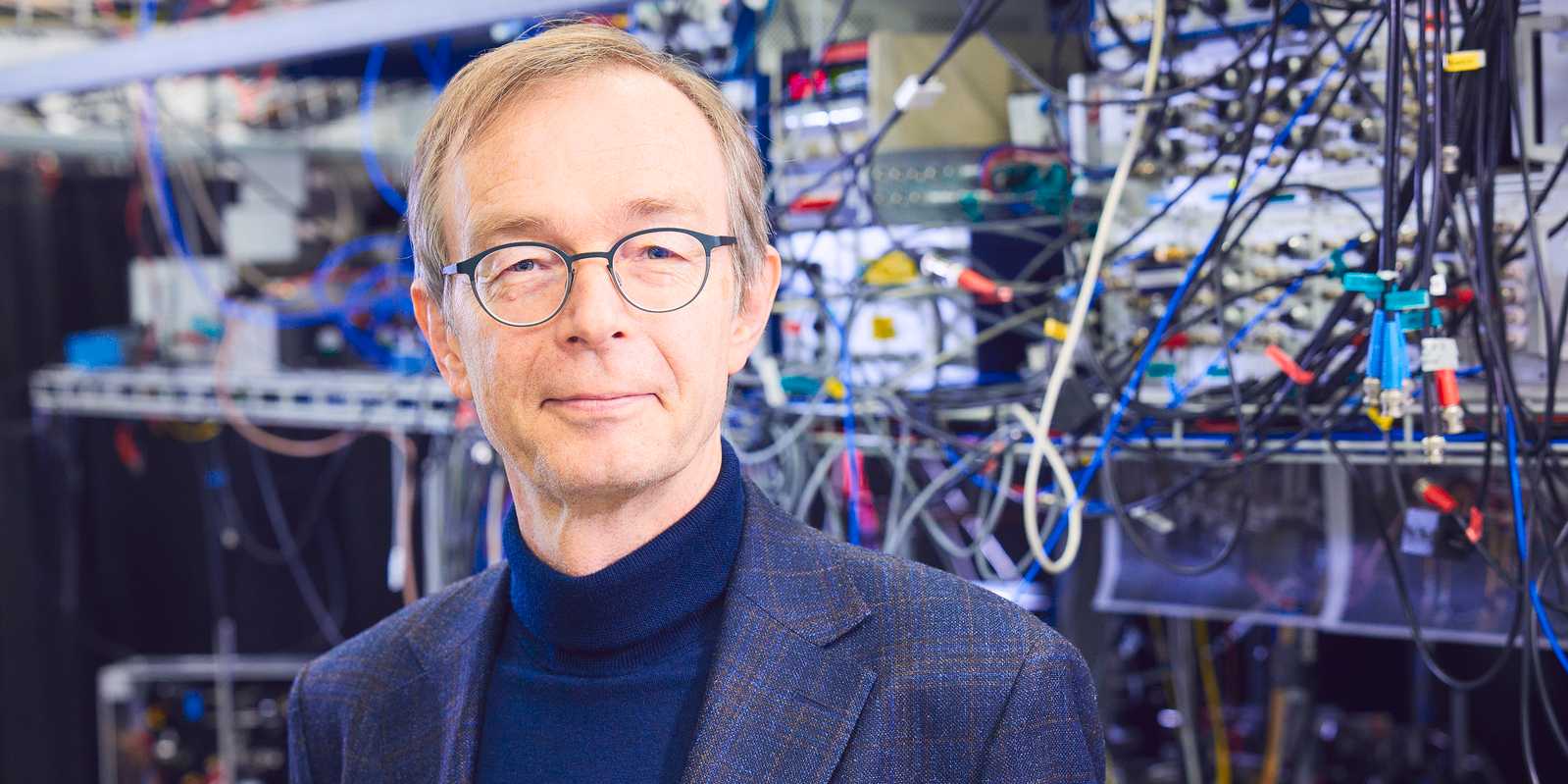
Tilman Esslinger of the Department of Physics, alongside collaborators Immanuel Bloch of the Max Planck Institute of Quantum Optics and Ludwig-Maximilians-Universität München, and Markus Greiner of Harvard University, have been jointly awarded the Micius Prize 2025 for their pioneering experimental realisation of bosonic and fermionic Hubbard models within optical lattices. This work constitutes analog quantum simulation of strongly interacting many-body systems, enabling comprehensive investigations into quantum phases, transport phenomena, and topological states of matter. Esslinger’s research group has specifically demonstrated the realisation of Mott-insulating phases in both Bose and Fermi gases, experimental validation of the Dicke model and the topological Haldane model, and direct observation of quantum transport within a Fermi gas, all achieved through manipulation of ultracold atomic gases confined by optical lattice potentials. The Micius Quantum Prize, established in 2018 by the Micius Quantum Foundation, recognises significant contributions to quantum technologies, and previous recipients include Peter Shor, Anton Zeilinger, and Nicolas Gisin; the award consists of a 150,000 US dollar prize and a commemorative medal.
Recognition of Quantum Simulation Pioneers
The Micius Prize 2025 has been jointly awarded to Tilman Esslinger, Professor at the Department of Physics, ETH Zürich; Immanuel Bloch, of the Max Planck Institute of Quantum Optics and Ludwig-Maximilians-Universität München; and Markus Greiner of Harvard University, in recognition of their pioneering experimental realisation of bosonic and fermionic Hubbard models using optical lattices as analog quantum simulators. The award, announced on 1 August 2025, acknowledges their collective contribution to the investigation of strongly interacting many-body systems, enabling comprehensive studies of quantum phases, transport phenomena, and topological states of matter. The Hubbard model, a cornerstone of condensed matter physics, describes the behaviour of interacting electrons in a lattice, and its experimental realisation using ultracold atoms represents a significant advancement in the field.
The researchers’ work leverages the unique properties of optical lattices – created by interfering laser beams to form a periodic potential – to trap and manipulate individual atoms. These atoms, cooled to temperatures near absolute zero, behave as quantum systems, allowing for the precise control and observation of quantum phenomena. By tuning the laser parameters, the researchers can effectively engineer the interactions between atoms, mimicking the behaviour of electrons in solid-state materials. This approach, known as analog quantum simulation, offers a powerful means of studying complex quantum systems that are intractable for classical computers. Specifically, the team demonstrated the realisation of both bosonic and fermionic Hubbard models, enabling the investigation of fundamental quantum phenomena such as the Mott transition – a metal-insulator transition driven by strong electron-electron interactions – and the exploration of exotic quantum phases.
The Micius Quantum Prize, established in 2018 by the Micius Quantum Foundation and named after the ancient Chinese philosopher, recognises scientists making substantial contributions to quantum communications, quantum simulation, quantum computation, and quantum metrology. Awardees receive a prize of approximately 150,000 US dollars and a commemorative medal, cementing the prize’s prestige within the quantum physics community, as evidenced by previous recipients including Peter Shor, Anton Zeilinger, and Nicolas Gisin. Esslinger’s research, alongside that of Bloch and Greiner, has expanded understanding of quantum many-body physics, with investigations encompassing the realisation of Mott-insulating phases in both Bose and Fermi gases, demonstrations of the Dicke model – a model describing the collective behaviour of interacting spins – and the topological Haldane model, and observations of quantum transport in a Fermi gas. Further details regarding the award are available on the Micius Quantum Prize website, and information on Esslinger’s research can be found via the Quantum Optics Group website and a recent news article on Tilman Esslinger’s Lattice Lab.
The Significance of the Micius Prize
The conferral of the 2025 Micius Prize upon Tilman Esslinger of the Department of Physics, jointly with Immanuel Bloch of the Max Planck Institute of Quantum Optics and Ludwig-Maximilians-Universität München, and Markus Greiner of Harvard University, underscores the burgeoning importance of analog quantum simulation as a foundational element of modern quantum physics. The award specifically recognises their “pioneering experimental realization of bosonic and fermionic Hubbard models in optical lattices as analog quantum simulators of strongly interacting many-body systems for comprehensive investigations of quantum phases, transport, and topological phenomena.” This acknowledgement is particularly significant given the limitations of classical computational methods when applied to the complexities of strongly correlated quantum systems – systems where interactions between constituent particles dominate their behaviour.
The Hubbard model, central to the awarded research, provides a simplified yet powerful framework for understanding the behaviour of electrons in solid-state materials. By trapping ultracold bosonic and fermionic atoms within the periodic potential created by an optical lattice – formed by interfering laser beams – Esslinger, Bloch, and Greiner effectively created a controllable, many-body quantum system. This allows for the direct observation of phenomena predicted by the Hubbard model, such as the Mott transition, where a material transitions from a metallic to an insulating state due to strong electron-electron interactions. The precision achievable in these experiments, manipulating parameters like laser intensity and atom density, allows researchers to finely tune the interactions between atoms, mimicking the behaviour of electrons in real materials.
Beyond the Hubbard model, the research groups have demonstrated the realisation of other important theoretical models, including the Dicke model – crucial for understanding collective behaviour in systems with many interacting spins – and the topological Haldane model, which predicts the existence of topologically protected edge states with potential applications in robust quantum information processing. Observations of quantum transport in a Fermi gas further contribute to a deeper understanding of how quantum particles move and interact within complex environments. The Micius Prize, established in 2018 by the Micius Quantum Foundation, carries substantial weight within the quantum community, as evidenced by the distinguished roster of previous recipients, including Peter Shor, Anton Zeilinger, and Nicolas Gisin. The approximately 150,000 US dollar prize and commemorative medal serve not only as recognition of past achievements but also as encouragement for continued innovation in the field. The work of Esslinger, Bloch, and Greiner represents a pivotal step towards harnessing the power of quantum simulation for materials science, condensed matter physics, and potentially, the development of novel quantum technologies.
More information
External Link: Click Here For More