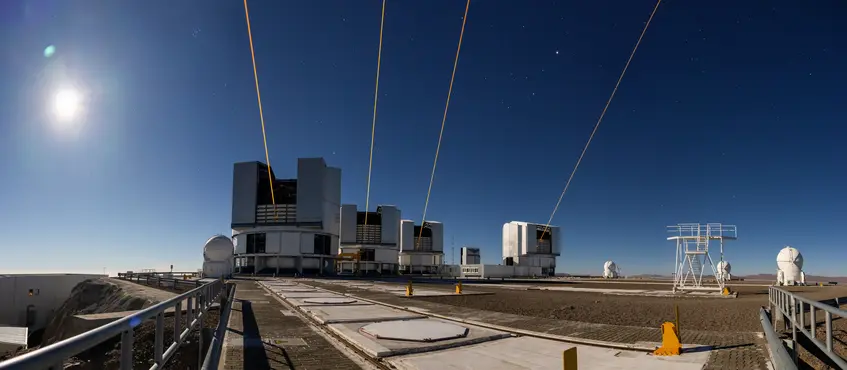
Imagine peering into the cosmos with unprecedented clarity, resolving details previously hidden by Earth’s turbulent atmosphere—that’s the promise of a major upgrade to the European Southern Observatory’s Very Large Telescope Interferometer (VLTI). Astronomers have now activated four powerful new lasers at the Paranal Observatory in Chile, a key component of the GRAVITY+ project, which combines the light-collecting power of all four eight-meter telescopes into a virtual giant. This advancement allows for remarkably precise measurements, promising to refine our understanding of black holes, the galactic center, and even the earliest quasars in the universe, ushering in a new era for high-resolution astronomy.
GRAVITY+ Project: Enhanced Interferometry Capabilities
The GRAVITY+ project represents a significant leap forward in interferometry, boosting the observational power of the European Southern Observatory’s Very Large Telescope Interferometer (VLTI). Crucially, the addition of four powerful lasers—one for each 8-meter telescope—creates artificial guide stars. These correct for atmospheric distortion, previously limited by the availability of bright natural reference stars, and dramatically expand the VLTI’s reach across the entire southern sky. This unlocks new possibilities for high-resolution astronomy.
This upgraded system isn’t simply about broader coverage; it’s about precision. New wavefront sensors, developed by the Max Planck Institute for Extraterrestrial Physics, observe these laser-created stars, enabling advanced adaptive optics. This allows GRAVITY+ to measure black hole masses with unprecedented accuracy and resolve details around these objects – and distant quasars – at times close to the Big Bang. The goal is to directly probe spacetime around black holes, testing Einstein’s theory of general relativity.
Early observations with GRAVITY+ have already demonstrated its potential. Initial tests on the Tarantula Nebula revealed a previously identified massive star is, in fact, a close binary system. This showcases the instrument’s resolving power and hints at the wealth of new discoveries to come, spanning from the Galactic Center to the earliest epochs of the universe. The enhanced sensitivity and resolution will revolutionize studies of black hole evolution and galactic formation.
Laser Implementation: Correcting Atmospheric Distortion
The GRAVITY+ project at the European Southern Observatory’s Very Large Telescope Interferometer (VLTI) recently activated four powerful lasers – one for each 8-meter telescope. These aren’t just for show; they create artificial “guide stars” approximately 90 kilometers above Earth. By measuring the distortion of light from these laser-induced stars, astronomers can then correct for the blurring effects of Earth’s atmosphere – a process known as adaptive optics. This significantly sharpens images, enabling observations previously impossible due to atmospheric interference.
Prior to this upgrade, atmospheric correction at the VLTI relied on bright, naturally occurring reference stars near the target object. This limited observational opportunities. Now, with the ability to project artificial stars anywhere in the southern sky, GRAVITY+ drastically expands the VLTI’s reach. The system utilizes wavefront sensors to precisely measure atmospheric turbulence and apply real-time corrections, boosting sensitivity and resolution across a much wider field of view.
This technology isn’t simply about clearer pictures. It unlocks new scientific possibilities, particularly in studying supermassive black holes. Improved sharpness allows for precise tracking of stars orbiting the Milky Way’s central black hole – potentially measuring its spin. Furthermore, GRAVITY+ will enable accurate black hole mass measurements in distant galaxies, providing crucial data on their evolution in the early universe – less than a few hundred million years after the Big Bang.
Research Focus: Black Holes and Early Universe
The GRAVITY+ project has significantly upgraded the Very Large Telescope Interferometer (VLTI) with the installation of four powerful lasers. These lasers create artificial guide stars, correcting atmospheric distortion and expanding the VLTI’s observational reach across the entire southern sky. Previously limited by the need for bright natural reference stars, astronomers can now study objects anywhere, dramatically increasing the number of accessible targets—particularly faint and distant ones—and enabling a new era of high-resolution astronomy.
A primary research focus for GRAVITY+ is probing supermassive black holes, both at the Galactic Center and in the early Universe. Improved precision will allow scientists to directly measure the spin of the Milky Way’s central black hole by tracking the orbits of nearby stars – a key test of Einstein’s theory of general relativity. Furthermore, the enhanced capabilities will enable more accurate black hole mass measurements in distant galaxies, offering insights into their evolution during the universe’s formative years, just hundreds of millions of years after the Big Bang.
Initial test observations with the upgraded VLTI/GRAVITY+ revealed a surprising discovery in the Tarantula Nebula: a star previously thought to be single is actually a close binary system. This demonstrates the instrument’s exceptional resolving power and foreshadows a wealth of new discoveries. By spatially resolving gas around distant black holes and precisely measuring the masses of those in the early Universe, GRAVITY+ promises to revolutionize our understanding of these enigmatic objects and their role in galactic evolution.
VLTI Upgrades: New Sensors and Observational Range
The VLTI is undergoing a significant upgrade with the GRAVITY+ project, now featuring four powerful lasers. These lasers create artificial guide stars by exciting sodium atoms 90km above Earth, dramatically expanding the observatory’s reach. Previously limited by the need for bright, nearby natural guide stars, GRAVITY+ can now correct for atmospheric distortion anywhere in the southern sky. This unlocks observations of previously inaccessible targets, promising a revolution in high-resolution astronomy.
A key component of the upgrade are new, state-of-the-art wavefront sensors developed by the Max Planck Institute for Extraterrestrial Physics (MPE). These sensors observe the laser-created artificial stars, enabling extremely precise adaptive optics corrections. By compensating for atmospheric “seeing”, GRAVITY+ delivers sharper images and more accurate measurements than ever before. This enhanced precision is crucial for studying faint or distant objects, pushing the boundaries of observational astronomy.
The increased capabilities are poised to advance research in two key areas: the Galactic Center and early Universe quasars. Astronomers aim to directly measure the spin of the supermassive black hole at the Milky Way’s core and more accurately determine black hole masses in the early universe—a critical time for galaxy evolution. Initial observations already revealed a massive star previously thought single is, in fact, a binary system, demonstrating the instrument’s resolving power.