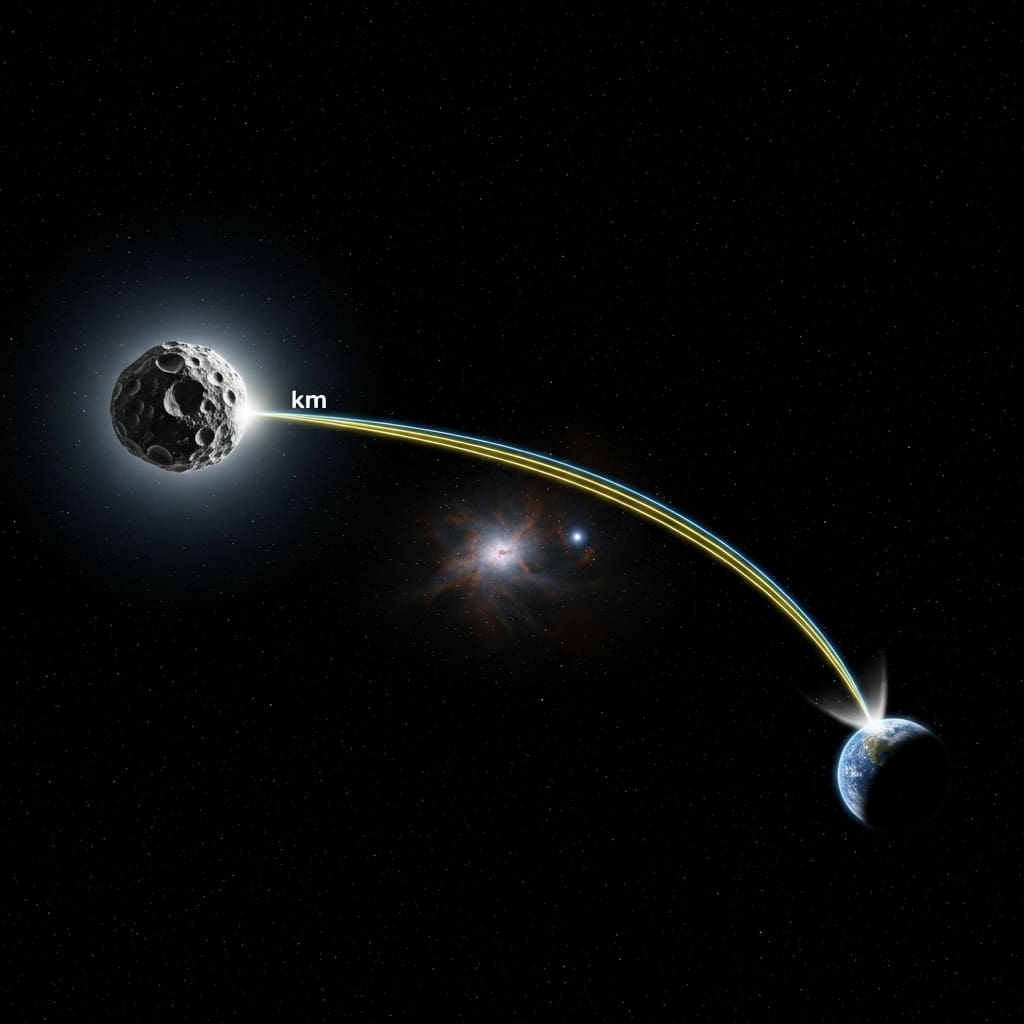
Scientists are increasingly focused on safeguarding Earth from the threat of near-Earth asteroids, and a new monitoring service , the ESA Meerkat Asteroid Guard , significantly enhances our ability to detect and assess potential impactors. Developed and maintained by the European Space Agency’s Near-Earth Object Coordination Centre, the system, led by Charlie Drury, Francesco Gianotto, and Marco Fenucci et al, systematically analyses short observational arcs of newly discovered objects to rapidly determine impact probabilities. This research is significant because Meerkat has demonstrably proven its effectiveness, successfully warning of six asteroid impacts before they occurred over the past five years, alongside providing valuable data on close approaches , a crucial step towards planetary defence.
This innovative methodology generates a comprehensive set of object scores derived from computed posterior probabilities, offering a detailed statistical description of both the orbital characteristics and physical properties of each NEO. These scores, coupled with informative plots, are packaged into automated email alerts dispatched to Meerkat subscribers whenever a significant impact probability, close approach, or other scientifically noteworthy event is detected. The system’s ability to rapidly analyse short-arc observations is particularly crucial, as these objects, typically smaller than 50 metres in diameter, are often detected only when in close proximity to Earth, making accurate orbit determination exceptionally challenging.
While the damage from such smaller asteroids is usually localised, impacts over populated areas can still cause significant injury and infrastructure damage, as tragically demonstrated by the 2013 Chelyabinsk event. The study unveils a robust and reliable monitoring service, capable of identifying and assessing the threat posed by imminent impactors, and providing critical information to astronomers for confirmation and follow-up, ultimately enhancing our ability to protect Earth from potentially hazardous near-Earth objects. The work opens avenues for further refinement of impact prediction models and the development of even more sophisticated asteroid detection and tracking systems.
Orbit determination, impact prediction and follow-up optimisation
This innovative method generates a suite of object scores derived from computed posterior probabilities across a defined grid, providing a detailed statistical description of both the object’s orbital characteristics and its physical properties. These scores, alongside informative plots, are packaged into automated email alerts dispatched to Meerkat subscribers whenever a significant impact probability, close approach, or other scientifically noteworthy event is detected. The research team developed a fully automated system, bypassing the need for manual intervention in initial impact assessments. This system harnesses data from initial observations to rapidly compute a range of possible trajectories, effectively narrowing down the potential impact zone with each new measurement.
The technique achieves high precision by propagating these trajectories forward, accounting for gravitational influences from the Sun, Earth, and other planets, and then comparing them against known Earth coordinates. The system’s performance is particularly notable given the challenges of short-arc orbit determination, where traditional methods struggle to provide accurate predictions, a problem Meerkat’s systematic ranging approach directly addresses. Researchers recorded that classical orbit determination methods are inadequate for short-arc observations, motivating the development of alternative techniques like systematic ranging. Currently, four operational systems monitor imminent impactors, Meerkat, Scout, NEOScan, and the Minor Planet Center’s internal system, all designed to analyze objects on the NEOCP before official designation.
These systems have successfully identified all recent imminent impactors and issued alerts for immediate confirmation and follow-up, proving their value to the planetary defence community. Should a potentially hazardous object be identified, the International Asteroid Warning Network (IAWN) is tasked with issuing an official warning for objects larger than 10m with an impact probability exceeding 1%. The first version of Meerkat became operational in 2021 and has since successfully alerted astronomers to all seven imminent impactors discovered. The system functions as a rapid complement to ESA’s Aegis system, which uses more rigorous orbit determination methods and performs century-long timescale propagations.
Scientists achieved improved speeds, architecture, and error rates with version 2.0, which utilizes ESA’s new flight dynamics library, GODOT, implemented in C++ with a Python API. Systematic ranging explores a raster of poorly known parameters, topocentric range ρ and topocentric range rate ρ, to constrain orbital solutions, enabling identification of the correct region of sky for follow-up observations. Notably, the system accurately predicted the impact location of 2022 WJ1, an object which likely resulted in meteorites falling into Lake Ontario. The authors acknowledge that the accuracy of size estimations relies on assumptions about object albedo and composition, introducing some uncertainty. Future work could focus on integrating additional data sources, such as observations from citizen science projects, to improve the precision of impact predictions and refine the characterisation of NEOs. This research establishes a robust and timely warning system, significantly enhancing our ability to mitigate the risks posed by near-Earth objects and furthering our understanding of the solar system.
👉 More information
🗞 The ESA Meerkat Asteroid Guard: a monitoring service for imminent impactors
🧠 ArXiv: https://arxiv.org/abs/2601.13323