Quantum simulations of molecules traditionally separate electronic and nuclear motion, an approximation known as the Born-Oppenheimer approximation, but this simplification limits the accuracy of modelling complex chemical processes. Delmar Cabral, Brandon Allen, and colleagues from Yale University, alongside Fabijan Pavošević from Algorithmiq Ltd., Sharon Hammes-Schiffer from Princeton University, Pablo Díez-Valle from Instituto Tecnológico de Galicia, and Jack Baker from LG Electronics Toronto AI Lab, now demonstrate a significant advance by performing quantum simulations that treat both electronic and nuclear quantum effects simultaneously. The team developed a new multicomponent approach and successfully implemented it on quantum hardware, utilising error mitigation techniques to achieve chemical accuracy in calculations of molecular energies. This work represents the first demonstration of error-mitigated correlated simulations encompassing both electronic and nuclear degrees of freedom, paving the way for more realistic and scalable modelling of molecular systems and potentially revolutionising fields like materials science and drug discovery.
Quantum Computing Accelerates Molecular Simulations
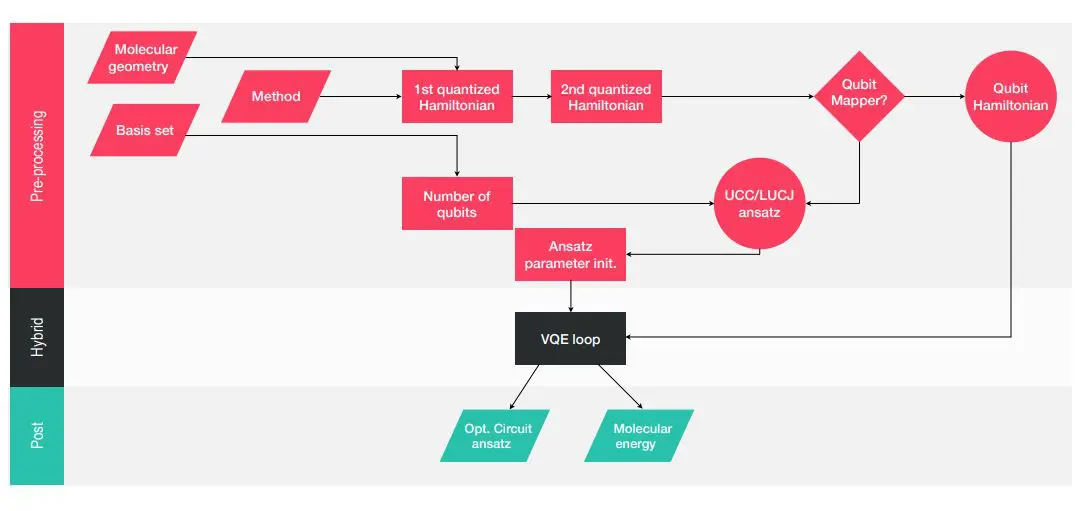
Scientists are leveraging the power of quantum computing to simulate molecules with unprecedented accuracy, overcoming limitations of traditional computational methods. This research focuses on solving the electronic Schrödinger equation and achieving accurate solutions for complex molecular systems, including those involving proton transfer and nuclear-electronic interactions. The team explores variations of the Unitary Coupled Cluster (UCC) theory, incorporating the Local Unitary Coupled Cluster Jastrow (LUCCJ) ansatz to reduce computational complexity by focusing on the locality of electron correlation. Researchers extend calculations beyond purely electronic structure to incorporate the simultaneous motion of nuclei and electrons using Nuclear-Electronic Orbital (NEO) theory, allowing for accurate descriptions of proton transfer and other processes involving both nuclear and electronic degrees of freedom.
They refine NEO theory with constrained calculations to improve accuracy and efficiency, emphasizing error mitigation techniques including symmetry verification, virtual distillation, and physics-inspired extrapolation. Adaptive variational algorithms optimize the wavefunction and minimize energy, while open-source software packages like OpenFermion and Qiskit facilitate development and implementation. By employing optimized basis sets, the team further improves the accuracy of calculations, representing a significant step toward realizing the potential of quantum computing for solving challenging problems in quantum chemistry and dynamics, with implications for drug discovery, materials science, and fundamental chemical research.
Quantum Simulation Unites Electrons and Nuclei
Scientists have achieved the first demonstration of error-mitigated multicomponent correlated simulations on quantum hardware, unifying electronic and nuclear degrees of freedom beyond the Born-Oppenheimer approximation. This work introduces a multicomponent unitary coupled cluster (mcUCC) framework, enabling simulations of molecular systems where both electrons and select nuclei, such as protons, are treated quantum mechanically, using the Nuclear-Electronic Orbital (NEO) formalism to expand the total wavefunction. Researchers performed simulations on two model systems, positronium hydride and molecular hydrogen with a quantum proton, establishing a foundation for modeling systems where traditional approximations fail. They implemented the mcUCC ansatz on IBM Q’s Heron superconducting hardware, employing a local unitary cluster Jastrow ansatz to reduce computational costs and utilizing the Physics-Inspired Extrapolation (PIE) error mitigation protocol, extending zero-noise extrapolation by deriving its functional form from restricted quantum dynamics. Results demonstrate that computed ground-state energies remain within chemical accuracy, consistent with stated uncertainty levels, signifying a substantial reduction in systematic bias without requiring fault-tolerant quantum error correction. Measurements confirm the feasibility of accurately simulating systems with quantum nuclei alongside electrons, a crucial step toward modeling phenomena like proton tunneling and hydrogen transfer, and the study analyzed hardware requirements for different excitation truncations within the mcUCC framework, paving the way for scalable algorithms.
Quantum Simulation Beyond Born-Oppenheimer Approximation
This work demonstrates a significant advance in quantum simulations of molecular systems, successfully incorporating both electronic and nuclear quantum effects beyond the conventional Born-Oppenheimer approximation. Researchers developed a multicomponent unitary coupled cluster framework, enabling the simulation of systems like positronium hydride and molecular hydrogen with a quantum proton, and implemented the mcUCC ansatz on IBM Q’s Heron superconducting hardware. Researchers utilized the Physics-Inspired Extrapolation (PIE) error mitigation protocol, and results indicate that intermediate levels of correlation can be recovered by strategically including specific excitation operators, such as double excitations, offering a pathway to balance computational cost and accuracy. The team also explored the adaptive selection of operators, further reducing the required quantum resources. The authors acknowledge that the current implementation is limited by the size of the simulated systems and the capabilities of available quantum hardware, and future research will focus on extending the method to larger molecules and exploring more sophisticated error mitigation techniques. They also plan to investigate alternative strategies for operator selection to further optimize the efficiency of the simulations and unlock the full potential of quantum computing for molecular simulations.
🗞 Error-Mitigation Enabled Multicomponent Quantum Simulations Beyond the Born-Oppenheimer Approximation
🧠 ArXiv: https://arxiv.org/abs/2511.11941