

Quantum error correction represents a crucial step towards building practical quantum computers, and researchers continually seek ways to improve its efficiency. Satoshi Yoshida from The University of Tokyo and Google Quantum AI, along with Craig Gidney, Matt McEwen, and Adam Zalcman, all at Google Quantum AI, have recently developed new circuits for the colour code, a promising approach to quantum error correction. Their work introduces two novel syndrome extraction circuits, one of which, termed the semi-wiggling colour code, aims to reduce errors by dynamically swapping the roles of data and measurement qubits. Importantly, the team also demonstrates a reduction in circuit complexity by utilising the CXSWAP gate, leading to a smaller footprint and potentially enabling more scalable quantum computations with improved performance.
Surface Code Optimizations For Fault Tolerance
This research details improvements to quantum error correction, specifically focusing on the surface code, a leading approach to protecting quantum information. The team addresses the critical challenge of building practical quantum computers by reducing the overhead, or number of qubits, required for error correction and improving the performance of decoding algorithms. Efficient decoding algorithms are crucial for making this process practical.
The work explores optimizations like code switching, a technique to enhance decoding performance, and investigates improvements to existing algorithms such as Minimum Weight Perfect Matching and Belief Propagation. A major goal is to reduce the number of physical qubits needed to protect a single logical qubit, and the researchers present detailed simulations and analysis to demonstrate the effectiveness of their optimizations, assessing error thresholds and logical error rates. This research is a significant contribution to the field of quantum error correction, presenting optimizations and analyses that could bring fault-tolerant quantum computers closer to reality.
Syndrome Extraction via Role-Reversing Circuits
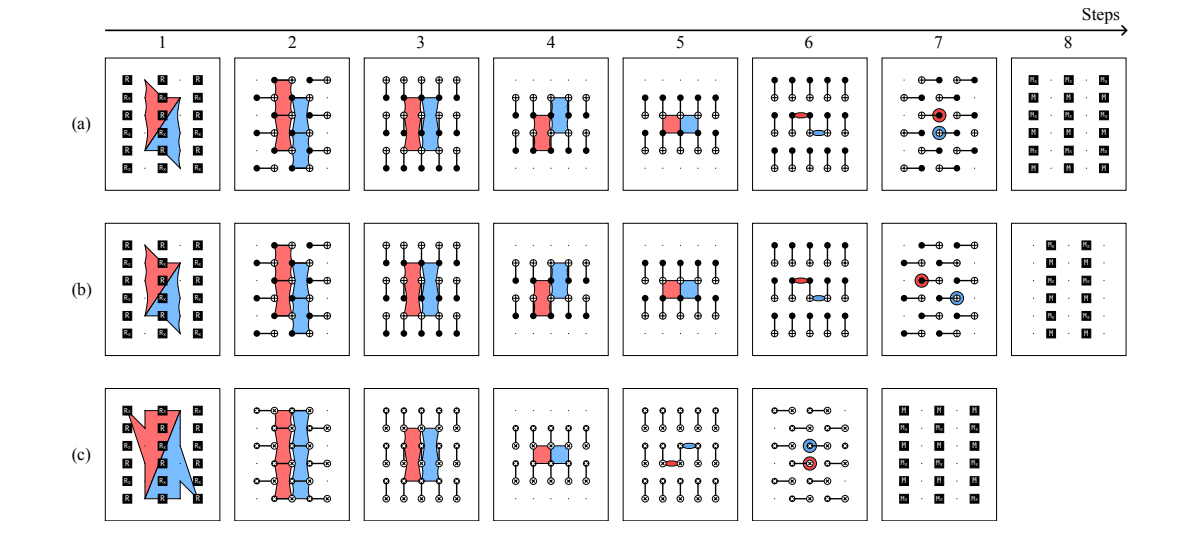
Scientists have developed two new types of circuits for extracting syndromes in the color code, a promising approach to quantum error correction. The first construction, termed the semi-wiggling color code, addresses leakage errors by periodically interchanging the roles of data and measurement qubits within the circuit. This innovative approach allows the application of specialized reset gates to all qubits, mitigating errors that can compromise quantum information. By shifting the direction of a key step in the original midout circuit, researchers successfully moved measurement qubits, achieving this role reversal.
The team further optimized the circuits by employing the CXSWAP gate, which offers advantages over conventional CNOT or CZ gates in certain superconducting qubit architectures. This optimization reduces circuit depth compared to designs utilizing CNOT gates, streamlining the structure by consolidating multiple steps into a single operation. The researchers discovered that by strategically applying circuit identities, they could replace two CNOT steps with one CXSWAP step, simplifying the circuit layout. Detailed analysis shows that the CXSWAP circuits generate diagonal gates on the boundary, crucial for maintaining the integrity of quantum information. The semi-wiggling midout circuit alternates the locations used for measurement in each cycle, further enhancing error mitigation. These advancements represent a significant step towards building more robust and efficient quantum computers, paving the way for complex calculations and secure communication.
Efficient Color Code Error Correction Circuits
This work presents advancements in quantum error correction circuits designed for the color code, introducing three new constructions: the semi-wiggling midout circuit, the CXSWAP midout circuit, and the CXSWAP superdense circuit. The semi-wiggling midout circuit mitigates leakage errors by periodically switching the roles of data and measurement qubits, a strategy enabled by the reset gate. Furthermore, the team demonstrates that the CXSWAP midout and superdense circuits achieve reduced circuit depth compared to previously established designs, resulting in approximately a ten percent reduction in the teraquop footprint under specific error conditions. These improvements in circuit efficiency offer opportunities to lower the overall logical error rate, especially in quantum architectures where the calibration of two-qubit gates equivalent to CXSWAP can be optimized to higher fidelity than conventional CNOT and CZ gates.
The researchers acknowledge that their numerical simulations rely on a uniform error model, a simplification of the complex error landscape in real quantum devices. Future work could explore the performance of these circuits under more realistic and nuanced error models, potentially revealing further optimizations and limitations. The presented results provide a foundation for investigating the interplay between circuit design and gate fidelity in achieving robust quantum computation.
👉 More information
🗞 Low Depth Color Code Circuits with CXSWAP gate
🧠 ArXiv: https://arxiv.org/abs/2510.00370

