

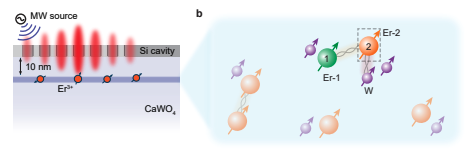
Atomic defects in solid materials are increasingly important for building quantum networks and memories, offering the potential for powerful information processing. Researchers Haitong Xu, Mehmet T. Uysal, Lukasz Dusanowski, and colleagues at Princeton University have now demonstrated a significant advance in controlling these defects, achieving coherent control of interacting electron and nuclear spins at the nanoscale. The team successfully manipulates pairs of electron spins and uses a nearby nuclear spin as a memory, performing repeated measurements without disrupting the quantum information. This level of control, exceeding the diffraction limit of light, enables the creation of robust and scalable quantum systems, potentially leading to massively multiplexed network nodes and more powerful quantum technologies.
However, reliably addressing individual spins at nanometer separations, where interactions are large, presents a significant challenge. Rare-earth ions offer a unique solution, as their narrow homogeneous optical linewidth allows frequency-domain resolution of a large number of emitters irrespective of their spatial separation. This work realises coherent optical and spin control of a pair of interacting Er3+ ions, together with a nearby nuclear spin ancilla. The researchers demonstrate two-qubit electron-electron gates and utilise them to perform repeated quantum non-demolition measurements.
Erbium Ions Controlled for Quantum Information Processing
Researchers addressed the challenge of controlling individual atomic defects, promising components for quantum networks, by focusing on rare-earth ions embedded within a solid material. These ions possess uniquely narrow spectral linewidths, allowing for the precise identification and control of numerous emitters even when they are closely spaced, a significant hurdle in quantum information processing. The team developed a method to coherently control a pair of these erbium ions, alongside a nearby nuclear spin, effectively creating a small quantum system for manipulating information. A key innovation lies in the use of microwave and optical techniques to implement quantum gates, the fundamental building blocks of quantum computers, between the electron spins of the erbium ions.
They demonstrated two-qubit gates, enabling interactions between these spins, and then used these interactions to repeatedly measure the state of one ion without disturbing the other, a process known as a non-demolition measurement. Furthermore, the researchers successfully transferred information from an electron spin to a nearby nuclear spin, storing it coherently for a relatively long period, over a second, and then retrieving it, demonstrating a robust method for quantum data storage. The approach relies on carefully controlling the spectral properties of the ions using both microwave and optical fields. By exploiting the narrow linewidths, the team could address and manipulate individual ions without affecting their neighbors.
They also employed a technique to protect the electron spins from decoherence during interactions, effectively shielding them from environmental noise. This, combined with precise timing of microwave pulses, allowed for the implementation of high-fidelity quantum gates and the preservation of quantum information for extended periods. The researchers envision scaling up this system by creating denser clusters of interacting ions using advanced material fabrication techniques and anticipate that by removing or polarizing impurities within the material, the coherence times of the electron spins can be dramatically increased, leading to even more reliable quantum operations. Ultimately, this approach paves the way for building complex, massively multiplexed quantum network nodes capable of processing and transmitting quantum information over long distances, potentially revolutionizing secure communication and computation.
Solid-State Qubits, Memories and Quantum Networks
This compilation of research papers focuses on the field of quantum information science, specifically solid-state qubits, quantum memories, and repeaters. The work explores various qubit technologies, including diamond nitrogen-vacancy (NV) centers, rare-earth ion impurities, calcium tungstate, and silicon-vacancy (SiV) centers. A significant portion of the research concentrates on rare-earth ions, particularly erbium and thulium, embedded in crystals, investigating methods for extending coherence times through pulse shaping and dynamical decoupling, and exploring the use of atomic and collective nuclear spin states for quantum storage. A dedicated area of investigation concerns measurement and non-demolition measurement, aiming to read out qubit states without destroying the quantum information. Finally, the research explores materials and techniques such as crystal growth, doping, and nanophotonic cavities to create and manipulate qubits.
Rare-Earth Ions Enable Long-Lived Quantum Control
This work demonstrates coherent control of interacting electron and nuclear spins within rare-earth ions, establishing a platform for advanced quantum information processing. Researchers successfully implemented two-qubit gates between electron spins and performed repeated non-demolition measurements on one electron spin using the other, showcasing precise control over these quantum bits. Furthermore, they achieved coherent storage and retrieval of qubit information in a nuclear spin, demonstrating a second-long coherence time and the ability of the nuclear spin to maintain coherence even during electron spin readout. These results highlight the potential for scaling quantum systems using rare-earth ions, as the narrow spectral linewidths allow for addressing and controlling a large number of individual ions. While current gate fidelities are limited by electron spin coherence, believed to be affected by impurities within the sample, the authors suggest that coherence times could be extended through purification or polarization of the sample. Future work may focus on increasing the density of interacting ions through techniques like patterned ion implantation, potentially enabling the creation of registers containing approximately 100 qubits and paving the way for highly multiplexed quantum repeater nodes and advanced quantum networks.
🗞 Coherent control of interacting solid-state spins below the diffraction limit
🧠 ArXiv: https://arxiv.org/abs/2508.09122


