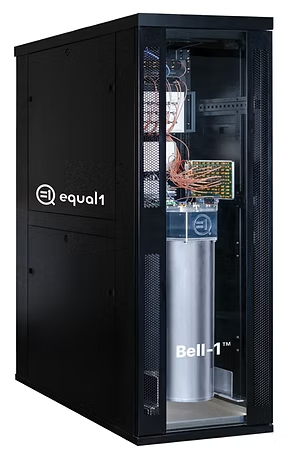
Equal1 has achieved a significant milestone in quantum computing by successfully validating a commercial CMOS process using GlobalFoundries’ 22FDX platform. This breakthrough enables the formation of multiple quantum dots with tunable tunnel coupling, marking the first time such functionality is demonstrated in a commercial setting.
The company’s monolithic chip features 29 NMOS and PMOS quantum cells, each capable of supporting up to three tunnel-coupled quantum dots, tested across a range of temperatures for robust performance. This advancement underscores Equal1’s commitment to developing scalable silicon-based quantum technologies that align with existing semiconductor manufacturing capabilities, paving the way for practical large-scale adoption as part of the emerging Quantum 2.0 era.
Equal1 has achieved a significant milestone in quantum computing by successfully validating a commercial CMOS process using GlobalFoundries’ 22FDX technology. This advancement enables the formation of multiple quantum dots with tunable tunnel coupling, marking a first in commercial processes.
The validated CMOS process allows for precise control over quantum dot interactions, crucial for scalable quantum systems. Equal1’s monolithic chip features 29 NMOS and PMOS quantum cells, each capable of supporting up to three tunnel-coupled quantum dots and charge sensors. Testing across various temperatures demonstrated robust performance, underscoring the reliability of this approach.
Jason Lynch, CEO of Equal1, emphasized that this milestone brings scalable quantum systems closer to reality by leveraging existing semiconductor manufacturing capabilities. Dr. Elena Blokhina, CTO, highlighted the use of standard silicon platforms for enhancing scalability and manufacturability.
Equal1’s collaboration with GlobalFoundries underscores the industry’s growing focus on integrating quantum technologies into mainstream manufacturing. By leveraging established CMOS platforms, Equal1 has positioned itself at the forefront of Quantum 2.0, contributing to the development of practical and scalable systems that seamlessly integrate with current technological ecosystems.
The methods and results of this groundbreaking work are available in a journal article published on arXiv. The research details the validation process, the design of the monolithic chip, and the testing methodologies employed to ensure robust performance across varying operational conditions.
More information
External Link: Click Here For More