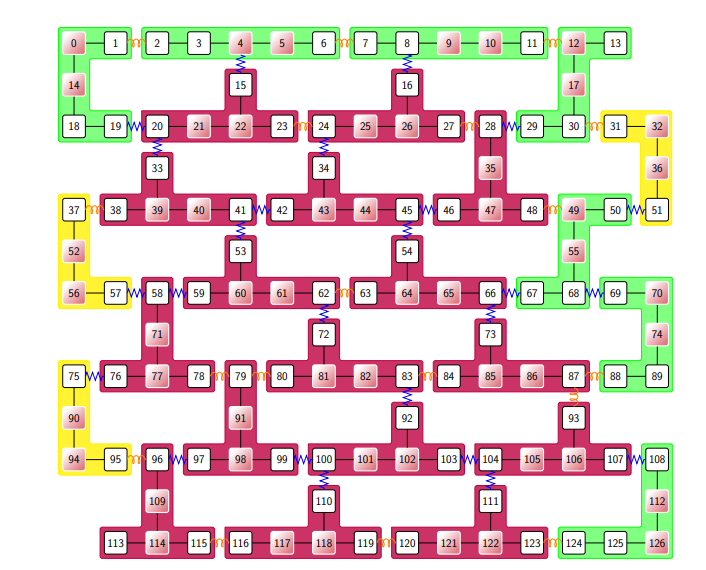
The quest for a fully functional quantum computer hinges on achieving complete control over quantum operations, but scaling up these systems presents a formidable challenge. Fernando Gago-Encinas and Christiane P. Koch, both from Freie Universität Berlin, and their colleagues demonstrate a pathway to overcome this hurdle by revealing that complex quantum computations require fewer connections between quantum bits, or qubits, than previously thought. Their research proves that linking two smaller, independently controllable qubit arrays with a single entanglement operation creates a larger system with complete operational control, offering a blueprint for building modular quantum processors. This discovery significantly reduces the complexity of quantum computer design, paving the way for more resource-efficient and scalable quantum computing technologies
Modular Qubit Arrays Achieve Full Controllability
Researchers demonstrate a notable advancement in quantum computing, revealing a pathway to construct larger, more powerful processors from smaller, manageable components. The team proves that connecting two independently controllable arrays of qubits with a single two-qubit connection is sufficient to create a combined system that is also fully controllable, a crucial requirement for performing any quantum computation. This finding addresses a major challenge in scaling up quantum computers, which currently face limitations due to increasing complexity as the number of qubits grows; traditional approaches demand an exponential increase in control infrastructure with each added qubit, quickly becoming impractical. Qubits, the fundamental units of quantum information, leverage the principles of superposition and entanglement to perform computations beyond the capabilities of classical bits.
The research establishes a modular approach to quantum processor design, allowing developers to construct complex systems by linking together smaller, pre-verified building blocks. This contrasts sharply with attempts to build large processors as single, monolithic units, which become increasingly difficult to manage and control, and prone to errors arising from manufacturing imperfections or environmental noise. The team’s proof demonstrates that the combined system retains the ability to perform any possible quantum operation, effectively acting as a single, larger controllable unit; this is achieved through a process called ‘compilation’, where complex operations are broken down into a sequence of simpler operations executable on the modular architecture. This modularity mirrors established principles in classical computing, where complex systems are built from interconnected, well-defined components, enhancing reliability and simplifying maintenance.
This is achieved without requiring a complex web of connections between every qubit, simplifying the engineering challenges considerably; in a fully connected architecture, each qubit must be directly addressable and controllable, demanding a vast number of control lines and associated electronics. Importantly, the findings extend beyond simple two-qubit connections, suggesting that any type of connection capable of creating entanglement between the two qubit arrays will suffice; entanglement, a uniquely quantum phenomenon, links the fates of two or more qubits, allowing for correlated behaviour even when physically separated. This opens up possibilities for utilizing a wider range of control mechanisms, offering greater flexibility in processor architecture, including photonic links, microwave resonators, or even mechanical couplings. The researchers illustrate the principle with examples of 10 and 127 qubits, demonstrating the scalability of the approach and its potential for implementation in existing and future quantum processors, including superconducting transmon qubits and trapped ion systems.
The core of the team’s methodology involves a rigorous mathematical framework based on ‘Lie algebra’ and ‘control theory’. Lie algebras provide a powerful tool for describing the symmetries and transformations of quantum systems, while control theory allows researchers to determine the optimal control signals needed to manipulate the qubits. The team demonstrates that the modular architecture possesses the same ‘control rank’ as a fully connected system, meaning it can achieve the same level of control over the qubits. This is crucial for ensuring that the modular processor can perform any arbitrary quantum computation with the same fidelity as a larger, fully connected processor. The team validated their theoretical findings through numerical simulations and, crucially, experimental demonstrations on a small-scale prototype quantum processor. This experimental validation is vital, as it confirms that the theoretical framework accurately reflects the behaviour of real quantum systems.
While reducing the number of controls offers advantages in terms of physical space and calibration effort, there is a potential trade-off with operation times; compiling complex operations into a sequence of simpler operations on the modular architecture may introduce overhead, increasing the overall computation time. Future research will focus on comparing the speed of computations in these modular systems with those of fully connected designs, and exploring strategies to mitigate any slowdown, such as optimizing the compilation process and developing more efficient control pulses. Further work will also investigate extending the proof to quantum systems beyond qubits, such as quantum harmonic oscillators, and adapting the method to systems with different fundamental building blocks, including topological qubits which promise inherent robustness against noise. This research represents a significant step towards building the large-scale, fault-tolerant quantum computers needed to solve complex problems beyond the reach of classical computers, with potential applications in materials science, drug discovery, financial modelling, and cryptography.
🗞 Scalable modular architecture for universal quantum computation
🧠 DOI: https://doi.org/10.48550/arXiv.2507.14691