
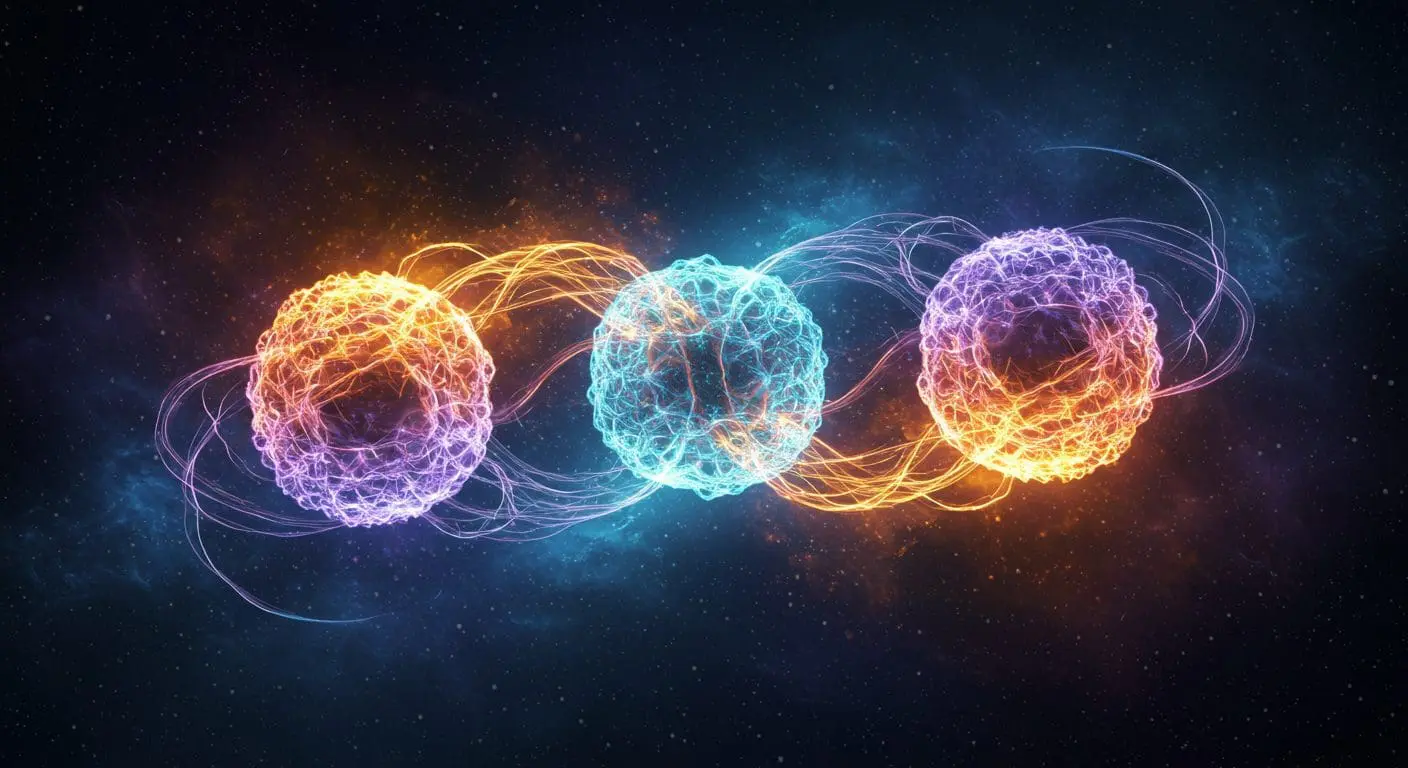
Research demonstrates that entanglement between coupled harmonic oscillators vanishes in specific parameter regimes despite system integrability. Entanglement localisation occurs in a ‘heavy mediator’ scenario, resembling scarring in chaotic systems, while ‘light mediator’ regimes exhibit smooth entanglement. This challenges interpretations of absent entanglement as solely indicative of classical mediation.
The behaviour of quantum entanglement – a phenomenon where two or more particles become linked and share the same fate, no matter how far apart – is central to understanding the foundations of quantum mechanics and its potential applications. Recent research challenges the conventional interpretation of entanglement loss as a definitive indicator of classical behaviour in mediated quantum systems. Researchers from the Indian Institute of Technology Bombay – P. George Christopher, S. Shankaranarayanan, and colleagues – demonstrate that the suppression of entanglement does not necessarily signify classical mediation, but can instead arise from the dynamic constraints imposed on the mediating system itself. Their work, detailed in the article ‘Entanglement suppression and quantum scars in a three-oscillator gravitational analogue’, utilises a model of coupled harmonic oscillators to explore these effects, revealing regimes where entanglement vanishes despite ongoing interactions and exhibiting behaviours analogous to ‘quantum scars’ – unusual, stable states found in chaotic quantum systems.
Entanglement Suppression and Quantum Scars in Coupled Harmonic Oscillators
Recent research details the suppression of quantum entanglement within a system of three coupled harmonic oscillators, a configuration designed to model interactions relevant to investigations of gravity and spacetime. The study demonstrates that bipartite entanglement – a measure of correlation between two quantum systems – can diminish between distant oscillators despite their coupling, challenging the conventional interpretation of entanglement as an unambiguous indicator of quantum behaviour. The analysis identifies two distinct dynamical regimes dependent on the strength of the interaction mediating coupling between the oscillators, offering a refined understanding of entanglement as a diagnostic tool.
Harmonic oscillators are systems that, when displaced from equilibrium, experience a restoring force proportional to the displacement – akin to a mass on a spring. Coupling these oscillators allows energy and information to be exchanged. Bipartite entanglement, in this context, signifies a correlation stronger than that permitted by classical physics.
The researchers categorised the system’s behaviour based on the ‘weight’ or strength of the mediating interaction. In the ‘Heavy Mediator Regime’, entanglement becomes sharply localised, forming discrete ‘islands’ surrounded by extensive regions of suppression. This pattern bears resemblance to ‘quantum scars’ – persistent, coherent structures observed in the quantum behaviour of systems that classically exhibit chaotic behaviour. Conversely, the ‘Light Mediator Regime’ facilitates the smooth and consistent generation of entanglement throughout the system.
Meticulous control and analysis of the system’s parameters revealed that entanglement-based tests require a nuanced understanding of the mediator’s dynamics to avoid misinterpretation. The absence of detectable entanglement, the researchers argue, does not necessarily imply a classical explanation. Instead, it may indicate that the mediating interaction is constrained to operate within a limited subspace of possible states. This concept is analogous to phenomena such as gravitational memory – the persistent effect of gravitational waves on spacetime – or the existence of decoherence-free subspaces, which are protected from environmental noise. This methodological emphasis on probing the mediator’s dynamics provides a novel approach to investigating complex quantum systems and exploring the connections between quantum mechanics and gravity.
Spectral analysis – examining the frequencies present in the system’s behaviour – confirms the dynamical stability of these low-entanglement states and reveals signatures consistent with scarring phenomena. This suggests a continuous-variable analogue – a parallel in systems dealing with continuous quantities like position and momentum – linked to underlying phase-space symmetries. The researchers established a clear link between entanglement suppression, quantum scars, and the dynamical constraints on mediating interactions, potentially offering a route to explore complex phenomena in quantum gravity and cosmology.
Future work will investigate the potential for exploiting these quantum scars to enhance quantum information processing and communication. The unique properties of these states could be harnessed to create more robust and efficient quantum devices. Furthermore, the researchers plan to explore connections between these quantum scars and other areas of physics, including chaos theory and condensed matter physics.
👉 More information
🗞 Entanglement suppression and quantum scars in a three-oscillator gravitational analogue
🧠 DOI: https://doi.org/10.48550/arXiv.2506.04300