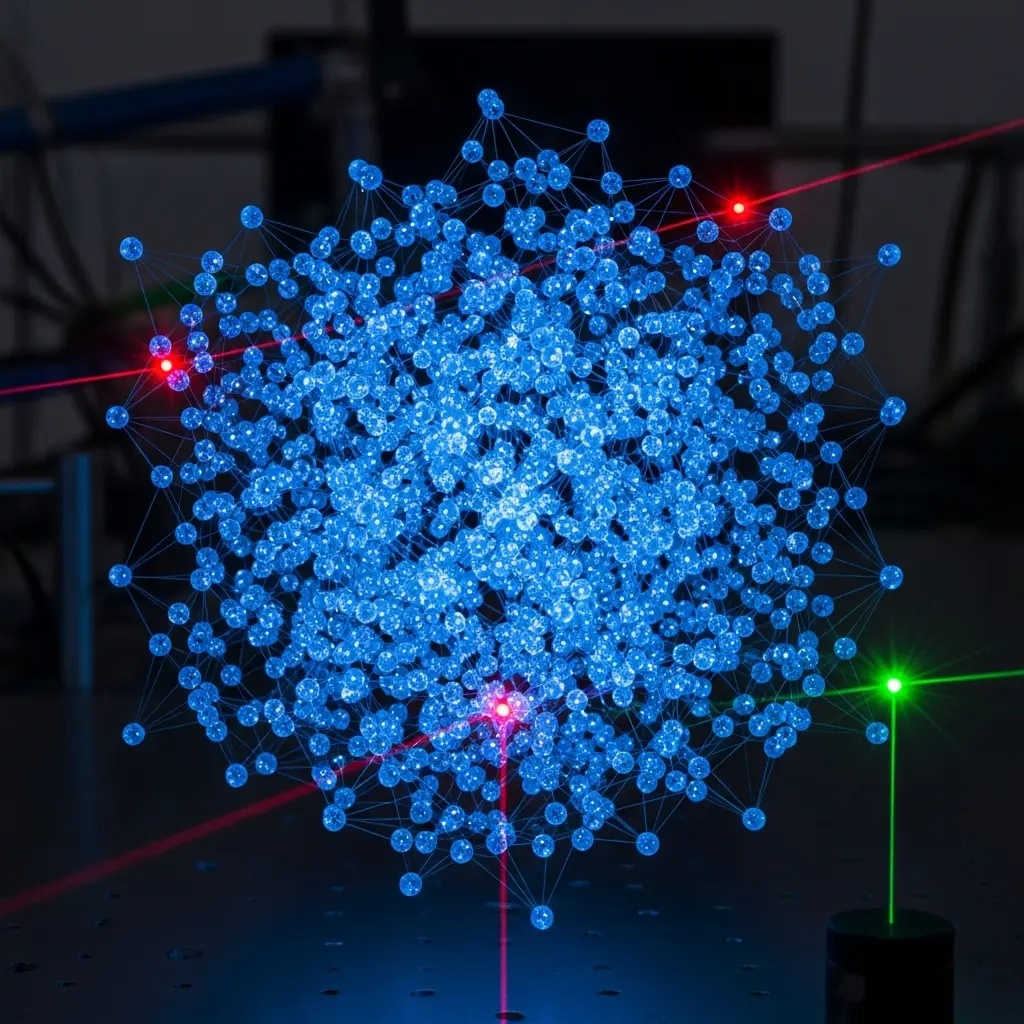
The behaviour of complex systems following a sudden change, or ‘quench’, remains a fundamental question in physics, and recent work by Chen Bai, Mao Tian Tan, and Bastien Lapierre, alongside Shinsei Ryu and colleagues, sheds new light on this process. The team investigates how entanglement, a key indicator of quantum connectedness, evolves in systems starting from a special initial state and subjected to spatially varying forces. Their research demonstrates that certain types of force prevent the expected chaotic behaviour known as ‘thermalization’, instead generating striking, graph-like patterns of entanglement that depend only on the shape of the force itself. This discovery challenges conventional understanding of how systems settle into equilibrium and offers a new perspective on the relationship between initial conditions, external forces, and the emergence of complex quantum states, supported by calculations linking one and three-dimensional systems.
Spatially Structured Entanglement from Nonequilibrium Thermal Pure States Researchers investigate the emergence of spatially structured entanglement in systems driven far from thermal equilibrium, focusing on thermal pure states which allow detailed analysis of entanglement properties. They explore how variations in driving forces induce specific entanglement patterns, moving beyond uniform entanglement found in equilibrium systems. This work demonstrates that nonequilibrium thermal pure states exhibit spatially structured entanglement, characterised by correlations varying predictably with position, and reveals a connection between the driving force and the resulting entanglement structure. The findings establish a framework for engineering entanglement in driven quantum systems, potentially enabling novel applications in quantum technologies and providing insights into the role of nonequilibrium dynamics in generating complex quantum correlations.
Inhomogeneous Quench Dynamics and Entanglement Structure
Scientists study quantum quench dynamics in (1+1)-dimensional critical systems, starting from thermal pure states called crosscap states, and evolving them under spatially inhomogeneous Hamiltonians. The spatial inhomogeneity is introduced through deformations of the Hamiltonian, expressed as combinations of generators related to the Virasoro algebra. They analyse free massless Dirac fermion theory and holographic conformal field theory as examples of integrable and non-integrable dynamics. Certain deformations, resembling “Möbius transformations”, induce a spatially inhomogeneous expansion of the initial state, leading to a non-trivial entanglement structure and a breakdown of the quasiparticle picture in the non-integrable case.
The team characterises the dynamics through entanglement entropy, energy flow, and the Loschmidt echo, revealing behaviour dependent on the strength and profile of the inhomogeneity. The results demonstrate a distinction between integrable and non-integrable systems, with the former exhibiting ballistic transport and the latter displaying diffusive behaviour. Furthermore, the entanglement entropy exhibits a logarithmic scaling with time in the non-integrable case, consistent with predictions from random matrix theory. The analysis provides insights into the fundamental properties of quantum critical systems and their response to external perturbations.
Quench Dynamics and Spatial Inhomogeneities Revealed
Scientists investigated the dynamics of quantum systems following a sudden change, known as a quench, starting from a crosscap state, present in one and two-dimensional critical systems, possessing unique entanglement properties. The research focuses on how the system evolves under spatially inhomogeneous Hamiltonians, which introduce variations in energy density. Experiments reveal that the system’s behaviour after the quench depends critically on the type of spatial inhomogeneity applied. Researchers discovered that certain deformations, specifically those resembling “Möbius transformations”, lead to thermalization, where the system reaches equilibrium.
In contrast, other deformations prevent both thermalization and information scrambling, instead producing late-time entanglement patterns resembling graphs. These graph-like patterns emerge from the interplay between the deformed Hamiltonian and the initial crosscap state, and are remarkably universal, determined solely by the deformation profile and largely independent of microscopic details. Measurements confirm that the entanglement patterns are not simply a consequence of the initial state or homogeneous time evolution. By introducing spatial inhomogeneities, scientists isolated features intrinsic to the crosscap state, demonstrating that the unusual entanglement behavior persists even when translation invariance is broken.
The team achieved these results through analytical calculations and holographic computations, using a three-dimensional AdS/CFT correspondence to reproduce the key findings from the one and two-dimensional studies. Specifically, the holographic calculations validated the emergence of graph-like entanglement patterns and confirmed their independence from microscopic details. Further analysis demonstrates that the observed graph-like entanglement patterns can be understood through the lens of quasiparticle behavior, linking them to circulant graphs. The research establishes a clear connection between the type of Hamiltonian deformation and the resulting entanglement structure, providing insights into the fundamental mechanisms governing information spreading and thermalization in quantum systems. The team’s findings demonstrate that certain types of spatial inhomogeneities can fundamentally alter the dynamics of quantum systems, preventing thermalization and leading to the emergence of novel entanglement structures.
Holography, Entanglement and Quantum Information Theory
This compilation encompasses research papers touching on theoretical physics, particularly quantum field theory, holography (AdS/CFT), entanglement, and quantum information. The central theme is holography, with many papers directly exploring the AdS/CFT correspondence and its applications. A significant portion of the research focuses on entanglement and its connection to holography, particularly through the Ryu-Takayanagi formula and its extensions. Further areas of investigation include conformal field theory, non-equilibrium dynamics, and Floquet systems, exploring how systems evolve when driven out of equilibrium.
Operator entanglement and scrambling are also explored, connecting entanglement to information processing. The papers explore foundational concepts and recent advancements, offering insights into black holes, condensed matter physics, and other related fields. The research provides a rich landscape for understanding the interplay between holography, entanglement, and quantum information, offering a foundation for future investigations in these areas.
🗞 Spatially Structured Entanglement from Nonequilibrium Thermal Pure States
🧠 ArXiv: https://arxiv.org/abs/2510.25868