

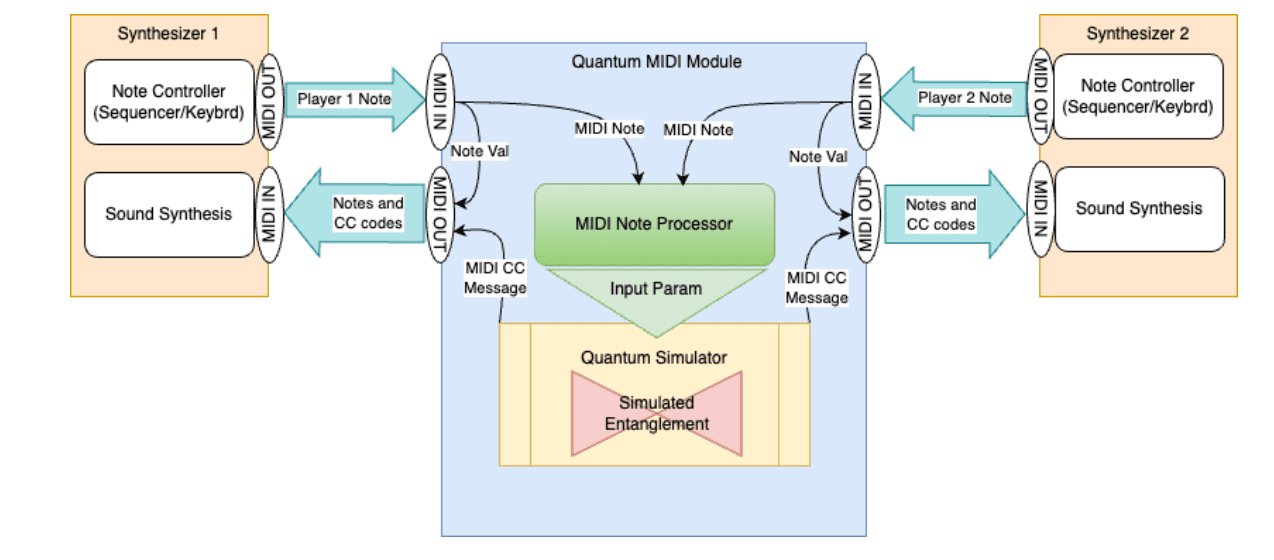
The interplay between musicians forms the core of a novel investigation into how shared musical experiences might be physically represented and even emulated, a challenge that Mark Carney from Quantum Village Inc and colleagues now address. They demonstrate a system that captures the tonal relationship between musicians and translates it into parameters controlling their instruments, effectively creating a feedback loop between performance and physical simulation. The team achieves this by using data from musical performance to influence random parameters on both instruments, ensuring these parameters are either closely correlated or deliberately opposed, depending on the musicians’ tonal connection. This work opens exciting possibilities for musical ensembles, allowing performers to explore and experience emulations of their own interactions and potentially unlocking new dimensions of musical expression.
The research focuses on translating a quantum simulation, executed on a compact Raspberry Pi Pico, into musical performance. Simulation results are encoded into MIDI data and transmitted to the musicians’ instruments, with the aim of establishing entanglement based on tonal relationships. Specifically, closer harmonic alignment between musicians encourages entanglement in a particular quantum state, while greater tonal distance promotes entanglement in a different state. This process creates random parameters that exhibit either correlation, identical values on both instruments, or anti-correlation, directly influenced by the tonal interplay between the players, thereby introducing a novel dimension to quantum-musical expression.
Quantum Entanglement Models Musical Relationships
This work explores the intersection of quantum computing, music, and philosophy, investigating how quantum principles can inform musical creation, performance, and analysis. The research considers entanglement not simply as a technical feature, but as a way to understand relationships within music, between notes, instruments, performers, and the audience. This approach suggests that musical elements can be interconnected, creating a holistic experience. The study also draws upon object-oriented ontology and quantum ontology, proposing a philosophical framework where objects, such as musical notes and instruments, possess inherent properties independent of perception, and where relationships between them are fundamental.
The research also addresses latency reduction through new hardware and software techniques, and applies object-oriented ontology principles to music composition, treating musical elements as independent objects with inherent properties. Specific ideas explored include the use of qudits, quantum digits with more than two states, to represent musical parameters in a more nuanced way than traditional bits. Research focuses on developing systems where the actions of one performer directly influence the sound produced by another, creating a sense of interconnectedness through networked instruments and real-time data processing. Algorithms are being created to generate music based on entangled quantum states, and investigations are underway to explore how quantum principles can inspire new musical scales or harmonic systems.
The use of quantum random number generators introduces unpredictability into musical improvisation. Key questions explored include the meaning of entangling musical elements, whether this is simply a metaphor or a genuine modeling of entanglement. The research investigates how to translate abstract quantum concepts into concrete musical experiences, and identifies the limitations of using quantum computing in music. Criteria for evaluating the aesthetic qualities of music created with quantum computing are also being developed, and the research asks whether quantum computing can help us understand the fundamental nature of music itself. In conclusion, this work presents a fascinating vision for the future of music, combining quantum computing, philosophy, and artistic practice to open up new possibilities for musical expression, performance, and understanding.
Musicians’ Harmony Drives Quantum Instrument Entanglement
Scientists successfully demonstrated the emulation of human musical entanglement through physical entanglement, achieving a significant breakthrough in quantum music. The core of this work lies in capturing the ‘tonal centrality’ between two musicians via MIDI data and translating it into parameters for a quantum simulation running on a Raspberry Pi Pico. Experiments revealed that the instruments respond to the musicians’ tonal relationship, entering an entangled state dependent on the degree of harmonic alignment. Specifically, when musicians play with close tonal harmony, their instruments become entangled in a particular quantum state, while diverging tonalities result in entanglement in a different state.
This research demonstrates the feasibility of harnessing quantum phenomena on compact, low-power devices, reducing latency and jitter in musical interfaces. The successful emulation of entanglement between musicians and instruments opens new avenues for artistic exploration, allowing performers to experience and shape quantum emulations of their musical interactions. By embedding quantum interfaces directly within instruments, scientists are paving the way for a new generation of reactive and expressive musical tools, deepening the connection between performer and instrument. This work confirms the potential for creating music sculpted by quantum-inspired processes, offering exciting new directions for experimentalists and instrumentalists alike.
Musical Entanglement Through Responsive Instruments
This research demonstrates a novel method for representing and emulating aspects of human musical interaction through physical systems. Scientists successfully captured the concept of ‘tonal centrality’ between musicians using MIDI data and integrated this information into a simulation running on an embedded device. The simulation then generates parameters that influence the musicians’ instruments, creating a dynamic relationship where instruments respond in correlated or anti-correlated ways based on the players’ tonal connection. This approach effectively introduces a new dimension to musical expression, allowing for the creation of shared, responsive parameters between instruments.
The work builds upon emerging theories of entanglement, extending the concept beyond physics to explore how humans and their tools, specifically musical instruments, interact. Findings suggest that deep entanglement between humans and instruments may enhance and enable deeper connections between musicians during performance. This challenges philosophical approaches that struggle to accommodate such interconnectedness, particularly those that insist on strict object separation. While acknowledging the complexities of defining musical works, recognizing their inherently open and evolving nature, researchers demonstrate a system that actively imitates and channels the phenomenon of entanglement, offering a unique challenge to existing philosophical frameworks.
👉 More information
🗞 Qubit Instrumentation of Entanglement
🧠 ArXiv: https://arxiv.org/abs/2509.18340

