Multipartite entanglement, a complex phenomenon where multiple particles become linked, plays a crucial role in the emerging field of measurement-induced phase transitions, which occur in complex quantum circuits, and understanding its structure represents a significant challenge for physicists. James Allen and William Witczak-Krempa, both from Université de Montréal, investigate how this entanglement spreads and behaves near these transitions, revealing a surprising long-range order unlike that seen in traditional critical systems. The researchers represent entanglement using “entanglement clusters” and propose relationships governing how these clusters grow, then demonstrate these ideas by precisely calculating entanglement exponents for specific circuits that connect to well-understood percolation models. These findings establish a strong foundation for understanding the intricate multiparty entanglement present in measurement-induced phase transitions and, more broadly, in diverse ensembles of quantum circuits, opening new avenues for exploring the fundamental properties of quantum systems.
Many-body localisation transitions (MIPTs) arise in ensembles of local quantum circuits built with unitaries and measurements. Unlike transitions where entanglement is limited to nearby particles, MIPTs exhibit long-range connections involving multiple entangled particles, characterised by a hierarchy of entanglement exponents. Scientists have now developed a method to map the spread of entanglement using “entanglement clusters”, allowing them to predict how entanglement scales with the number of participating particles. This approach allows researchers to conjecture general relationships governing these exponents, specifically that entanglement power increases with the number of particles and remains within predictable limits.
Entanglement Decay and Conformal Field Theory Tests
Scientists are investigating how entanglement diminishes with distance in various quantum circuits, and whether these circuits exhibit properties similar to conformal field theory (CFT), a powerful framework for understanding critical phenomena. Experiments with different circuit designs, including measurement-only circuits, hyperbolic circuits, and circuits based on balanced sequences, demonstrate that longer-range entanglement is achievable. However, current results indicate that these circuits do not fully align with the behaviour predicted by CFT, suggesting a trade-off between achieving long-range connections and exhibiting CFT-like behaviour. The geometry of the circuit, whether hyperbolic or ladder-like, plays a crucial role in determining how entanglement spreads.
Multiparty Entanglement Scales Predictably in Phase Transitions
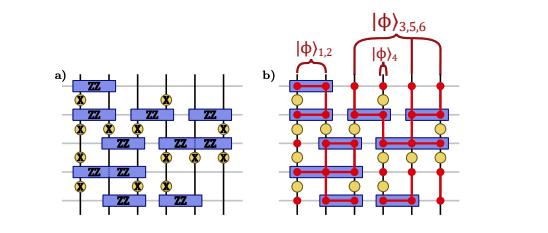
Scientists have achieved a detailed understanding of multiparty entanglement in measurement-induced phase transitions (MIPTs), revealing how entanglement scales with the number of participating particles. The research focuses on quantifying genuine multiparty entanglement, a crucial resource for quantum algorithms, and how it behaves in complex quantum circuits with measurements. The team constructed a theoretical framework based on “entanglement clusters”, representing the connections between subregions sharing entanglement, and proposed three key relationships governing the exponents. First, they established that the exponent representing k-party entanglement is always greater than or equal to the exponent for k-party mutual information.
Second, they demonstrated that this exponent increases as the number of entangled particles increases. Finally, the research confirms that increasing the number of particles does not lead to an abnormally suppressed level of entanglement. Measurements performed on a specific type of quantum circuit provided precise values for the exponents, confirming the theoretical predictions.
Multiparty Entanglement and Percolation in Circuits
This research establishes a detailed understanding of multiparty entanglement in measurement-induced phase transitions, systems where entanglement spreads in complex ways due to repeated measurements within quantum circuits. Scientists demonstrated the existence of long-range genuine multiparty entanglement, and characterised its behaviour using the “entanglement cluster” approach. Specifically, the team obtained precise values for entanglement exponents in one-dimensional circuits resembling percolation, confirming theoretical predictions with numerical simulations. They extended this analysis to two-dimensional systems, obtaining initial data on entanglement exponents and establishing a potential link to the 3D percolation model. The exponents obtained satisfy established conjectures regarding entanglement behaviour, including classical dominance, monotonicity, and subadditivity. While these exponents differ from those found in other random circuit ensembles, the research suggests the measurement-only circuit may exhibit particularly long-range entanglement.
👉 More information
🗞 Spatial structure of multipartite entanglement at measurement induced phase transitions
🧠 ArXiv: https://arxiv.org/abs/2509.12109