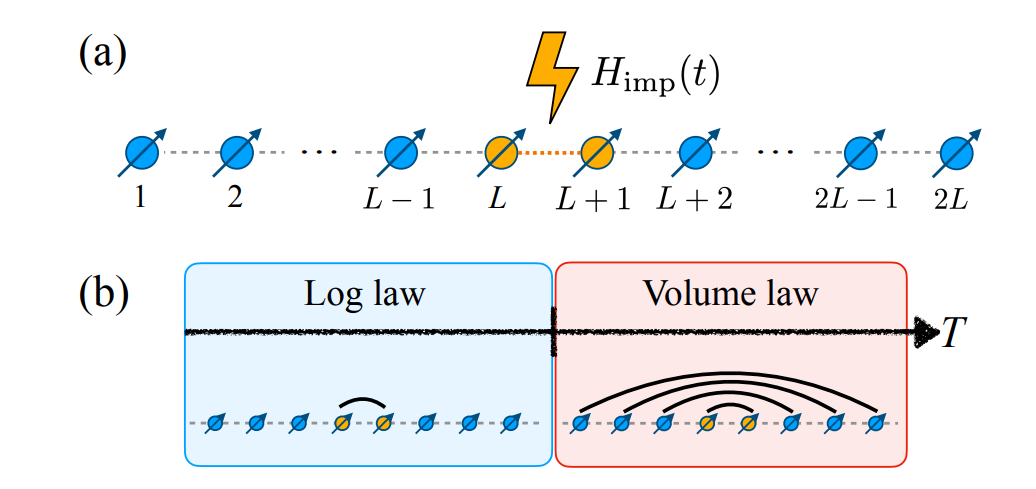
The behaviour of entanglement, a key feature of quantum systems, dramatically changes when a system experiences periodic disturbances, a phenomenon researchers now investigate in detail. Zhi-Xing Lin from Princeton University, Abhinav Prem from Bard College, and Shinsei Ryu, also at Princeton University, alongside Bastien Lapierre from Ecole Normale Supérieure, explore how driving impurities within a one-dimensional quantum chain affects the spread of entanglement. Their work reveals a surprising connection between the frequency of these disturbances and the resulting entanglement growth, demonstrating that carefully controlled, local driving can produce behaviour normally associated with much larger, more complex systems. The team’s findings establish that this local control generates emergent bulk phenomena, offering new insights into how energy localises and thermalises within actively driven quantum materials.
Driven Impurity Models and Quantum Entanglement
This research explores how a localized, time-varying force affects entanglement within a chain of interacting quantum particles. Scientists investigated driven impurity models and discovered a surprising link between the driving frequency and the growth of quantum entanglement. The findings reveal that entanglement development changes dramatically depending on how quickly the force oscillates, indicating a critical point where the system’s behaviour fundamentally alters. Entanglement, a key feature of quantum mechanics, describes a strong correlation between particles, even when separated by large distances.
Understanding how to control entanglement is crucial for developing future quantum technologies. This study demonstrates that by carefully tuning the driving frequency, scientists can control the rate at which entanglement spreads throughout the system, transitioning between localized and global behaviours. The research team employed a combination of analytical calculations and numerical simulations to unravel the complex dynamics of these driven systems. They discovered that at low driving frequencies, the entanglement growth resembles that of a local disturbance. However, as the driving frequency increases, the entanglement grows more rapidly, indicating a loss of quantum coherence and a transition to a more disordered state.
This transition is associated with a change in the energy landscape of the system, where long-range connections between particles become dominant. The findings have significant implications for understanding non-equilibrium physics, the study of systems that are not in thermal equilibrium. They also provide insights into the behaviour of open quantum systems, which interact with their environment. By demonstrating the ability to control entanglement through localized driving forces, this research opens up new possibilities for manipulating quantum systems and developing novel quantum technologies.
Driven Impurity Alters Entanglement Growth Significantly
Scientists have discovered a striking change in entanglement dynamics within a one-dimensional chain of quantum particles subjected to a localized, periodic force. The research reveals that the growth of entanglement depends critically on the frequency of this driving force. For slow oscillations, entanglement grows linearly, indicating energy rapidly spreading throughout the system. Surprisingly, when the driving force oscillates more rapidly, the entanglement growth slows dramatically, resembling the response to a sudden, localized disturbance. This unexpected behaviour suggests that the system responds differently depending on the driving frequency, transitioning between a global and a localized response.
Detailed analysis reveals that this transition originates from a specific feature in the system’s energy landscape, created by the periodic drive. The team traced this to a change in the single-particle Floquet quasi-energy spectrum. Further investigation revealed that the system develops long-range connections between distant particles at certain driving frequencies, driving rapid entanglement growth. Conversely, at slower frequencies, these connections remain local, explaining the slower entanglement growth. Extensive computer simulations confirmed these findings, demonstrating that the unusual entanglement growth persists even with weak interactions between the particles. The research establishes that precise control of a system using periodic drives, known as Floquet engineering, can generate emergent bulk phenomena, shedding new light on energy localization and thermalization in driven many-body systems. This work provides a foundation for exploring new ways to manipulate quantum systems and develop novel quantum technologies.
Entanglement Transition Driven by Periodic Force
Scientists have uncovered a surprising entanglement transition in a one-dimensional chain of quantum particles driven by a localized, periodic force. The research demonstrates that the way entanglement grows within the system changes dramatically depending on the frequency of this driving force, revealing a sharp transition between localized and global behaviours. Experiments reveal that for slow oscillations, entanglement growth is subextensive, resembling a local disturbance. However, when the driving force oscillates more rapidly, the entanglement grows linearly with time, indicating heating across the entire system.
The team traced this transition to a change in the system’s energy landscape, observing a gap closure in the single-particle Floquet quasi-energy spectrum. Below a critical frequency, the dynamics remain localized, but above this frequency, the gap closure causes long-range connections to dominate, driving rapid entanglement growth. Analysis shows that a key component of the system, the average energy operator, develops non-local connections responsible for this rapid entanglement growth when the driving frequency exceeds a critical value, while remaining local at lower frequencies. Extensive computer simulations confirm that this behaviour persists even with weak interactions, remaining stable for measurable timescales. The research establishes that even a strictly local periodic drive can generate emergent bulk phenomena, triggering heating and volume-law entanglement across the entire system. This work provides new insight into energy localization and thermalization in driven many-body systems, demonstrating a novel mechanism for controlling entanglement growth through localized Floquet engineering.
Driving Frequency Controls Entanglement Growth Dynamics
This research establishes a clear connection between the frequency of a localized driving force and the resulting entanglement dynamics within a one-dimensional chain of quantum particles. Scientists discovered a distinct transition in how entanglement grows over time, dependent on the driving frequency. At slow oscillations, entanglement entropy increases linearly, indicating energy rapidly spreading throughout the system. Surprisingly, at faster oscillations, the entanglement growth slows dramatically, resembling the behaviour observed after a local disturbance. Detailed analysis reveals this transition originates from a change in the system’s energy landscape, created by the periodic drive.
The team demonstrated that the average energy operator develops non-local connections at certain frequencies, driving rapid entanglement growth, while remaining local at others. Importantly, these findings persist even with weak interactions present, suggesting a robust phenomenon. These results illuminate how local control can induce emergent bulk behaviour, offering new insights into energy localization and thermalization in driven quantum systems. The authors acknowledge that definitively proving a genuine phase transition requires further investigation, particularly for strongly interacting systems.
Future research directions include exploring the potential criticality associated with extending this model to non-Hermitian impurities, which could connect to non-unitary conformal field theories. The team highlights the amenability of these findings to experimental verification using existing cold-atom technology, where precise temporal control of local energies is achievable. They suggest that while directly measuring entanglement entropy is challenging, the transition can be observed through measurements of transport or energy growth.
🗞 Local-to-Global Entanglement Dynamics by Periodically Driving Impurities
🧠 ArXiv: https://arxiv.org/abs/2510.20908