The search for a complete theory of gravity continues to challenge physicists, with experimental verification proving particularly difficult. Yuka Shiomatsu from Ochanomizu University, Youka Kaku from Kobe University, and Akira Matsumura from Kyushu University, along with colleagues, now present a novel approach to detecting gravity-induced entanglement using tabletop experiments. Their work demonstrates a method for significantly amplifying this entanglement between two masses by exploiting the principles of parametric resonance, a phenomenon that causes systems to oscillate with increasing amplitude. The team’s analysis reveals exponential growth in entanglement, suggesting a pathway to observe this subtle quantum effect far below the energy scales previously thought possible and opening new avenues for testing fundamental aspects of gravity.
Gravity’s Influence on Massive Quantum Entanglement
This research investigates whether gravity can create measurable quantum entanglement between massive objects, a fundamental question at the intersection of quantum mechanics and general relativity. Understanding this interplay could reveal limits on measurement precision and potentially enable new technologies for sensing, communication, and quantum information processing. The researchers explored theoretical models and experimental setups using optomechanical systems, devices that couple light to mechanical motion. A key innovation involves the use of inverted oscillators, systems designed to allow for larger quantum fluctuations and enhanced entanglement.
Detailed mathematical models were developed to describe the system’s dynamics, accounting for gravity, quantum noise, and decoherence, with entanglement quantified using established measures. The results demonstrate that inverted oscillators significantly enhance entanglement generation compared to traditional systems. The models show gravity can act as an entangling force, bringing the massive objects into a correlated quantum state, with the degree of entanglement sensitive to system parameters like mass and oscillation frequency. Strategies to mitigate decoherence, such as cooling and using squeezed light, were also explored. The feasibility of implementing these experiments was assessed, and the potential for sudden decoherence due to particle excitation was highlighted.
Parametric Resonance Amplifies Gravity-Induced Entanglement
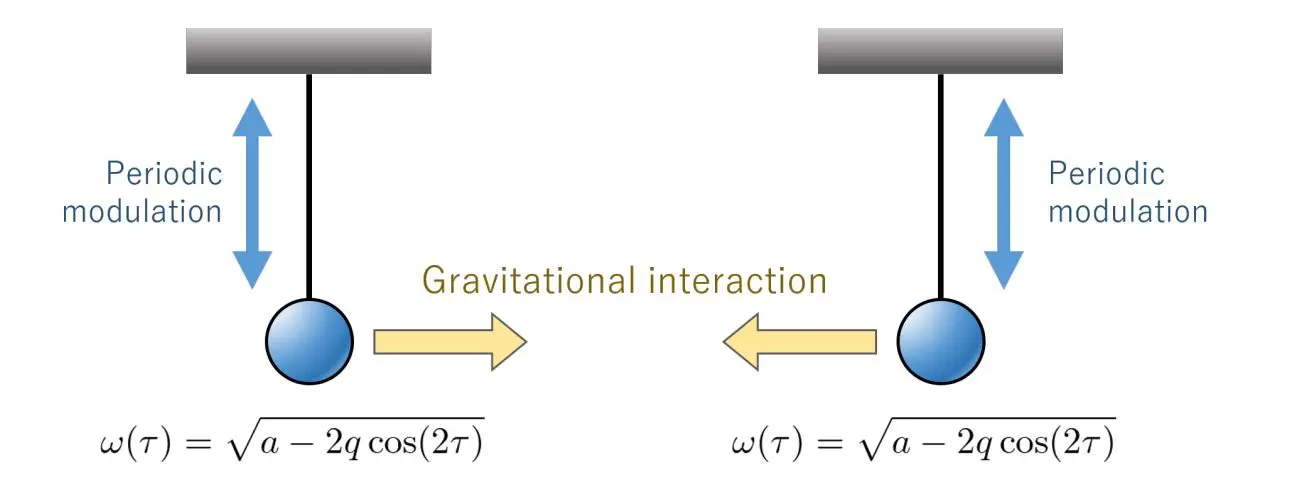
Scientists have developed a novel approach to amplify gravity-induced entanglement between two masses by harnessing parametric resonance, a technique where periodic modulation of system parameters causes exponential growth. The study centers on two parametrically resonant oscillators interacting solely through Newtonian gravity, allowing precise investigation of entanglement generation at a scale far below the Planck scale. Researchers mathematically modeled the system and evaluated logarithmic negativity as a quantifiable measure of entanglement. The core of the work involves analyzing the Mathieu equation, which governs the motion of each oscillator under parametric excitation, and identifying unstable parameter regions where parametric resonance occurs, leading to dramatic amplification of entanglement.
Scientists demonstrated that within these unstable regions, the entanglement grows exponentially, with a rate directly linked to the characteristic exponent of the Mathieu equation, revealing a fundamental connection between the system’s dynamics and quantum correlation. This method differs from previous approaches by leveraging the inherent instability of parametric resonance to achieve exponential growth even with tightly controlled system parameters. The study investigated the effects of realistic environmental factors, including random force noise and linear damping, on the generated entanglement. The analysis demonstrates that while these factors can suppress entanglement, the exponential growth driven by parametric resonance remains dominant under appropriate conditions, highlighting the potential for practical implementation.
Entanglement Amplification via Parametric Resonance and Gravity
Scientists have demonstrated a novel method for amplifying entanglement between two masses using principles of parametric resonance and Newtonian gravity, achieving exponential growth without relying on unstable potentials. The research centers on two parametrically resonant oscillators, each governed by the Mathieu equation, which describes periodic modulation of an oscillator’s frequency. Through careful analysis, the team discovered that manipulating the curvature of a stable trapping potential periodically can dramatically increase entanglement between the oscillators. The study reveals that the degree of entanglement is directly linked to the spatial spreading of the oscillators’ wavefunctions, with larger spreading correlating to stronger entanglement.
By operating in an unstable parameter region of the Mathieu equation, the oscillators’ wavefunctions exhibit exponential growth, leading to a corresponding exponential increase in entanglement. Specifically, the team identified that the entanglement growth rate matches the characteristic exponent of the Mathieu equation, demonstrating a precise relationship between the system’s dynamics and the entanglement generated. Detailed analysis of the system’s stability diagram revealed regions where exponential growth of displacement, and thus entanglement, can be achieved. For representative parameter points, the team observed how increasing a key parameter leads to a shallower potential and greater spatial broadening of the wavefunction. This broadening, they found, is a key driver of the observed gravity-induced entanglement.
Entanglement Amplification via Gravitational Instability
This research demonstrates a pathway to generate and amplify entanglement between two massive oscillators using gravity, operating far below the Planck energy scale. By employing parametric resonance and a Mathieu-type drive, the team showed that entanglement, quantified by logarithmic negativity, can grow exponentially under specific conditions. The analysis reveals that this growth is dependent on the system entering an unstable regime, characterized by a positive imaginary component of the Floquet exponent. Importantly, the study investigated the impact of environmental factors on this entanglement.
Results indicate that random force noise suppresses entanglement generation, with the degree of suppression linked to the ratio between noise strength and gravitational coupling. However, even with noise present, entanglement can still develop if the noise remains sufficiently weak relative to the gravitational force. Linear damping, while constrained by the uncertainty principle, was found to have a minimal effect on entanglement, neither hindering nor significantly enhancing its growth. The authors acknowledge that maintaining a low noise level is crucial for observable entanglement and highlight the challenge of balancing gravitational coupling with environmental noise. Future work could explore realizing the Mathieu drive through optical-spring effects or periodic modulation of pendulum length, potentially paving the way for experimental verification of gravity-induced entanglement.
🗞 Boosting Gravity-Induced Entanglement through Parametric Resonance
🧠 ArXiv: https://arxiv.org/abs/2511.09169