Chiral symmetry restoration, a fundamental aspect of strongly interacting matter, receives fresh investigation through a novel information-theoretic approach, as demonstrated by Seung-il Nam of Pukyong National University and colleagues. The team explores this phenomenon in hot and dense quark matter by utilising the lesser Green’s function within the established Nambu-Jona-Lasinio model, constructing a reduced correlator to quantify entanglement between left and right-handed quark sectors. Their work reveals that chirality entropy increases consistently with both temperature and chemical potential, exhibiting a clear link between dynamical mass generation and entanglement, and ultimately establishing a new probe for understanding chiral symmetry restoration in extreme conditions. The research achieves a detailed understanding of critical exponents and scaling behaviour, yielding values that further validate the connection between information content and the fundamental properties of quark matter.
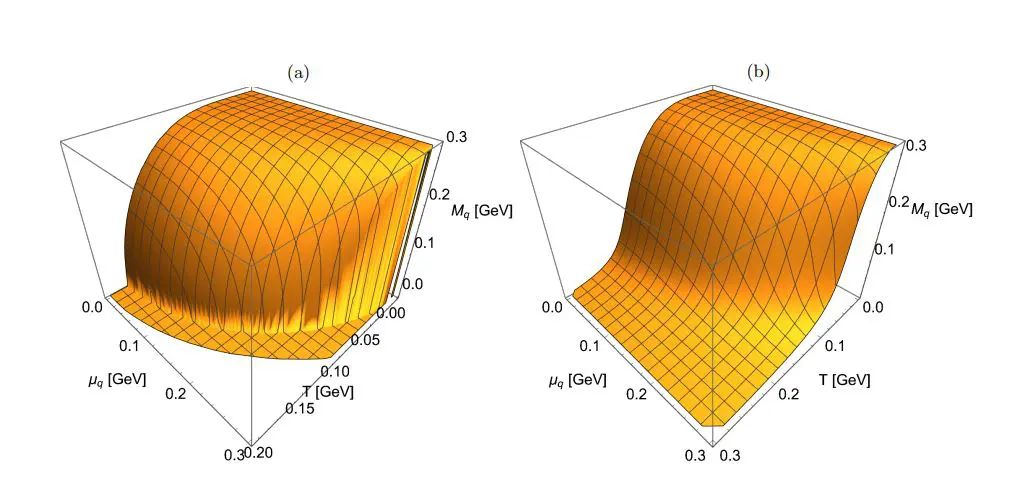
This work quantifies the entanglement between left- and right-handed quarks, providing a new information-theoretic probe for understanding strongly interacting matter. The team measured the dynamical quark mass, a key indicator of chiral symmetry breaking, and found it exhibits a second-order phase transition in the chiral limit, where current quark mass is zero, and a smooth crossover for finite quark masses. Experiments revealed that the chirality entropy, which quantifies chiral entanglement, increases consistently with both temperature and chemical potential, approaching a maximum value as these parameters increase.
Detailed analysis of the dynamical quark mass at finite chemical potential demonstrated a transition from a second-order phase transition to a first-order transition as density increases, culminating in a critical end point characteristic of quantum chromodynamics. Specifically, the team observed a substantial dynamical quark mass near zero temperature and chemical potential, indicating strong chiral symmetry breaking in the vacuum. Further measurements showed that as temperature increases at zero chemical potential, the constituent quark mass decreases continuously to zero, signaling the second-order phase transition. Along the chemical potential axis, a similar qualitative behaviour occurs, with the transition sharpening and becoming first order at high densities. The inclusion of a finite current quark mass transformed the sharp phase boundary into a smooth crossover, with the dynamical quark mass remaining finite even at high temperatures, consistent with lattice quantum chromodynamics results. These findings demonstrate that the model accurately captures the qualitative pattern of chiral symmetry restoration in hot and dense matter, and that reasonable variations in model parameters do not alter the overall behaviour.
Entanglement Quantifies Chiral Symmetry Restoration
This research successfully quantifies chiral symmetry restoration in hot and dense quark matter using a novel information-theoretic approach. Scientists employed the von Neumann chirality entropy, calculated within a theoretical model, to measure the entanglement between left- and right-handed quark sectors. Results demonstrate that this entropy increases consistently with both temperature and chemical potential, providing a quantifiable link between chiral symmetry restoration and the degree of entanglement within the system. The calculated critical exponents and scaling behaviour further refine understanding of the phase structure of quark matter.
The study establishes the von Neumann chirality entropy as a valuable tool for probing the complex behaviour of strongly interacting matter, offering a new perspective on the interplay between dynamical mass generation and chiral mixing. While the current analysis focuses on a specific model, the authors acknowledge limitations inherent in the theoretical framework, which does not account for quark confinement. Future research directions include extending this approach to more complex models and applying it to analyses of entanglement in hadronic matter, potentially refining our understanding of the fundamental properties of matter under extreme conditions.
🗞 Lesser Green’s Function and Chirality Entanglement Entropy via the In-Medium NJL Model
🧠 ArXiv: https://arxiv.org/abs/2511.22412