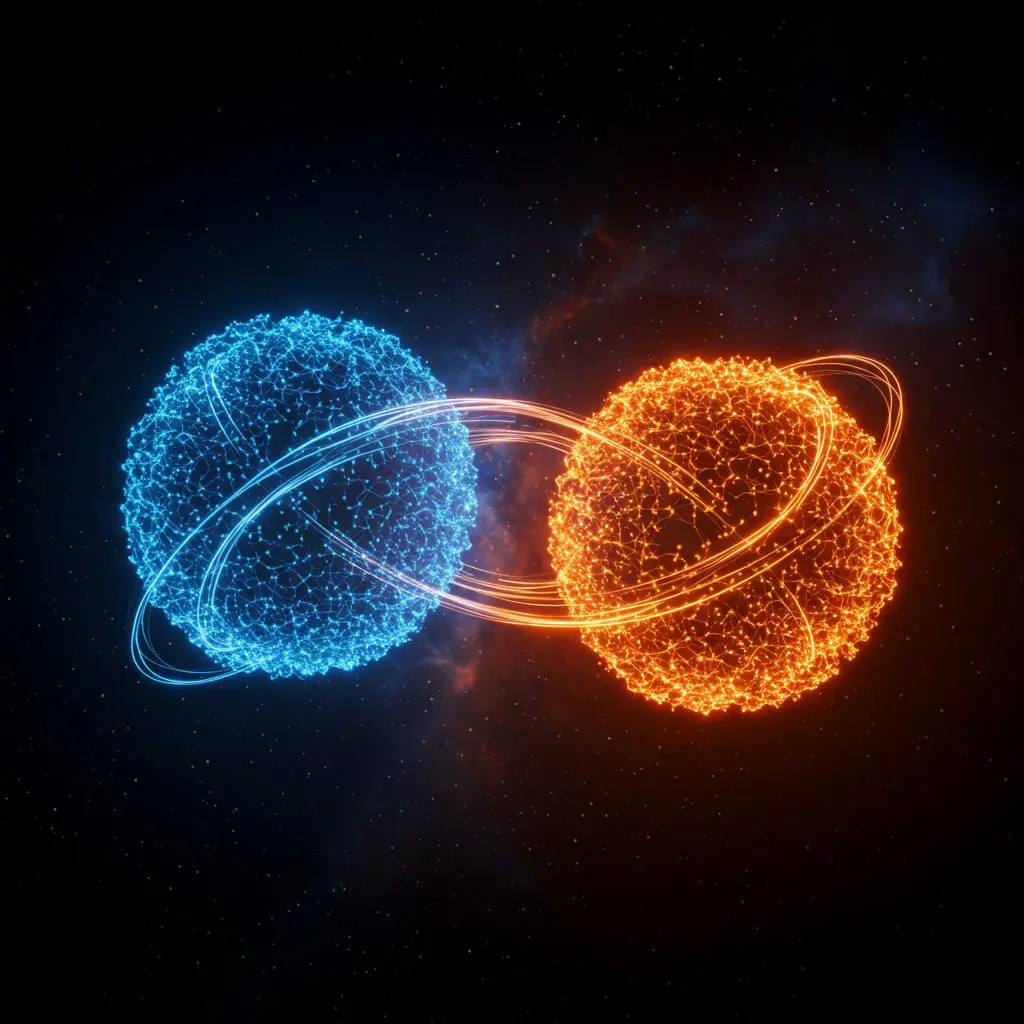
Quantum entanglement, a phenomenon where particles become inextricably linked, holds immense promise for future technologies, but its fragility presents a significant challenge. Samuel A. Márquez González from the University of Maryland, along with colleagues, investigates the interplay between entanglement and decoherence, the process by which quantum systems lose their coherence due to environmental interactions. This research explores how various environmental factors and types of noise contribute to the decay of entanglement, a process known as entanglement sudden death, and reveals the delicate balance required to maintain these fragile quantum states. Understanding this interplay is crucial for developing robust quantum technologies, including secure communication and advanced computation, where preserving entanglement is paramount for reliable performance.
Entanglement’s Fragility and Decoherence Mitigation
Quantum entanglement is a fundamental phenomenon where two or more particles become linked, sharing the same fate no matter how far apart they are. This connection is crucial for emerging quantum technologies, including computing, communication, and sensing. However, entanglement is incredibly delicate and susceptible to disruption from its surroundings. Decoherence, the loss of quantum coherence and therefore entanglement, isn’t a violation of quantum mechanics, but a natural consequence of the system becoming entangled with its surroundings. Several factors contribute to decoherence, including thermal fluctuations, random motion of particles, interactions with electromagnetic fields, and collisions with other particles.
Any interaction that leaks information about the quantum system to the outside world can induce decoherence. The research details three primary types of quantum noise: amplitude damping (loss of energy), phase damping (loss of relative phase between states), and depolarizing noise (random transformation of quantum states). Several techniques are being explored to combat decoherence and maintain entanglement. Quantum error correction encodes information for error detection and correction, while entanglement purification distills high-quality entangled states from noisy ones. Decoherence-free subspaces encode information in regions immune to certain noise types, and dynamical decoupling applies timed pulses to average out noise effects.
Environmental isolation shields the system, and strong coupling carefully controls interactions with the environment. Understanding entanglement in strongly correlated systems and how heat flows across quantum systems are key areas of investigation. The key takeaways are that entanglement is fragile, decoherence is inevitable in real-world systems, mitigation strategies are crucial for practical quantum technologies, and ongoing research is needed to fully understand and control the interplay between entanglement and decoherence.
Tracking Entanglement Loss Through Environmental Interactions
Researchers investigate the delicate balance between maintaining entanglement and mitigating decoherence, crucial for advancing quantum technologies. The study focuses on understanding how interactions with the surrounding environment lead to the decay of quantum coherence and the loss of entanglement. The methodology employs mathematical tools to model the quantum system and its environment, allowing for detailed analysis of their interactions. The approach considers the system’s interaction with individual environmental degrees of freedom, treating each interaction as a collision event. This allows researchers to track the evolution of the system’s state before and after each collision, using mathematical operators to describe the transformation.
A key simplification assumes the interaction doesn’t cause transitions within the system itself, allowing for a more manageable mathematical description. By applying this framework, researchers can examine how the environment “scatters” off the system, capturing information about its state. This interaction is described by equations detailing the transformation of the system’s quantum state, focusing on the decay of coherence, the superposition of states enabling quantum phenomena. The rate of decay directly reflects the strength of the decoherence process. This methodology allows for precise quantification of decoherence, revealing how environmental interactions destroy the delicate quantum correlations essential for entanglement. Entanglement between the system and its environment becomes practically irreversible due to uncontrollable environmental factors. Understanding this process is paramount for developing strategies to preserve entanglement and enable robust quantum technologies, such as quantum computing and quantum communication.
Entanglement Lifespan Limited by Environmental Interactions
Researchers are deepening our understanding of entanglement, a fundamental quantum phenomenon where particles become linked, sharing the same fate no matter how far apart they are. This work focuses on the delicate balance between creating and maintaining entanglement, and the inevitable process of decoherence, where interactions with the environment degrade these fragile quantum links. Understanding this interplay is crucial for developing technologies that rely on entanglement, such as quantum computers and secure communication networks. The research highlights how environmental interactions fundamentally limit the lifespan of entanglement.
Real-world quantum systems are susceptible to disturbances from their surroundings, introducing decoherence and scrambling quantum information. Entanglement doesn’t simply fade away, but undergoes a complex dance of creation and destruction, oscillating between strong correlation and complete disentanglement before succumbing to environmental noise. Thermal decoherence, where heat-induced fluctuations disrupt quantum states, proves to be a significant factor in the loss of entanglement. The research reveals a clear relationship between temperature and entanglement preservation; lower temperatures allow entanglement to persist longer, while higher temperatures accelerate its decay.
Researchers employed mathematical models to quantify this relationship, demonstrating that the degree of entanglement can be predicted based on temperature, energy differences, and thermal excitation. These calculations show that even in complex systems, a non-zero level of entanglement can be maintained at very low temperatures, despite decoherence. The research extends beyond simple systems, demonstrating that thermal decoherence impacts entanglement even in more complex scenarios. Researchers utilize a framework that accounts for fluctuating environmental conditions to accurately model entanglement behavior in these complex systems, providing valuable insights for designing robust quantum technologies.
Entanglement Decay and Noise Mitigation Strategies
This study investigates the complex relationship between quantum entanglement and decoherence, demonstrating how environmental factors significantly impact the integrity of entangled states. Thermal fluctuations, electromagnetic fields, and collisions all contribute to decoherence, leading to entanglement decay. Understanding these interactions is crucial for developing robust quantum technologies that rely on sustained entanglement. The findings emphasize the importance of mitigation strategies, including error correction codes, entanglement purification protocols, and the use of decoherence-free subspaces, for protecting entangled states from environmental disturbances.
🗞 Exploring the Interplay Between Quantum Entanglement and Decoherence
🧠 ArXiv: https://arxiv.org/abs/2508.14790