The concept of entanglement, famously demonstrated in physics by Bell’s Theorem, describes a powerful correlation between systems, and Nicholas Godfrey from Queensland University of Technology and Ted Sichelman from University of San Diego now apply this principle to the realm of law. Their work represents a significant step forward by mathematically modelling how legal concepts become interconnected, extending beyond interpretation to encompass the very creation and application of laws. This research demonstrates that changes within one area of law instantaneously affect others, mirroring the instantaneous correlation observed in physical entanglement, and offers a new framework for understanding legal systems. By quantifying this ‘legal entanglement’, the team provides deeper insights into the role of boundaries within law, and importantly, suggests ways to improve the development of legal artificial intelligence, even prompting a re-evaluation of entanglement itself when viewed through a legal lens.
Quantum Entanglement Models Legal Interconnections
Scientists have developed a compelling new approach to understanding legal systems by drawing parallels to quantum entanglement, where particles become linked and share the same fate regardless of distance. This research goes beyond simple analogy, proposing a detailed framework for applying quantum concepts to legal reasoning, interpretation, and adjudication. The team suggests this approach illuminates how legal decisions are interconnected, how information costs influence legal outcomes, and even offers insights into the fundamental nature of legal rules. Central to this work is the concept of quantum entanglement, adapted to represent the interconnectedness of legal rules, precedents, and decisions.
A decision in one case becomes entangled with others, meaning they are not independent. This mirrors the quantum principle of superposition, where a system can exist in multiple states simultaneously until measured, analogous to legal ambiguity where a rule might have multiple interpretations until clarified by a court. Measurement, in the quantum world, forces a system into a single state, corresponding to a court making a decision and establishing a precedent. Researchers propose quantifying this interconnectedness using ‘entanglement entropy’, a measure of the degree of entanglement between quantum systems.
Higher entropy would indicate a greater degree of entanglement within the legal system. They also suggest that legal systems with high modularity, where rules are relatively independent, may have lower information costs, as changes in one area are less likely to cascade through the entire system. This framework allows for a deeper understanding of how information costs are affected by the interconnectedness of legal rules. The team explores specific legal applications of this model, demonstrating how entanglement can explain the non-fixed nature of legal rule meaning, dependent on its relationship to other rules and precedents.
In adjudication, a court’s decision in one case entangles it with previous and future cases, creating a web of interconnected precedents. This model is particularly relevant in areas like patent validity, where invalidating one patent can affect others, and mergers and acquisitions, where interpretations of agreements cascade through networks of companies. Researchers propose using network theory, informed by quantum concepts, to represent the relationships between legal actors and rules. This work challenges traditional legal positivism, which views law as a set of rules applied mechanically, suggesting instead that legal meaning is relational and context-dependent.
It aligns with legal realism, emphasizing context and judicial discretion, and builds on complexity theory, recognizing interconnectedness and cascading effects. However, this interconnectedness also raises questions about legal certainty, as entangled rules make predicting outcomes more difficult. Intriguingly, the authors propose a reverse application to physics, suggesting that the legal model of entanglement might offer insights into the physical phenomenon itself. They hypothesize that quantum entanglement might be driven by second-order informational processes, rather than being purely physical, and that these informational rules might be non-local, acting instantaneously across vast distances.
This approach could offer a non-realistic explanation of quantum entanglement, independent of classical physics. While largely conceptual at this stage, this research acknowledges the need for empirical validation and highlights the challenges of quantifying entanglement in legal systems, requiring large datasets of legal texts and decisions. Future research will focus on developing quantitative measures, testing the model with real-world data, and exploring its implications for legal theory and practice. In summary, this paper presents a bold and innovative attempt to bridge the gap between law and physics, offering a potentially fruitful new way of thinking about legal reasoning, interpretation, and adjudication.
Legal Entanglement and System Modularity
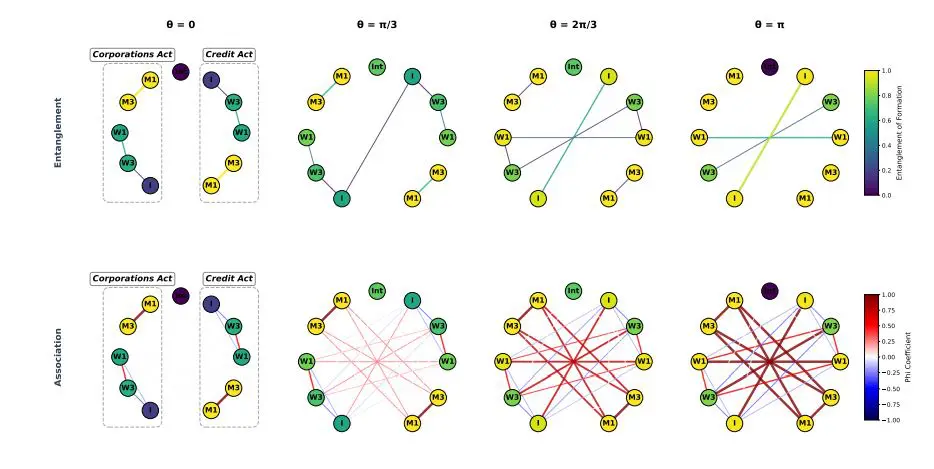
Scientists have pioneered a novel method for quantifying entanglement, extending mathematical modeling beyond physics and into the realm of legal concepts. Building on established work concerning legal entropy and complexity, the study measures entanglement within legal systems, drawing parallels to the phenomenon observed in quantum mechanics. The core of this work adapts techniques from network analysis, grouping relationships, including entanglement edges, into communities to quantitatively assess the ‘modularity’ of legal subsystems. This modularity correlates inversely with ‘information costs’ associated with analyzing legal relations and entanglement, providing a metric for system efficiency.
The team employed a framework inspired by existing methods for quantifying modularity, allowing for a comparative analysis of entanglement across diverse legal contexts. To explore the implications of this approach, scientists posited an idealized informational space where legal acts instantaneously update entangled legal states, mirroring the instantaneous correlation observed in quantum entanglement. This conceptualization draws an analogy to commercial and governmental legal databases, such as Lexis-Nexis and Westlaw, which document legal acts and are then interpreted by legal professionals. The study proposes that these databases could operate instantaneously, creating a globally connected informational space separate from physical reality.
Researchers further extended this model by suggesting that this informational space could function as an external communication channel, analogous to the mechanism behind quantum entanglement. This channel would catalog and monitor all physical systems, instantaneously constraining the possibilities of measurement for entangled systems. This parallels higher-order legal rules, such as claim and issue preclusion, which dictate how decisions by one court bind others. The team acknowledges potential concerns regarding the violation of the ‘no-signaling principle’ and the introduction of a seemingly inaccessible ontological layer, but argues that any causal explanation of quantum entanglement must be nonlocal, and that the proposed informational space operates within that constraint, confining signals to measurement events rather than ordinary state evolution.
Quantum Entanglement Applied to Legal Systems
This work presents a novel mathematical framework for understanding entanglement, extending the concept from physics to the realm of legal concepts and systems. Researchers define a qubit, the fundamental unit of quantum information, as a system existing in a ‘superposition’ of states represented as |ψ⟩ = α|0⟩ + β|1⟩, where α and β are complex numbers determining the probability of measurement in either state. The probability of measuring the qubit in state |0⟩ is given by |α|², and in state |1⟩ by |β|², with the constraint that |α|² + |β|² always equals 1, ensuring a total probability of 100 percent. This foundational concept is then applied to legal systems, proposing that legal states can also exist in a superposition prior to judgment.
The team introduces ‘quantum legal entanglement’ as a phenomenon occurring when legal states are in superposition and a change in one state instantaneously affects other ‘entangled’ legal states. This entanglement implies that measuring one entangled legal state will yield different outcomes than if it were not entangled. Researchers demonstrate this concept across three key legal contexts: legal interpretation, law formulation, and dispute adjudication. The formalism developed allows for a richer understanding of how legal concepts relate to one another and how judgments impact interconnected legal principles.
Furthermore, the study extends beyond theoretical application, suggesting potential benefits for the development of advanced legal artificial intelligence systems. By quantifying entanglement, the framework offers a means to model the complexities of legal reasoning and improve the accuracy of AI-driven legal tools. Notably, the work also proposes a novel approach to understanding physical entanglement itself, suggesting that legal entanglement, if analogous to.