The creation and control of complex quantum states represent a significant challenge in modern physics, and researchers increasingly explore methods to encode and transmit information using these states. M. Javad Zakeri from University of Central Florida, Armando Perez-Leija from Saint Louis University, and Andrea Blanco-Redondo from University of Central Florida, alongside their colleagues, now demonstrate a new approach to generating high-dimensional entanglement in photons. Their work overcomes a key limitation in the field, providing a method to scale up entanglement to a larger number of photonic modes, and relies on specifically designed silicon photonic structures to create entangled photon pairs. The results reveal entanglement across up to five modes, with notable robustness against the inevitable imperfections of nanofabrication, and this achievement paves the way for scalable and fault-tolerant photonic quantum systems with potential applications in information science and beyond.
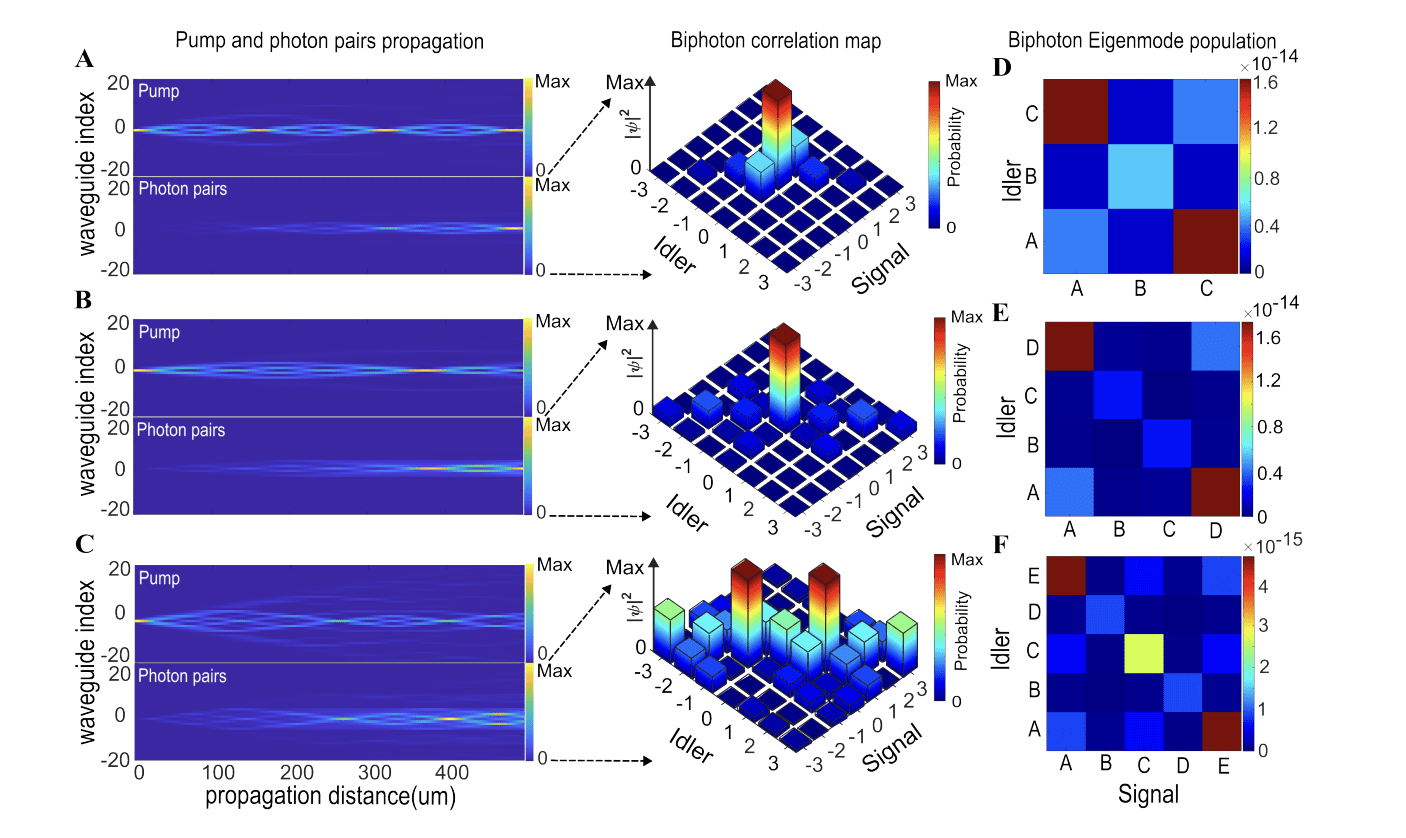
The application of topology to encode and transport quantum information has gained considerable attention in condensed matter physics and is now extending into quantum photonics. This research proposes and experimentally demonstrates a method to generate high-dimensional topological photonic entanglement, utilizing carefully designed silicon photonic waveguide topological superlattices that support nonlinear generation of energy-time entangled photon pairs on a superposition of multiple topological modes. Measurements and theoretical analysis reveal entanglement of up to five topological modes.
Silicon Superlattices Generate Entangled Photon Pairs
Scientists developed a silicon photonics platform to generate and manipulate high-dimensional quantum states, addressing a critical need for scalable quantum technologies. The study centers on carefully designed silicon photonic waveguide superlattices, fabricated to support nonlinear generation of entangled photon pairs across multiple modes simultaneously. Researchers implemented three distinct array designs, each featuring unit cells composed of 4, 5, and 6 waveguides, meticulously engineered to fulfill criteria for robust topological band gaps, ensuring stable quantum behavior. These superlattices combine topological and non-topological sections, creating a unique environment for generating entangled photons.
The team leveraged the high optical nonlinearity of silicon waveguides to generate biphotons in entangled superpositions of three, four, and five topological modes, a significant advancement beyond previous two-mode entanglement methods. Fabrication involved precise control over the unit cell structure, ensuring inversion symmetry and strong intercell coupling, vital for maintaining the desired topological properties. Measurements and theoretical analysis confirmed entanglement across up to five modes, demonstrating resilience to the inevitable imperfections introduced during nanofabrication. This approach relies on exciting a linear superposition of interface modes within the engineered superlattices, effectively creating a multi-dimensional quantum system. Researchers validated the entanglement through quantum correlation measurements performed on numerous fabricated devices, confirming the stability and robustness of the generated states. The study demonstrates a scalable route toward fault-tolerant quantum photonic circuits and resilient quantum communication links, offering a promising pathway for future quantum technologies.
Topological Protection Enhances Quantum Light Propagation
This research explores the use of topological principles to create robust quantum systems. The core idea involves designing photonic structures where light propagation is protected from defects and imperfections, stemming from the topology of the structure, meaning certain properties of light are determined by its overall shape and connectivity. The Zak phase, a topological invariant, characterizes the band structure of these periodic systems and is linked to the existence of edge states, which are localized at the boundaries of the structure. These edge states are crucial for robust light propagation.
The research aims to generate and manipulate entangled photons using these topologically protected waveguides, a fundamental resource for quantum information processing. A major goal is to create quantum systems less susceptible to noise and decoherence, and topological protection offers a way to achieve this. The study describes the design and fabrication of photonic superlattices with topological properties, engineered to support topologically protected edge states. A significant achievement is the demonstration of biphoton entanglement in these topologically protected modes, meaning pairs of photons are entangled while propagating along the edges of the structure, making the entanglement more robust.
The research extends to multiband topological systems, allowing for more complex entanglement schemes and functionalities. The team presents methods for selectively filtering entangled photons based on their topological properties, which could be useful for building more sophisticated quantum circuits. A strong emphasis is placed on implementing these topological photonic systems on silicon chips, crucial for scalability and integration with existing photonic technologies.
High-Dimensional Entanglement via Silicon Photonics
This research demonstrates a new method for generating high-dimensional photonic entanglement, a crucial resource for advanced quantum technologies. Scientists successfully created entanglement across up to five modes using silicon photonic waveguide topological superlattices, leveraging nonlinear processes to generate correlated photon pairs. The approach relies on carefully designed topological structures that support the superposition of multiple modes, enabling the creation of complex quantum states. Measurements and theoretical analysis confirm that the dimensionality of the entanglement scales predictably with the complexity of the underlying structure, offering a controlled route to larger quantum systems.
Importantly, the generated quantum states exhibit resilience to imperfections arising from the nanofabrication process, a significant step towards building practical and robust quantum devices. Beyond the role of topology, the platform’s simplicity and accessibility provide opportunities to explore other multimode quantum phenomena, such as parity-related entanglement and hyperentanglement. The authors acknowledge that the robustness of the entanglement is linked to the size of the bandgaps within the structure, suggesting that further bandgap engineering could enhance performance. Future work may focus on exploring these additional quantum phenomena and scaling the system to even higher dimensions, potentially contributing to the development of fault-tolerant quantum computing systems.
👉 More information
🗞 High-dimensional topological photonic entanglement
🧠 ArXiv: https://arxiv.org/abs/2509.14164