

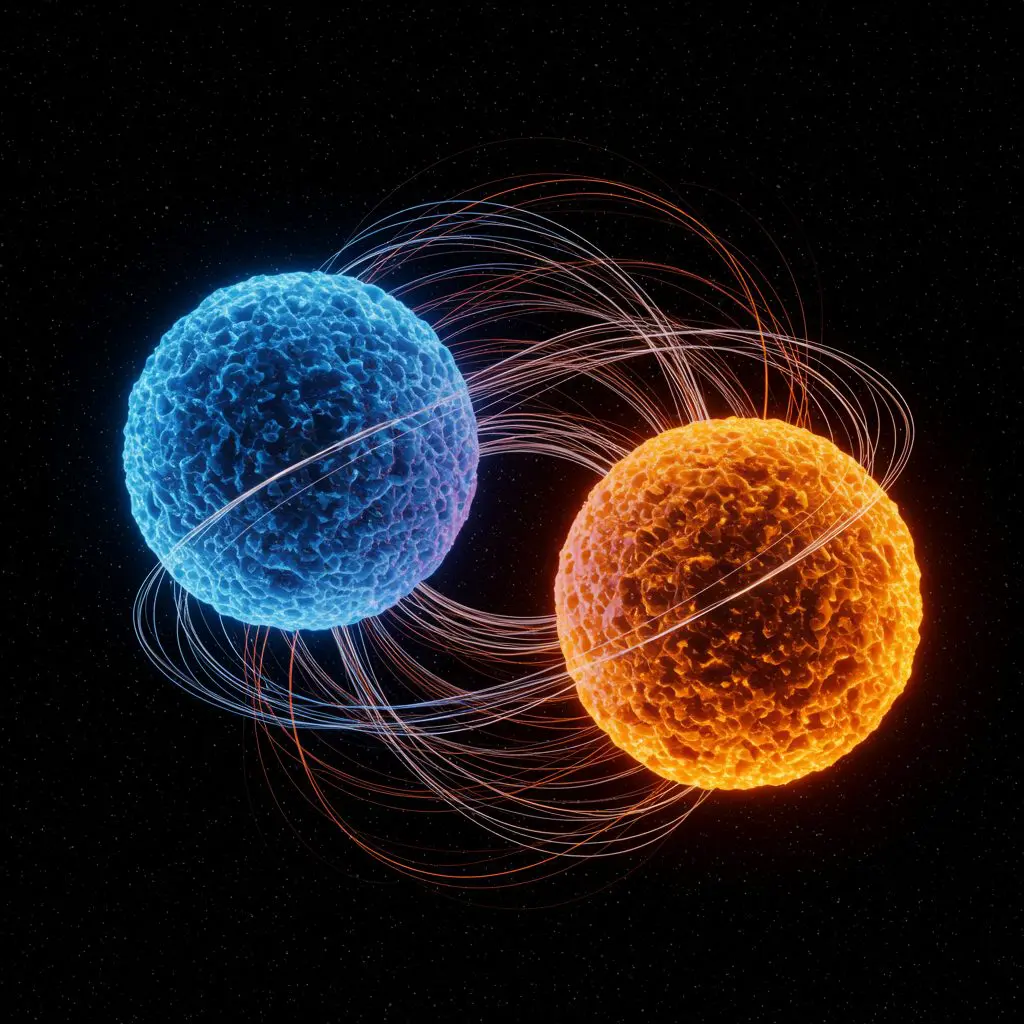
The intricate connections within quantum systems extend beyond immediate neighbours, as a new study reveals the existence of ‘entanglement halos’. Nadir Samos Sáenz de Buruaga from the Universidade de Lisboa, Silvia N. Santalla from the Universidad Carlos III de Madrid, and Germán Sierra, affiliated with both the UAM-CSIC and the University of California, Santa Barbara, alongside their colleagues, demonstrate that distant sites within a quantum system can become strongly entangled. This research establishes the concept of these halos, which appear in star-like patterns with connections that weaken with distance, and are observed in both free-fermion and spin-1/2 antiferromagnetic Heisenberg models. The discovery highlights how the geometry and connectivity of a system fundamentally shape its quantum entanglement, potentially leading to symmetry-protected topological features and offering pathways for experimental investigation using current quantum technologies.
These halos emerge in systems arranged in star-like geometries with connections that weaken with distance, and the team demonstrated their existence using both free-fermion and spin models. The arrangement of connections and the underlying quantum model determine the properties of these halos, and the findings highlight the capacity of geometry to generate complex entanglement structures with potentially useful physical properties, accessible through advanced technologies.
Recursive Renormalization of Star Heisenberg Models
This research details a method for representing the ground state of a spin model arranged in a star geometry using a Matrix Product State (MPS). The approach involves a recursive renormalization group (RG) procedure, repeatedly simplifying the system while preserving its essential quantum properties. The team constructs the MPS by building up layers of mathematical structures, known as tensors, using established principles of angular momentum combination. This method allows researchers to efficiently represent and analyze the complex quantum state of the system. The study reveals that the RG procedure leads to alternating spin values during the simplification process.
The core of the work lies in calculating the matrices that form the MPS, utilizing established mathematical relationships. The researchers emphasize the importance of these building blocks in understanding the overall quantum state. The resulting MPS representation is recursive, mirroring the recursive nature of the RG procedure. The team notes a connection between their approach and a well-known quantum state, suggesting a deeper relationship between different quantum systems. The research distinguishes between the physical spins in the original model and the virtual spins that emerge during the MPS representation, highlighting the mathematical tools used to describe the system.
Entanglement Halos in Star-Like Quantum Systems
Researchers have discovered novel entanglement structures, termed “halos”, within the ground state of quantum systems arranged in star-like geometries. These halos represent strongly connected groups of distant sites, and their properties are determined by both the arrangement of connections and the underlying quantum model governing the system. The team demonstrated that these halos can exhibit characteristics of topologically protected states, suggesting potential applications in robust quantum information processing. The research reveals that a “ring-star” arrangement supports halos that are either single or double-layered, with entanglement encompassing two rings in systems with certain symmetries.
Remarkably, the system simplifies to a product state of these halos, meaning the overall quantum state can be described by the combined properties of individual, disconnected halo groups. However, when the geometry shifts to a “site-star”, a fundamentally different type of entanglement emerges. In this arrangement, the system does not factorize into independent halos, instead exhibiting “twisted” entanglement with strong connections between adjacent rings but minimal correlation within a single ring. For free-fermion site-stars, this twisted entanglement results in a large number of possible ground states. In contrast, for spin-based site-stars, the twisted halos exhibit a nested structure, resembling Russian nesting dolls, where each halo is coupled to a combined spin representing all inner halos. These findings demonstrate that geometry plays a crucial role in determining the nature of quantum entanglement and opens new avenues for designing and controlling complex quantum systems.
Entanglement Halos and Topological Phase Emergence
This research introduces the concept of entanglement halos, which are structures of strongly entangled sites appearing within the ground state of certain quantum systems. The team demonstrates the emergence of these halos in systems arranged in star-like geometries with connections that weaken with distance, using both free-fermion and spin models. Importantly, the study reveals that the specific arrangement and connectivity of these systems can give rise to symmetry-protected topological phases, including a non-local realization of a known quantum phase. The findings suggest potential implications for quantum communication protocols that rely on spatially structured entanglement.
However, the authors acknowledge that these entanglement halos may be susceptible to environmental noise, necessitating further investigation into their stability and controllability. Future research could explore systems with more realistic connection strengths, and the team proposes experimental implementation using ultracold atomic technologies or artificial photonic lattices. Ultimately, this work contributes to a growing understanding of the interplay between strong interactions, quantum mechanics, and potentially, gravity.


