

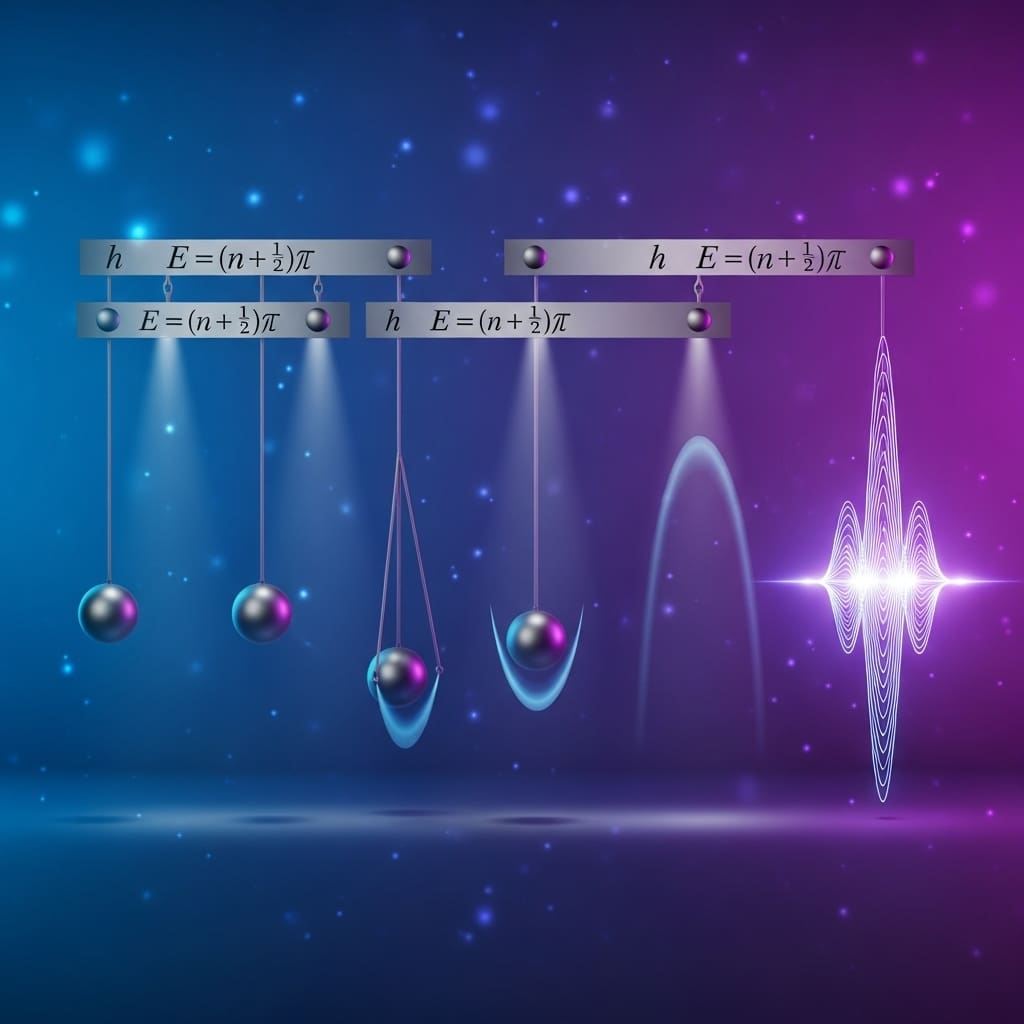
The behaviour of coupled harmonic oscillators, even at their lowest energy states, traditionally appears limited to simple, predictable patterns, but new research challenges this assumption. Safoura Mirkhalaf from the University of Warsaw, Helmut Ritsch and Karol Gietka from the University of Innsbruck demonstrate that measurable frequency shifts in these systems actually reveal underlying quantum properties. Specifically, the team shows these shifts act as a clear signature of ground-state entanglement and two-mode squeezing, a uniquely quantum correlation between the uncoupled oscillators. This discovery is significant because it establishes a direct link between a readily observable classical property, frequency, and a fundamental quantum phenomenon, offering a novel way to detect entanglement and potentially improve the precision of frequency measurements without requiring complex squeezed light sources. The research uncovers a surprising connection between classical and quantum realms, revealing how quantum features can persist even in systems considered to be on the boundary between the two.
They demonstrate that frequency shifts, arising from the interaction between oscillators, directly reflect the degree of squeezing present in the ground state, providing a measurable indicator of non-classical behaviour. Furthermore, the study establishes a clear connection between frequency shifts and the entanglement between the oscillators, showing that stronger entanglement corresponds to larger frequency shifts. This analysis confirms that observing these frequency shifts provides a practical method for characterizing both squeezing and entanglement in coupled harmonic oscillator systems, offering valuable insights for quantum information processing and fundamental quantum optics research.
Entanglement Revealed Through Zero-Temperature Frequency Shifts
This work demonstrates that coupled harmonic oscillators, even when cooled to their ground state, exhibit non-classical correlations and entanglement. Researchers challenged the conventional understanding of these systems by showing that observable frequency shifts act as a signature of these quantum effects. The study pioneered a method for detecting two-mode squeezing, a specific type of entanglement, between the uncoupled oscillator modes by analyzing these frequency shifts at zero temperature. Scientists established that frequency shifts and entanglement are different expressions of the same underlying phenomenon, accessible through standard frequency measurements. The team developed a technique to exploit this underlying squeezing to enhance signal-to-noise ratios in precision frequency measurements of individual oscillators, achieving improved sensitivity without requiring squeezed noise input, and circumventing the need for complex squeezed-state generation.
Ground State Entanglement via Frequency Shifts
Scientists have demonstrated that coupled harmonic oscillators, even in their ground state, exhibit genuinely quantum features beyond simple quantized energy levels. The research reveals that frequency shifts observed in these systems act as a signature of two-mode squeezing and entanglement between the uncoupled modes, a phenomenon not previously recognized in such systems. These shifts, arising from the coupling between oscillators, represent an underlying quantum correlation detectable through standard frequency measurements. The team mathematically describes the ground state of two coupled harmonic oscillators, showing it can be expressed in terms of a mixing angle, which reveals that the system’s behaviour is fundamentally entangled, even when it appears classical in certain representations. This analysis reveals that the system can be described as two decoupled harmonic oscillators, enabling quantum-enhanced sensing in a platform traditionally considered classical.
Squeezing Reveals Hidden Quantum Correlations
This research demonstrates that linearly coupled quantum harmonic oscillators, often considered essentially classical, can exhibit hidden quantum correlations detectable through measurable classical observables. Specifically, the team showed that frequency shifts induced by coupling between oscillators encode two-mode squeezing, a quantum phenomenon, between the original uncoupled modes. Importantly, these frequency shifts and the underlying squeezing represent the same physical effect expressed in different mathematical descriptions. The findings reveal a pathway to quantum advantage without requiring direct manipulation of quantum noise, instead leveraging the implicit squeezing already present in the system’s ground state. This approach achieves a signal-to-noise improvement that surpasses standard squeezing techniques, suggesting that encoding quantum resources within a system’s structure can be more efficient than externally imposing them. The research challenges the conventional understanding of squeezing, proposing that the metrological benefits typically associated with quantum squeezing can, in certain systems, manifest as classical frequency shifts.
👉 More information
🗞 Frequency shifts as a reflection of ground state squeezing and entanglement in two coupled harmonic oscillators
🧠 ArXiv: https://arxiv.org/abs/2511.03687


