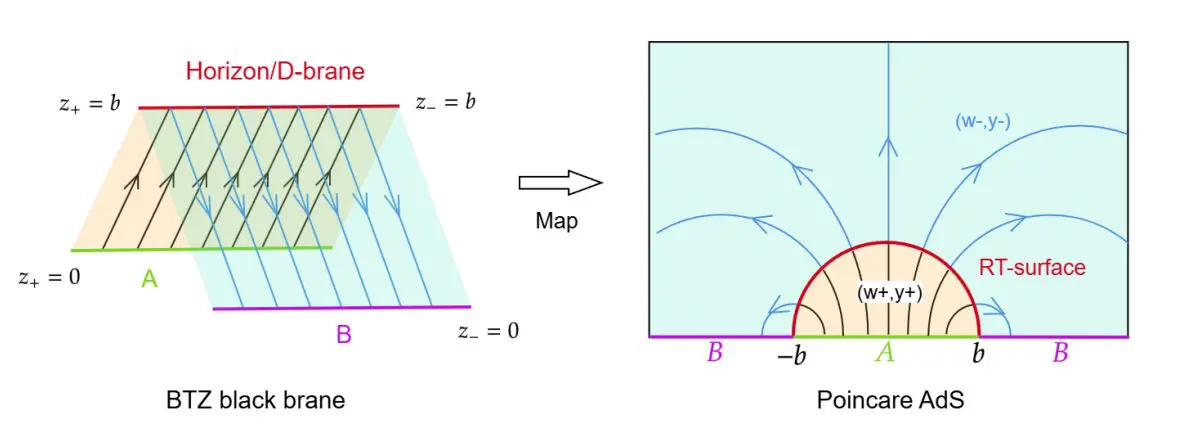
Entanglement, a fundamental property of quantum mechanics, increasingly appears central to understanding gravity and the structure of spacetime, and new research from Houwen Wu and Shuxuan Ying of Chongqing University, along with colleagues, proposes a novel theoretical framework connecting these seemingly disparate fields. The team develops an action, a mathematical description of how a quantity changes, specifically for entanglement entropy, within the established framework of the AdS/CFT correspondence, a powerful tool linking gravity in higher dimensions to quantum field theories. This work demonstrates that the laws of gravity emerge directly from this action, revealing a surprising connection between entanglement and spacetime geometry, and importantly, establishes a clear physical interpretation of ‘bit threads’, hypothetical connections between entangled particles. By linking the emergent string worldsheet description to the Ryu-Takayanagi formula for entanglement entropy, the researchers suggest a unified picture where key concepts like the Susskind-Uglum conjecture and the ER=EPR proposal are manifestations of a single underlying principle, and even propose a path towards refining existing conjectures about the nature of black hole interiors.
The team constructed an action, a set of rules governing the behaviour of entanglement entropy, and demonstrated that the equations describing AdS3 gravity emerge directly from it. This approach formulates a worldsheet theory, a description of string-like objects, that accurately captures the behaviour of entanglement entropy, offering a fresh perspective on the relationship between gravity and quantum information.
The action, when applied in specific conditions, reduces to a string worldsheet action incorporating a curved spacetime metric, an antisymmetric Kalb-Ramond field, and a dilaton. This connection reveals a clear physical interpretation of bit threads, hypothetical connections linking entangled particles. The research establishes a direct relationship between the emergent string worldsheet and the Ryu-Takayanagi surface, a geometric construct used to calculate entanglement entropy, providing new insights into its fundamental nature.
String Theory, Gravity and Holographic Principles
This compilation of research papers represents a comprehensive overview of modern theoretical physics, spanning string theory, quantum gravity, holography, and conformal field theory. The collection highlights a strong focus on foundational string theory and quantum gravity, including key works on the AdS/CFT correspondence and black hole physics. Several papers explore the connection between black hole entropy and entanglement entropy, a crucial area of investigation in theoretical physics.
A significant theme throughout the collection is String Field Theory, a framework for calculating interactions between strings. The work of several researchers demonstrates a growing interest in calculating higher-order string interactions and exploring non-perturbative aspects of string theory. The papers by Wang, Wu, and Yang suggest that entanglement is not merely a property of spacetime, but a fundamental ingredient in its creation.
The collection also addresses the black hole information paradox, exploring potential resolutions using string theory and entanglement. Hyperbolic geometry appears repeatedly, particularly in the context of String Field Theory, suggesting its potential role in understanding string interactions. This compilation reflects current research trends, including the use of machine learning in String Field Theory calculations and the exploration of non-perturbative approaches to string theory.
Entanglement Entropy, Open Strings, and Gravity’s Emergence
This research presents a novel action for entanglement entropy within the framework of the AdS/CFT correspondence, successfully deriving the equations governing AdS gravity directly from it. The team demonstrated that, in specific conditions, this action aligns with a string worldsheet action incorporating a symmetric spacetime metric, a Kalb-Ramond field, and a dilaton, thereby establishing a clear physical interpretation of bit threads. The work reveals a direct relationship between the emergent string worldsheet and the Ryu-Takayanagi surface, a geometric construct used to calculate entanglement entropy, providing new insights into its fundamental nature.
The findings demonstrate that entanglement entropy can be understood through open string charge, while Bekenstein-Hawking entropy arises from closed string charge, suggesting a unifying principle connecting several previously distinct concepts, including the Susskind-Uglum conjecture, open-closed string duality, and the ER=EPR proposal. Furthermore, the researchers propose a quantization of the Ryu-Takayanagi surface, potentially linking it to loop gravity and refining existing conjectures regarding entanglement entropy.
🗞 Towards a worldsheet theory of entanglement entropy
🧠 ArXiv: https://arxiv.org/abs/2511.16586