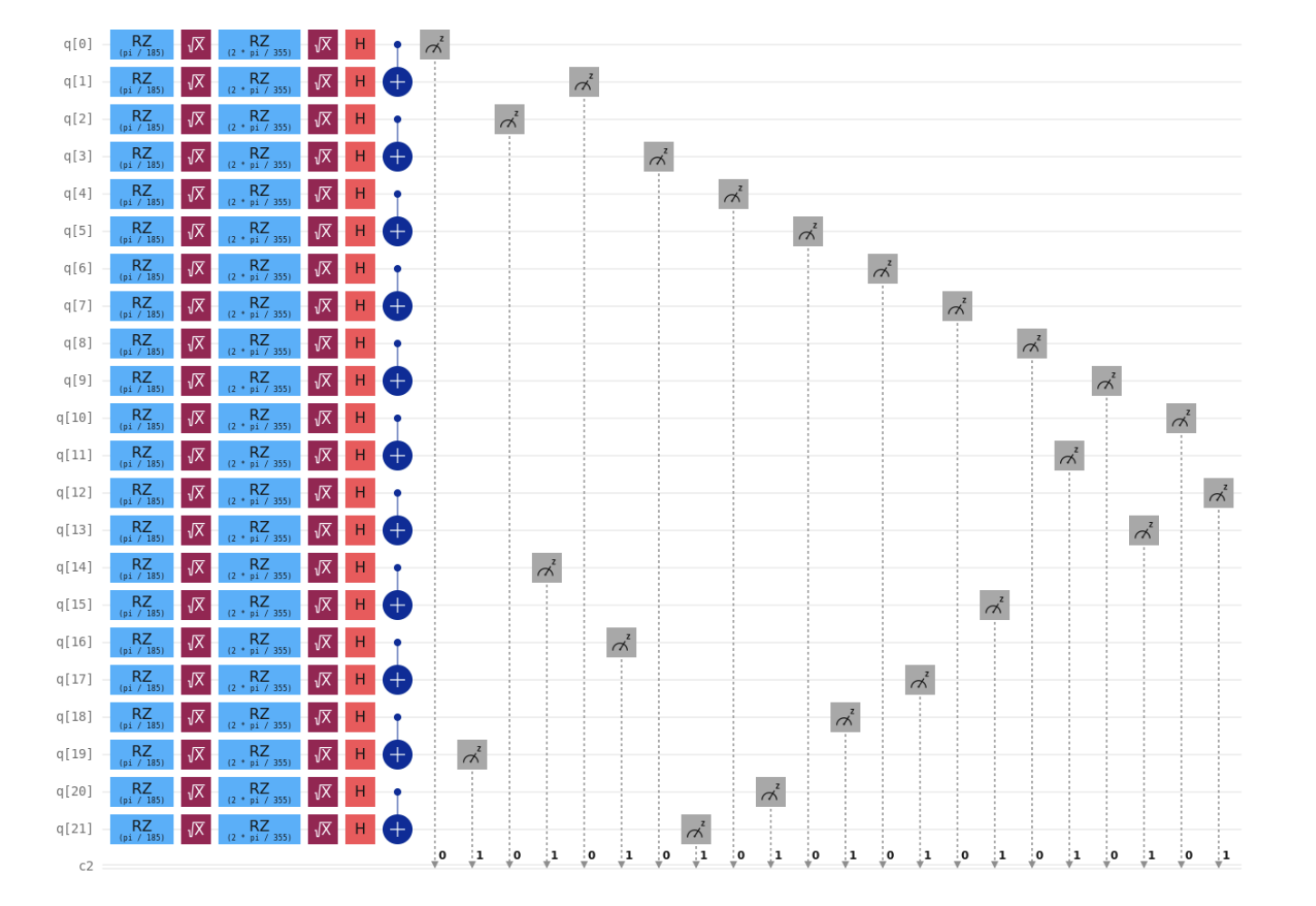
Quantum communication relies on the precise manipulation of entangled quantum states, and recent research focuses on assessing the performance of real quantum hardware for this purpose. J. Thirunirai Selvam and S. Saravana Veni, both from Amrita School of Physical Sciences at Amrita Vishwa Vidyapeetham, lead a study investigating quantum circuit performance on IBM’s Brisbane quantum processor. The team demonstrates the successful implementation of fundamental quantum gates and detailed analysis of entangled state evolution, crucial for secure information transfer and the development of quantum networks. By incorporating realistic conditions such as decoherence and noise into their simulations, the researchers provide valuable insight into the practical viability of these systems and their potential to simulate complex quantum models, ultimately advancing the field of quantum information science for both foundational research and future applications.
The study highlights the role of entanglement as a critical resource in quantum communication, enabling secure connectivity across quantum networks. Simulations incorporate realistic conditions, including decoherence and noise, to assess the practical viability of entangled-state operations, offering insight into complex interactions in superconducting architectures.
NISQ Qubit Control and Error Mitigation
This research comprehensively investigates advancements in quantum computing, particularly within the limitations of current technology. The focus lies on noisy intermediate-scale quantum (NISQ) devices, exploring hardware development, performance characterisation, and strategies to combat errors. The team investigates quantum algorithms for various computational tasks, including solving complex equations and analysing data, while also developing methods to verify the accuracy of quantum computations. Efforts to enhance qubit quality, achieving longer coherence times and more precise control, are ongoing.
The team successfully implemented error mitigation techniques, reducing the impact of noise on quantum computations, which is crucial for obtaining meaningful results from current devices. They also executed algorithms for solving equations and analysing graphs on quantum hardware, and developed techniques to validate the correctness of these computations. The research utilises superconducting qubits, artificial atoms created using superconducting circuits, and employs circuit quantum electrodynamics (cQED) to control and manipulate these qubits. Techniques like surface codes, error detection, and post-processing methods are used to combat noise, and randomized benchmarking is employed to characterise qubit and gate performance.
Gaussian boson sampling, a specific quantum algorithm, is also used to demonstrate quantum advantage, leveraging IBM’s open-source quantum computing framework, Qiskit. This research is significant because it brings us closer to realising the potential of quantum computers to solve problems intractable for classical computers, addressing the practical limitations of current technology. Future work will likely focus on improving qubit quality, scaling up quantum systems, developing more robust error correction codes, exploring new quantum algorithms, and combining the strengths of both quantum and classical computers.
👉 More information
🗞 Quantum Circuit Benchmarking on IBM Brisbane: Performance Insights from Superconducting Qubit Models
🧠 ArXiv: https://arxiv.org/abs/2508.05331