

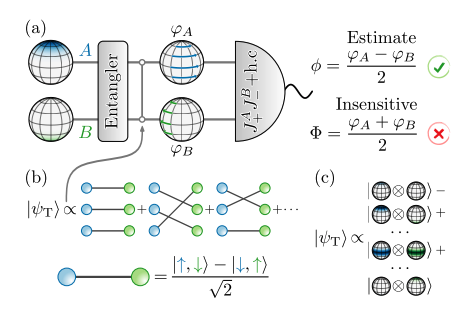
Researchers demonstrate a sensor network utilising entanglement to enhance precision measurement, surpassing the standard quantum limit and approaching the Heisenberg limit. The architecture intrinsically mitigates common-mode noise, maintaining robustness against local fluctuations, and achieving a measurable improvement in sensitivity through both unitary and dissipative state preparation.
The pursuit of increasingly sensitive measurement techniques drives innovation across diverse scientific fields, from gravitational wave detection to medical diagnostics. A new theoretical framework proposes a network of entangled sensors capable of surpassing conventional limitations in precision, specifically by mitigating the impact of pervasive common-mode noise which often plagues multi-particle sensing systems. This approach leverages the quantum mechanical phenomenon of entanglement to achieve sensitivities approaching the Heisenberg limit, a fundamental boundary in measurement accuracy. Raphael Kaubruegger, Diego Fallas Padilla, Athreya Shankar, Christoph Hotter, Sean R. Muleady, Jacob Bringewatt, Youcef Baamara, Erfan Abbasgholinejad, Alexey V. Gorshkov, Klaus Mølmer, James K. Thompson, and Ana Maria Rey detail their findings in a recent publication entitled “Lieb-Mattis states for robust entangled differential phase sensing”, outlining a sensor architecture utilising specifically prepared entangled states, known as Lieb-Mattis states, to enhance signal detection while maintaining robustness against environmental disturbances. Their work explores both unitary and dissipative methods for generating these states, demonstrating through numerical simulations the potential for scalable, enhanced sensing in noisy environments.
Precision measurement benefits significantly from advances in networked quantum sensors, which address limitations imposed by common-mode noise, a pervasive issue degrading the performance of entangled systems. Researchers develop a two-node sensor network specifically for differential signal estimation, effectively rejecting shared environmental disturbances while retaining robustness against local noise sources. This innovative architecture achieves sensitivities approaching the Heisenberg limit, a substantial improvement over classical standard quantum limit (SQL) performance. The SQL dictates that signal variance scales inversely with particle number; the Heisenberg limit, however, allows for a scaling inversely proportional to the square of the particle number, representing a fundamental enhancement in precision.
The research details two distinct strategies for generating
The research details two distinct strategies for generating entanglement, a quantum mechanical phenomenon where two or more particles become linked and share the same fate, between the sensor nodes, each offering unique advantages in implementation and performance. The first employs unitary entanglement generation, analogous to bosonic two-mode squeezing, a process where the uncertainty in one property of a quantum system is reduced at the expense of increased uncertainty in another. This theoretically achieves Heisenberg-limited sensitivity and maximises potential precision enhancement. The second strategy utilises dissipative preparation, relying on collective emission into a shared cavity mode, a resonant structure that enhances light-matter interaction. This offers a demonstrable improvement over the SQL and provides a practical alternative to unitary entanglement, which can be experimentally challenging to implement.
Numerical simulations validate the efficacy of both entanglement protocols under realistic conditions, including the presence of common-mode noise – disturbances affecting both sensors equally – and local, uncorrelated noise. These simulations confirm the network’s ability to mitigate detrimental environmental effects, demonstrating a clear advantage over single-sensor approaches. Researchers actively explore architectures leveraging entanglement to approach the Heisenberg limit, offering significant improvements in sensitivity for applications ranging from gravitational wave detection to biomagnetic field sensing. A key challenge addressed throughout the body of work concerns the inherent fragility of entangled states to noise, and this network architecture represents a significant step towards realising robust, high-precision quantum sensors.
👉 More information🗞Lieb-Mattis states for robust entangled differential
🗞 Lieb-Mattis states for robust entangled differential phase sensing
🧠 DOI: https://doi.org/10.48550/arXiv.2506.10151


