Entanglement, a key resource for next-generation technologies, promises to revolutionise communication and computation by exceeding the limitations of classical systems. Gustavo C. Amaral, Nienke M. ten Haaf, and Breno Perlingeiro, alongside a large collaborative team from institutions including The Netherlands Organization for Applied Scientific Research, Qunnect NL B. V., and SingleQuantum B. V., now demonstrate a significant step towards realising practical entanglement-based networks. They successfully distributed polarization-entangled photon pairs across a campus-scale network, integrating both fibre optic and free-space optical links. This achievement, built entirely with commercially available components, advances the technological maturity of quantum communication systems and paves the way for the deployment of early-stage networks, not only on Earth but also for potential applications in space.
Fiber and Free-Space Quantum Communication System
The KiQQer project demonstrates a system capable of both secure communication and extremely precise time synchronization. It employs a hybrid architecture, combining fiber optic links for local connections with free-space optical links for longer distances, potentially including satellite connections. Strong authentication is critical to the system’s security, utilizing hardware-based authentication to defend against attacks from future quantum computers. The system generates pairs of entangled photons using a specialized source operating at two wavelengths, one for quantum communication and another for classical timing signals.
Highly sensitive detectors capture these individual photons, enabling the transmission of quantum information. Fiber optics facilitate short-distance connections, while free-space optics extend the range, potentially enabling global connectivity. Precise clock synchronization is achieved using specialized modules, distributing a stable time reference across the network. This research demonstrates the principles of Quantum Key Distribution (QKD) and Quantum Time Transfer (QTT). Entanglement, a fundamental quantum phenomenon, links particles regardless of distance.
Physically Unclonable Functions (PUFs) create unique, device-specific security features, making them difficult to counterfeit. The system addresses threats posed by algorithms like Shor’s, by employing quantum-resistant authentication. Wavelength-Division Multiplexing (WDM) allows multiple signals to be transmitted simultaneously over a single fiber optic cable, increasing data capacity. The hybrid approach offers a practical path towards building scalable quantum communication networks. Hardware-based authentication is essential for protecting against attacks from quantum computers. The system demonstrates the feasibility of distributing a highly accurate time reference using entangled photons, potentially enabling secure and precise timing networks spanning continents, utilizing satellites as relays.
Daylight Quantum Network Distribution Demonstrated
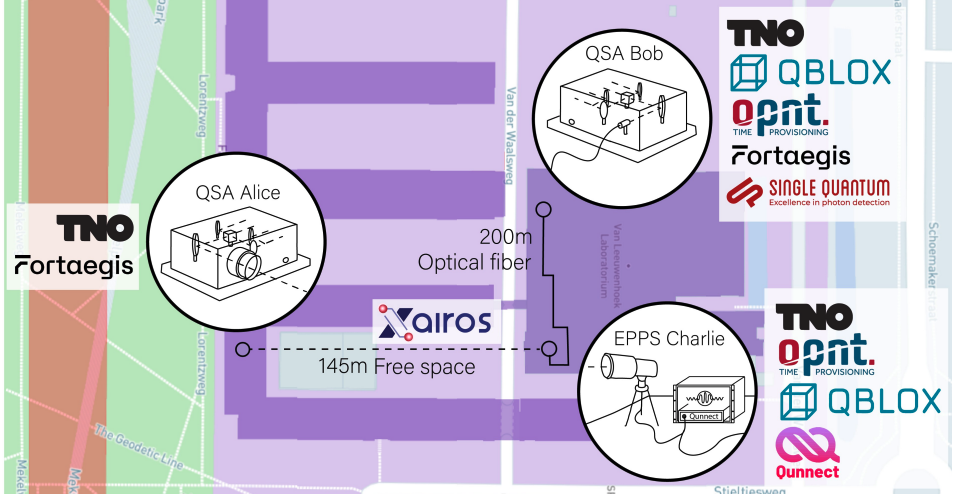
Researchers successfully distributed entangled photons across a three-node network within a campus environment, combining fiber optic and open-air connections. This achievement represents a significant step towards practical quantum communication networks, utilizing commercially available components to build a functioning system for both terrestrial and potentially space-based applications. A key innovation was the system’s ability to function effectively in daylight conditions, a major challenge for many quantum communication experiments. Researchers refined spectral filtering to reduce background noise, carefully narrowing the filter bandwidth to maximize the detection of quantum signals.
This was coupled with a data acquisition and processing system utilizing field-programmable gate arrays (FPGAs) to encrypt classical data alongside the quantum signals, demonstrating the potential for simultaneous secure communication and quantum key distribution. The researchers employed coincidence counting, looking for simultaneous detections of entangled photons at distant nodes, providing strong evidence of quantum correlation. This achievement confirms the feasibility of interconnecting quantum processors and enabling distributed computing for complex problems. The system successfully distributed polarization-entangled photon pairs, a fundamental resource for quantum technologies. The system incorporates advanced synchronization techniques, utilizing a “White Rabbit” protocol to maintain precise timing across the network, crucial for coordinating quantum operations. This combination of technologies demonstrates a comprehensive approach to building secure and reliable quantum networks. The demonstration achieved compatibility with first-generation quantum network applications, including entanglement-based quantum key distribution, quantum time transfer, and controlled physically unclonable functions. This compatibility indicates that the technology is maturing beyond laboratory experiments and towards practical deployment.
Campus Quantum Network Demonstrates Entanglement Distribution
This research successfully demonstrates the distribution of entangled photons across a campus-scale network incorporating both fiber optic and free-space optical links. The demonstrated system supports potential applications beyond secure communication, including high-throughput encryption using physically unclonable functions and precise quantum time transfer. Calculations suggest the network could, in principle, support data rates exceeding 60 Gbit/s when combined with encryption methods, and offers a pathway to secure and resilient timing solutions independent of traditional satellite infrastructure.
🗞 Hybrid Fiber-Free-Space Entanglement Distribution Using Off-the-Shelf Quantum Devices
🧠 ArXiv: https://arxiv.org/abs/2508.11023