The demand for secure and high-capacity communication networks necessitates the development of technologies capable of transmitting complex quantum states over significant distances. Recent research addresses this challenge by demonstrating the successful transmission of a four-qubit cluster state – a fundamental resource for quantum networking – across 25 kilometres of single-mode fibre. Philip Rübeling, Robert Johanning, and colleagues from the Institute of Photonics, Leibniz University Hannover, detail their findings in a paper entitled ‘Fiber transmission of cluster states via multi-level time-bin encoding’. Their approach utilises a novel method of encoding quantum information within the timing of photons, circumventing the need for complex optical components and paving the way for scalable, long-distance quantum communication networks.
Cluster state transmission represents a considerable technological hurdle, demanding innovative solutions to realise robust quantum networks and advanced information processing capabilities. Future telecommunication networks will likely rely on the transmission of complex quantum states to enable secure and transformative information processing, utilising the principles of quantum entanglement and superposition. Cluster states—multipartite entangled states that maintain entanglement even when subjected to local measurements—constitute a vital resource for networking applications, including blind photonic computing, quantum state teleportation, and all-photonic repeaters. Previous attempts to transmit these states over optical fibre have, however, encountered significant limitations, hindering the development of practical quantum networks.
This work demonstrates the first successful transmission of a four-qubit cluster state over 25 kilometres of single-mode fibre, marking a crucial step towards long-distance quantum communication and scalable quantum networks. The approach utilises a two-photon multi-level time-bin encoding scheme, enabling efficient and robust transmission of quantum information through optical fibres. The cluster state is directly generated by exploiting coherent control of a parametric generation process, circumventing the need for a resource-intensive controlled-phase gate, simplifying the experimental setup and improving overall efficiency.
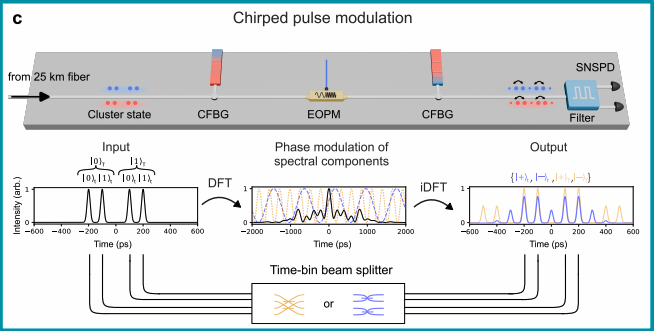
To enable efficient and reconfigurable projective measurements on the multi-level time-bin encoded state, chirped-pulse modulation is introduced, a technique that manipulates the temporal shape of light pulses to enhance measurement precision. The implementation of the first time-bin beam splitter, a crucial component for performing measurements on time-bin encoded qubits, allows selective routing and combination of different time-bin components of the quantum state. This enables certification of genuine multipartite entanglement, confirming strong correlations between all four qubits, and demonstration of one-way quantum computing operations.
The generation of entangled photons relies on spontaneous parametric down-conversion (SPDC), a nonlinear optical process where a pump photon is converted into two entangled daughter photons within a nonlinear crystal. Time-bin encoding, where quantum information is encoded in the arrival time of photons, is employed to enhance transmission fidelity. This method is particularly resilient to fibre dispersion, a phenomenon that broadens pulses as they travel, potentially destroying the encoded information.
Fiber loss and polarization drift pose significant challenges to long-distance quantum communication. Mitigation strategies include the use of low-loss fibres and polarization compensation techniques to minimise these effects and improve system performance. Polarization compensation actively monitors and corrects the polarization state of the photons, ensuring alignment throughout transmission. Maintaining the polarization state is critical, as any deviation degrades the entanglement.
The experimental setup comprises a source of entangled photons, a polarization controller, a single-mode fibre, and a detection system. The polarization controller adjusts the polarization state of the photons, ensuring alignment with the fibre’s polarization-maintaining axis. The single-mode fibre transmits the entangled photons over 25 kilometres, while the detection system measures their arrival time and polarization.
Optical components are carefully aligned and experimental parameters optimised to maximise entanglement fidelity and minimise noise and decoherence. Time-correlated single-photon counting (TCSPC) is used to measure photon arrival time, providing high timing resolution and sensitivity. A polarization analyser measures the polarization state of the photons, allowing characterisation of the entangled state.
The experimental results demonstrate the feasibility of transmitting complex entangled states over long distances using time-bin encoding and polarization compensation. The achieved fidelity of 0.83 confirms the high quality of the generated and transmitted entangled state, validating the approach.
Quantum repeaters, which extend transmission distance by establishing entanglement between shorter segments, and entanglement purification, which improves entangled state quality by removing noise, can further enhance performance. By combining these techniques, current limitations can be overcome, paving the way for a secure and reliable quantum internet with implications for secure communication, distributed computing, and fundamental science.
👉 More information
🗞 Fiber transmission of cluster states via multi-level time-bin encoding
🧠 DOI: https://doi.org/10.48550/arXiv.2507.01497