

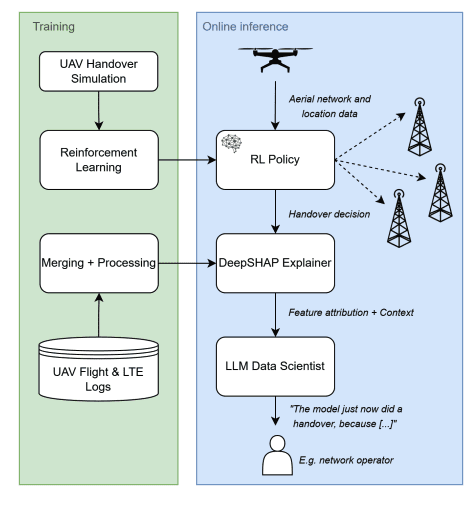
In a study published on April 25, 2025, titled Explainable AI for UAV Mobility Management: A Deep Q-Network Approach for Handover Minimization, researchers developed an XAI framework integrating SHAP to enhance the interpretability and reliability of reinforcement learning-based handover decisions in cellular networks supporting unmanned aerial vehicles.
The integration of unmanned aerial vehicles (UAVs) into cellular networks faces challenges due to frequent handovers caused by probabilistic line-of-sight conditions. To address this, reinforcement learning (RL)-based methods, particularly deep Q-networks (DQN), have been used to optimize handover decisions. However, the lack of interpretability in these models limits their practical application. This paper introduces an explainable AI (XAI) framework incorporating Shapley Additive Explanations (SHAP) to enhance transparency in DQN-based mobility management systems. By analyzing key features like reference signal received power (RSRP), RSRQ, buffer status, and UAV position, the framework provides interpretable insights into handover decisions. Real-world data from UAV trials validates the approach, demonstrating its ability to bridge the gap between AI-driven models and human decision-making through intuitive explanations.
Unmanned Aerial Vehicles (UAVs), or drones, are increasingly deployed across various applications, including delivery services, surveillance, and emergency response. However, effective management of UAV mobility remains a critical challenge, particularly in ensuring seamless connectivity and minimizing unnecessary handovers between communication networks. To address this, researchers have developed an innovative framework that integrates explainable artificial intelligence (XAI) with reinforcement learning to optimize UAV mobility decisions.
The proposed approach leverages deep Q-networks (DQN), a
The proposed approach leverages deep Q-networks (DQN), a type of reinforcement learning algorithm, combined with Shapley Additive Explanations (SHAP) to provide transparency into the decision-making process. This integration enhances the efficiency of UAV operations while ensuring that AI-driven strategies are understandable and trustworthy for human operators.
At the heart of this research is the use of SHAP values, a game-theoretic approach to explain model predictions. SHAP allows researchers to identify the most influential features in the decision-making process. By applying SHAP to a DQN-based handover strategy, the team quantified the impact of various factors such as buffer status, signal strength, and positional data on UAV mobility decisions.
The framework was tested using simulated environments, where the contributions of different features—such as buffer_queue_size (the amount of buffered data) and rsrp_0 (reference signal received power)—were analyzed to determine their influence on handover actions. The results demonstrated that positional data played a dominant role in shaping decisions, while other factors contributed more modestly but meaningfully to the overall outcome.
The research revealed several important insights into UAV mobility management:
First, integrating buffer status with traditional handover metrics significantly reduced unnecessary handovers, improving operational efficiency and reducing latency. This optimization ensures that UAVs maintain stable connections without frequent disruptions, which is critical for applications requiring continuous communication.
Second, the use of SHAP values provided a clear explanation of how different features influenced the model’s decisions. This transparency enhances trust in AI systems, enabling human operators to validate and adjust strategies as needed. By understanding the rationale behind each decision, operators can better manage UAV fleets and adapt to dynamic environments.
Third, the framework maintained reliable connectivity by prioritizing
Third, the framework maintained reliable connectivity by prioritizing handovers based on both immediate signal quality and longer-term buffer management. This balanced approach ensures seamless operations in dynamic environments, where UAVs must navigate changing conditions while maintaining communication links.
This research underscores the potential of explainable AI to transform UAV mobility management by combining advanced reinforcement learning techniques with transparent decision-making processes. By reducing unnecessary handovers while maintaining connectivity, the framework offers a practical solution for optimizing drone operations in real-world scenarios.
Looking ahead, the researchers plan to extend this work to multi-agent reinforcement learning, enabling coordinated mobility management across fleets of UAVs. This advancement could pave the way for more efficient and reliable drone operations, from urban delivery networks to large-scale surveillance missions.
The integration of SHAP values into AI systems not only enhances performance but also addresses a critical challenge in artificial intelligence: ensuring that complex decision-making processes are understandable and accountable. As UAV technology continues to evolve, such transparent and efficient solutions will be essential for unlocking its full potential.
🗞 Explainable AI for UAV Mobility Management: A Deep Q-Network Approach for Handover Minimization
🧠 DOI: https://doi.org/10.48550/arXiv.2504.18371


