The pursuit of high-temperature superconductivity has recently focused on lanthanum nickelate, a material exhibiting promising properties, and researchers are now gaining deeper insights into the mechanisms driving this phenomenon. Zeyu Chen from the Beijing Institute of Technology, Yu-Bo Liu from the Chinese Academy of Sciences, and Fan Yang, also from the Beijing Institute of Technology, and their colleagues have conducted a detailed study of a theoretical model describing this material, revealing a dominant form of interlayer pairing crucial for superconductivity. Their work employs a sophisticated computational technique, variational Monte Carlo simulation, to demonstrate that even with relatively weak interactions between layers, strong pairing persists, significantly exceeding predictions from simpler theoretical approaches. This finding highlights the importance of considering electron correlations, specifically through a process called Gutzwiller projection, which is often overlooked, and offers a new understanding of how superconductivity arises in these complex nickelate materials, potentially informing ongoing experiments with ultra-cold atoms.
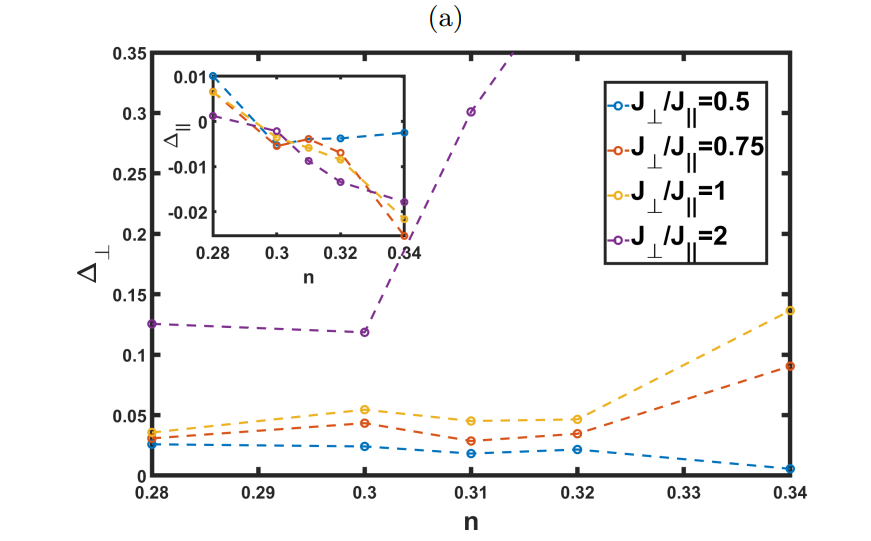
The electrons within the dx2−y2 orbital function as charge carriers, experiencing both intralayer and interlayer magnetic interactions. Researchers investigate this system using variational Monte Carlo simulation, revealing a dominant interlayer s-wave pairing mechanism, a crucial factor in achieving superconductivity. This pairing mechanism demonstrates significant improvement compared to those predicted by simpler theoretical approaches. In realistic materials, finite electron interactions reduce the strength of interlayer coupling, a factor that explains the limitations of simpler theories in describing high-temperature superconductivity.
Nickelate Superconductivity, Strong Coupling and Mechanisms
This compilation of research papers explores the emerging field of nickelate superconductivity, particularly focusing on La3Ni2O7 and related materials. The central question driving this research is how superconductivity arises in these nickelates, with investigations focusing on strong electron correlations and unconventional pairing symmetries. Researchers believe that Hund’s rule interactions, which favor high-spin states, are crucial in mediating the pairing, and that the hybridization between different nickelate orbitals is vital for the electronic structure. Several studies explore the role of magnetic fluctuations in mediating the pairing interaction, and the existence of bosonic modes and their connection to the superconducting gap are also under investigation.
Understanding the electronic structure, including band structure and Fermi surface topology, is fundamental, with researchers utilizing techniques like angle-resolved photoemission spectroscopy and theoretical calculations. A significant portion of the research involves developing theoretical models to describe the nickelate systems and predict their behavior, often solved using advanced computational techniques. Growing high-quality thin films and creating heterostructures is crucial for experimental studies, allowing researchers to control the electronic properties and explore new phenomena. Researchers are drawing parallels between nickelate superconductivity and other unconventional superconductors, such as cuprates and iron-based superconductors, and exploring the role of dimensionality and the potential for mixed-dimensional pairing.
Theoretical studies utilizing Quantum Monte Carlo, Hubbard models, and Density Matrix Renormalization Group investigate the role of strong correlations and magnetic interactions. Angle-resolved photoemission spectroscopy studies and investigations into electronic correlations and gap structure provide experimental insights. Research into thin films and heterostructures, including the growth and characterization of thin films, complements these theoretical and spectroscopic studies. Analog systems, such as ultracold atoms in optical lattices, are also being used to simulate nickelate systems and gain insights into the underlying physics.
The overwhelming consensus is that strong electron correlations play a crucial role in the superconductivity of these materials, and that conventional BCS theory is unlikely to fully explain the observed phenomena. Hund’s rule interactions and magnetic fluctuations are frequently invoked as key ingredients in the pairing mechanism. Modeling these strongly correlated systems is computationally challenging, requiring advanced techniques. Much of the experimental work is focused on thin films and heterostructures, which allow for better control of the material properties. This is a very active and rapidly evolving field, with new papers appearing frequently.
Interlayer Pairing Drives Nickelate Superconductivity
Scientists have achieved a significant breakthrough in understanding high-temperature superconductivity in bilayer nickelates, specifically La3Ni2O7. Their research focuses on the pairing mechanism responsible for this phenomenon, utilizing variational Monte Carlo simulations to model electron behavior within the material. Results demonstrate a dominant interlayer s-wave pairing, a crucial factor in achieving superconductivity, with substantial improvements in order parameters compared to predictions from simpler theoretical approaches. The team investigated the role of electron interactions and its impact on the strength of interlayer pairing.
Measurements confirm that even with relatively weak effective interlayer interactions, the interlayer pairing remains considerably large and comparable to the critical temperature observed experimentally. This finding challenges previous theoretical models, which struggled to explain superconductivity with such weak interlayer coupling. The data indicates that accurately accounting for electron correlations enhances the critical temperature, a factor often overlooked in simpler theories. Further analysis reveals that suppressing interlayer hopping, the movement of electrons between layers, actually promotes interlayer pairing. This observation aligns with the known weak interlayer hopping of the dx2−y2 orbital in La3Ni2O7, reinforcing its importance for achieving superconductivity. The research delivers a new perspective on the pairing mechanism in bilayer nickelates and provides valuable data for recent experiments utilizing ultra-cold atoms in mixed-dimensional systems.
🗞 Variation Monte Carlo Study on the bilayer model for La Ni O
🧠 ArXiv: https://arxiv.org/abs/2510.04224