The behaviour of electrons in nanoscale rings promises advances in spintronics and quantum computing, but achieving stable, persistent currents within these structures remains a significant challenge. Tie-Feng Fang from Nantong University, alongside Wei-Tao Lu and Ai-Min Guo from Central South University, with Qing-Feng Sun from Peking University, now demonstrates a surprising enhancement of these currents in specially designed rings composed of three interacting magnetic atoms. Their research reveals that ‘frustration’, a competition between different magnetic arrangements within the ring, actually boosts the current, creating a stronger and more stable flow of electrons. This discovery is important because it shows how carefully controlling the interactions between atoms can unlock new possibilities for manipulating electron flow at the nanoscale, potentially leading to more robust and efficient quantum devices.
The research demonstrates that fluctuations in charge can alter the ring’s aromaticity, driving transitions between different molecular states. The current increases as the interactions between the atoms are tuned, particularly when the system transitions between different magnetic arrangements. This enhancement suggests a novel mechanism for controlling current flow at the molecular level, potentially impacting the design of nanoscale electronic devices. The findings provide insights into the behaviour of frustrated magnetic systems and offer a pathway towards manipulating quantum states in molecular materials.
Persistent Currents in Frustrated Quantum Trimers
This research explores the behaviour of a frustrated trimer, a system of three interacting quantum structures. The central focus is on the emergence of persistent currents, which flow without an applied voltage, and the complex quantum mechanical effects that govern this behaviour. The team utilizes advanced computational techniques to model the system and understand its properties. This work connects to broader concepts in condensed matter physics, including the behaviour of electrons in strongly interacting materials, frustrated magnetism, and the quantum mechanical concept of aromaticity. A frustrated trimer is a system where the interactions between the three quantum structures are geometrically or energetically frustrated, leading to complex ground states and unusual behaviour.
Persistent currents arise from quantum mechanical effects and are related to the topology of the system. The Kondo effect describes how localized magnetic moments interact with conduction electrons, influencing the electrical resistance of materials. The Numerical Renormalization Group is a powerful computational technique used to study strongly correlated quantum systems, allowing researchers to accurately calculate their properties. The concept of aromaticity, traditionally used in chemistry to describe stable cyclic molecules, is extended to this quantum system, referring to a special type of electronic structure that leads to enhanced stability and unique properties.
The research demonstrates that persistent currents can emerge in the frustrated trimer due to the interplay of quantum mechanical effects. These currents are not driven by an external voltage but arise from the system’s internal interactions. The frustration in the trimer leads to a complex interplay between the Kondo effect and the emergence of persistent currents. The system exhibits behaviour that is different from a simple Kondo system. The strength of the interaction between electrons plays a crucial role in determining the system’s behaviour, with a strong but finite interaction being necessary to observe the persistent current.
The researchers draw an analogy between the electronic structure of the frustrated trimer and the concept of aromaticity in chemistry, noting that the system exhibits a special type of electronic structure that leads to enhanced stability and unique properties. The persistent currents are related to the topology of the system and the way the electrons circulate within it. The primary computational technique used to model the system and calculate its properties is the Numerical Renormalization Group. Perturbation theory and analytical calculations are used to supplement the numerical results and provide insights into the underlying physics.
This research is firmly rooted in condensed matter physics, specifically the study of strongly correlated quantum systems. The potential for using these systems as qubits, the building blocks of quantum computers, is mentioned, highlighting the connection to quantum computing. The analogy to aromaticity in chemistry provides a link to this field, and the topological aspects of the persistent currents connect to the field of topological materials. The key takeaway is that the frustrated trimer is a fascinating system that exhibits complex quantum mechanical behaviour. Persistent currents can emerge in this system due to the interplay of frustration, the Kondo effect, and topological effects. The research provides insights into the fundamental properties of strongly correlated quantum systems and their potential applications in quantum computing and other fields.
Tuning Magnetism Enhances Molecular Ring Current
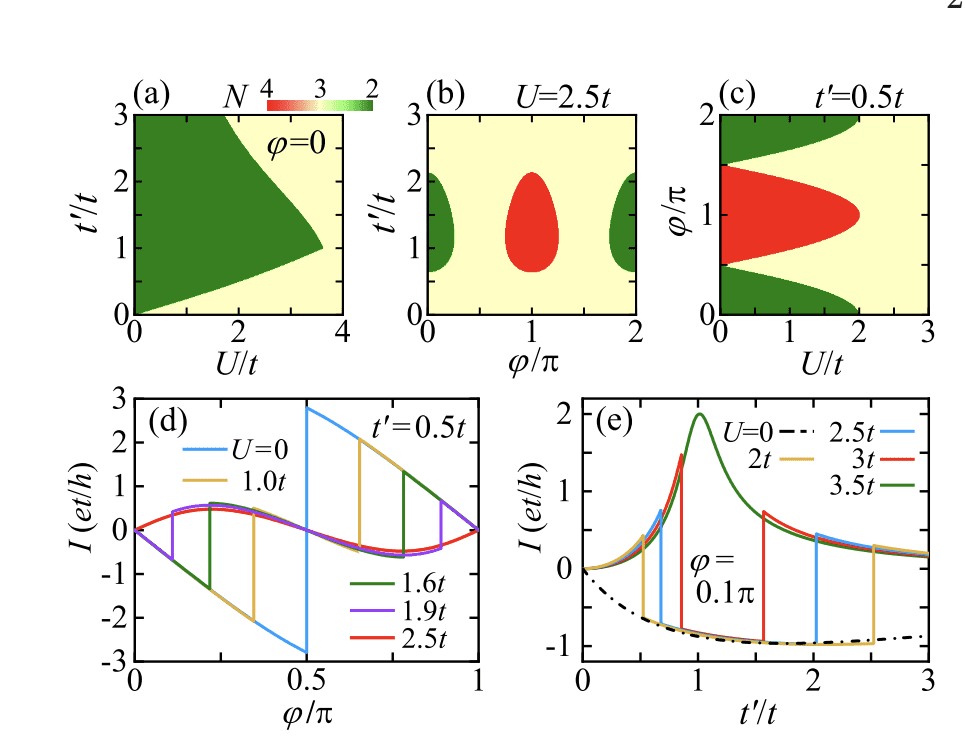
This research investigates persistent current within a molecular ring composed of three magnetic atoms situated on a metallic surface, and enclosing a magnetic flux. The team demonstrates that fluctuations in charge can alter the ring’s aromaticity, driving transitions between different molecular states. Importantly, the magnitude of the current exhibits an unusual enhancement when the interactions between the atoms are finely tuned, specifically at the point where the system transitions between ferromagnetic and antiferromagnetic arrangements. This peak in current is further complicated by a non-typical temperature dependence, initially increasing with temperature before eventually decreasing, which suggests a unique mechanism related to the Kondo effect.
The findings contribute to a deeper understanding of aromaticity in cyclic molecules, extending beyond traditional rules. They also offer insights into the behaviour of loop currents in more complex materials. Future research could explore the behaviour of similar rings with different atomic arrangements or materials, and investigate how these findings might be applied to the design of novel electronic devices or materials with tailored magnetic properties.
👉 More information
🗞 Frustration-enhanced persistent currents in correlated trimer nanorings
🧠 ArXiv: https://arxiv.org/abs/2509.03924