The pursuit of efficient, self-powered energy sources drives innovation in triboelectric nanogenerators, but achieving high charge density consistently presents a significant hurdle. Jia-Yao Ye, Susanta Chakraborty, Karthick Subramani, and colleagues at Nanjing University of Posts and Telecommunications address this challenge by introducing ferroelectric nematic liquid crystals as powerful charge boosters within these generators. Their research demonstrates that incorporating these unique materials dramatically enhances performance, achieving an impressive open-circuit voltage of 1. 1kV and a power density seven times greater than conventional designs. This breakthrough establishes a new platform for high-performance energy harvesting, effectively bridging the fields of soft matter physics and applied energy technologies, and paving the way for devices capable of powering hundreds of LEDs without external power management.
Ferroelectric Liquid Crystals Boost Generator Performance
This research details a novel approach to enhancing triboelectric nanogenerator (TENG) performance by incorporating a ferroelectric nematic liquid crystal (FNLC) into a polyvinylidene fluoride (PVDF) matrix. The key achievement lies in significantly improving charge generation and accumulation within the TENG, paving the way for more efficient energy harvesting. Researchers successfully integrated the FNLC into PVDF, creating a composite material that leverages the inherent piezoelectricity and ferroelectricity of the liquid crystal to boost performance. The resulting composite material exhibits a substantially higher charge density compared to pure PVDF.
This enhancement arises from a synergistic effect, where the FNLC’s piezoelectricity and ferroelectricity work in concert with the PVDF’s triboelectric properties. Furthermore, the FNLC’s polar domains align under mechanical stress during TENG operation, further enhancing polarization and charge accumulation. Importantly, the FNLC appears to reduce charge trapping within the PVDF matrix, leading to more efficient charge transfer and a higher overall output. The optimized TENG demonstrates a significant increase in both voltage and current generation. The composite material also exhibits improved mechanical stability and long-term performance, making it suitable for durable applications.
This research highlights the importance of minimizing charge trapping in TENG materials, and demonstrates that the FNLC acts as a charge carrier facilitator, increasing the efficiency of charge transfer. This work paves the way for developing high-performance TENGs with improved energy harvesting capabilities. These enhanced TENGs could power a wide range of small electronic devices, sensors, and wearable technology. The composite material’s flexibility makes it suitable for integration into flexible and wearable electronic applications. Moreover, the study provides valuable insights into the underlying mechanisms governing charge generation and transport in TENGs, contributing to the advancement of this field. In essence, this research demonstrates that incorporating ferroelectric liquid crystals into PVDF matrices is a promising strategy for significantly enhancing the performance and expanding the applications of triboelectric nanogenerators.
Ferroelectric Liquid Crystals Enhance Triboelectric Generator Performance
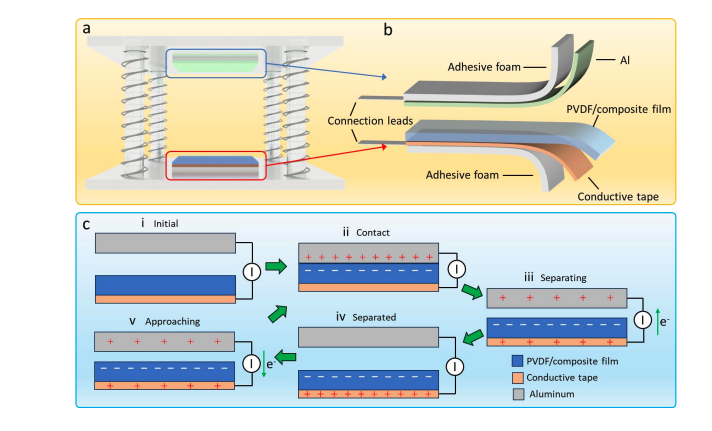
Researchers developed a novel method to enhance triboelectric nanogenerator (TENG) performance by incorporating ferroelectric nematic liquid crystals (NF-LCs) into a PVDF-based film. The system operates by inducing triboelectrification through periodic movement, causing a transfer of surface charges between materials. Upon separation, positive charges accumulate, driving electrons through an external circuit and generating a voltage pulse. The optimized composite film achieved an impressive open-circuit voltage of 1. 1kV, a substantial increase from the 257V generated by pure PVDF under the same conditions.
The short-circuit current also increased significantly, reaching 49. 2 microamps at a specific frequency, compared to 19. 8 microamps for pure PVDF. Furthermore, the study revealed a maximum power density of 110W/m2 for the composite film, seven times higher than that of pure PVDF. This work establishes a new platform for high-performance self-powered energy harvesting, linking soft matter physics with applied energy technology.
Ferroelectric Liquid Crystals Boost TENG Performance
Driven by the growing demand for clean energy, scientists have achieved a significant breakthrough in triboelectric nanogenerator (TENG) technology by incorporating a novel ferroelectric nematic liquid crystal (NF-LC) material. This work addresses the critical challenge of achieving high charge density in TENGs, demonstrating a substantial performance enhancement through the strategic addition of this unique material. Researchers introduced NF-LC as a functional filler within a PVDF-based TENG, progressively increasing the electroactive phase and effective polarization of the PVDF composite. This careful manipulation of material properties resulted in markedly improved electrical performance due to favorable dipolar alignment and strengthened charge-trap effects.
The optimized composite film achieved an impressive open-circuit voltage of 1. 1kV, a short-circuit current of 50 microamps, and a power density of 110W/m2, a seven-fold increase compared to pure PVDF. Experiments revealed that increasing the concentration of the NF-LC material directly correlated with enhanced surface charge density and improved triboelectrification performance. Measurements demonstrated that the open-circuit voltage progressively increased with increasing NF-LC concentration, while the short-circuit current also increased across a range of frequencies. Further analysis showed exceptional charge-storage capacity, successfully powering over 500 LEDs without the need for external power management circuitry. This breakthrough establishes NF-LC-based TENGs as a promising new platform for high-performance, self-powered energy harvesting, effectively bridging the gap between fundamental soft-matter science and applied energy technology.
Ferroelectric Liquid Crystal Boosts Nanogenerator Performance
This research demonstrates a significant advance in triboelectric nanogenerator technology through the incorporation of a ferroelectric nematic liquid crystal into a polymer dielectric material. By combining this liquid crystal with polyvinylidene fluoride, scientists have created a composite film exhibiting substantially enhanced electrical performance compared to conventional materials. Specifically, the optimized composite achieves an open-circuit voltage of 1. 1kV, a short-circuit current of 50 microamps, and a power density of 110W/m², representing a seven-fold increase over pure polymer films.
This improvement stems from the liquid crystal’s ability to promote dipolar alignment and strengthen charge-trapping effects within the composite material. The resulting nanogenerator exhibits both high power density under low-frequency mechanical stimuli and excellent stability, maintaining performance through over 16,000 mechanical cycles and directly powering 500 LEDs without requiring additional circuitry. This work establishes a new platform for high-performance, self-powered energy harvesting, linking the principles of soft matter physics with practical energy technologies and offering a versatile approach to developing next-generation flexible electronic devices.
🗞 Ferroelectric Nematic Liquid Crystals as Charge Boosters for Triboelectric Nanogenerators
🧠 ArXiv: https://arxiv.org/abs/2511.17202