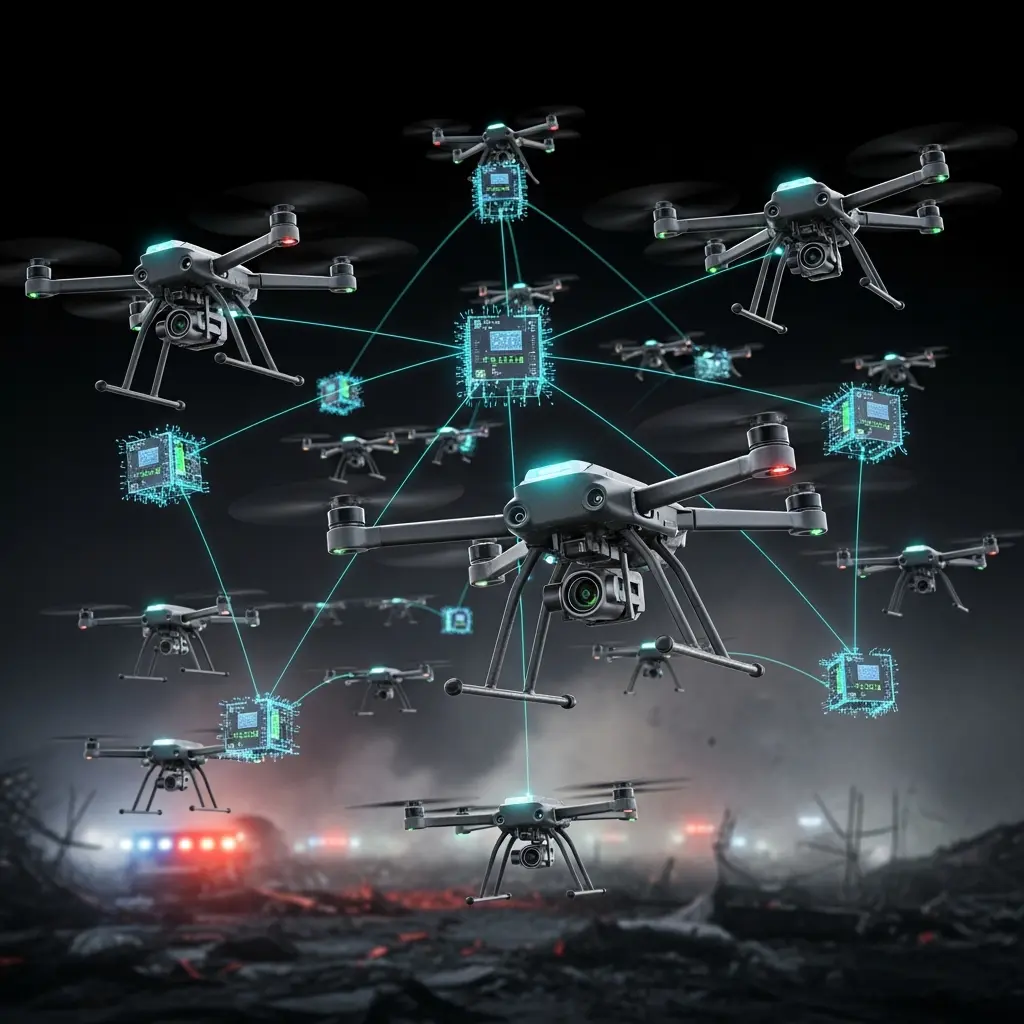
The need for adaptable and rapidly deployable networks is driving innovation in mobile edge computing and data collection, particularly in challenging environments lacking traditional infrastructure. Researchers Boxiong Wang, Hui Kang, Jiahui Li, et al. from Jilin University and Nanyang Technological University are addressing this demand with a novel system integrating low-altitude satellites and autonomous aerial vehicles (AAVs). Their work focuses on collaborative operation between these platforms to efficiently serve ground devices, simultaneously minimising latency and energy consumption while maximising data collection. This research is significant because it proposes a new approach to jointly optimise these competing demands in a dynamic environment, overcoming the limitations of onboard resources and fluctuating signal conditions. The team’s Q-weighted variational policy optimization-based joint approach, utilising diffusion models, demonstrably outperforms existing methods in simulated scenarios, paving the way for more effective aerial networks.
Their work focuses on collaborative operation between these platforms to efficiently serve ground devices, simultaneously minimising latency and energy consumption while maximising data collection.
This research is significant because it proposes a new approach to jointly optimise these competing demands in a dynamic environment, overcoming the limitations of onboard resources and fluctuating signal conditions. The team engineered a system integrating unmanned aerial vehicles (AAVs) with satellite networks to deliver simultaneous mobile edge computing (MEC) and data collection (DC) capabilities, particularly suited for challenging environments lacking terrestrial infrastructure.
Scientists formulated a joint optimisation problem designed to minimise average MEC end-to-end delay and AAV energy consumption, while simultaneously maximising the volume of collected data, a challenging non-convex mixed-integer nonlinear programming (MINLP) problem. To overcome this computational hurdle, the study pioneered a Q-weighted variational policy optimisation (QVPO)-based approach, controlling AAV movement, associating ground devices, making offloading decisions, and allocating bandwidth. The researchers cleverly reformulated the optimisation problem as a Markov decision process, adapting to variable action dimensions and hybrid action spaces, enabling effective decision-making in a dynamic environment.
Crucially, the team harnessed the multi-modal generation capabilities of diffusion models to optimise policies, achieving improved sample efficiency and controlling diffusion costs during the training phase. This innovative application of diffusion models represents a significant methodological advancement. Experiments employed a Gale-Sharpley (GS)-based ground device association strategy integrated within the DRL framework, further refining the QVPO algorithm. Simulation results demonstrate that the proposed QAGOB approach outperforms five benchmark algorithms, achieving improvements of 11.48% in MEC delay and 13.99% in collected data volume.
The research highlights the advantages of jointly optimising MEC and DC, demonstrating significant gains compared to separate optimisation of each function. This integrated approach delivers a systematic framework for satellite-AAV joint MEC-DC scenarios, offering a robust and stable solution under diverse and randomised conditions, and paving the way for resilient and efficient data networks in remote or disaster-affected areas.
AAV Movement and MEC Optimisation Achieved
The convergence of autonomous aerial vehicles (AAVs) and mobile edge computing (MEC) is proving essential for applications demanding wide coverage and rapid deployment, particularly in areas lacking terrestrial infrastructure. This research details a system where AAVs collaborate with ground devices (GDs) to simultaneously provide MEC services and data collection capabilities. Scientists formulated a joint optimization problem designed to minimise average MEC end-to-end delay and AAV energy consumption, while maximising the volume of collected data.
The work addresses the challenges of limited on-board resources and dynamic channel conditions inherent in heterogeneous AAV systems. Experiments revealed a novel Q-weighted variational policy optimization-based joint AAV movement control, GD association, offloading decision, and bandwidth allocation (QAGOB) approach. Researchers reformulated the complex optimization problem as a Markov decision process, adapting to variable action dimensions and a hybrid action space.
QAGOB leverages the multi-modal generation capacities of diffusion models to optimise policies, achieving improved sample efficiency and controlled diffusion costs during training. Measurements confirm that this approach significantly outperforms five benchmark algorithms, including both traditional deep reinforcement learning and diffusion-based deep reinforcement learning methods. The team measured substantial performance gains through the joint optimisation of MEC and data collection, demonstrating advantages over separate optimisation of each function.
This study highlights the potential of integrated aerial and space networks, where AAVs and satellites complement each other to deliver on-demand communications, adaptive data collection, and dynamic MEC services. The research addresses the conflicting requirements of latency-sensitive MEC tasks and high-throughput data collection, optimising resource allocation under dynamic network conditions. Specifically, the developed system tackles the trade-offs between AAV movement for latency reduction and maintaining data rates, as well as balancing task processing and energy consumption.
Results demonstrate the ability of the QAGOB approach to navigate a high-dimensional decision space and adapt to rapidly changing operational environments, paving the way for advanced 6G network applications in areas like uncrewed mining, remote environmental monitoring, and post-disaster rescue operations. This breakthrough delivers a robust framework for coordinating aerial and satellite resources to meet the dual demands of computation and data transmission.
QAGOB Optimises AAV Networks for Speed and Efficiency
This research presents a novel approach to optimise joint mobile edge computing (MEC) and data collection (DC) within a network utilising unmanned aerial vehicles (AAVs). The authors developed a Q-weighted variational policy optimisation-based joint AAV movement control, ground device association, offloading decision, and bandwidth allocation (QAGOB) method to minimise both MEC end-to-end delay and AAV energy consumption, while simultaneously maximising data collection.
By reformulating the problem as a Markov decision process and leveraging diffusion models, QAGOB demonstrates improved sample efficiency in policy optimisation. Through simulations, the team demonstrated that QAGOB significantly outperforms existing benchmarks, including traditional and diffusion-based deep reinforcement learning algorithms. Specifically, the proposed method achieved improvements of 11.48% in MEC delay and 13.99% in collected data volume, alongside reduced AAV energy consumption, when compared to separate optimisation of MEC and DC.
The authors acknowledge that the performance of their approach is dependent on accurate modelling of the dynamic channel conditions and the computational complexity of the diffusion models employed. Future work could explore extending the framework to more complex scenarios, such as incorporating three-dimensional AAV movements or addressing the challenges of unpredictable environmental factors.
👉 More information
🗞 Low-Altitude Satellite-AAV Collaborative Joint Mobile Edge Computing and Data Collection via Diffusion-based Deep Reinforcement Learning
🧠 ArXiv: https://arxiv.org/abs/2601.07307