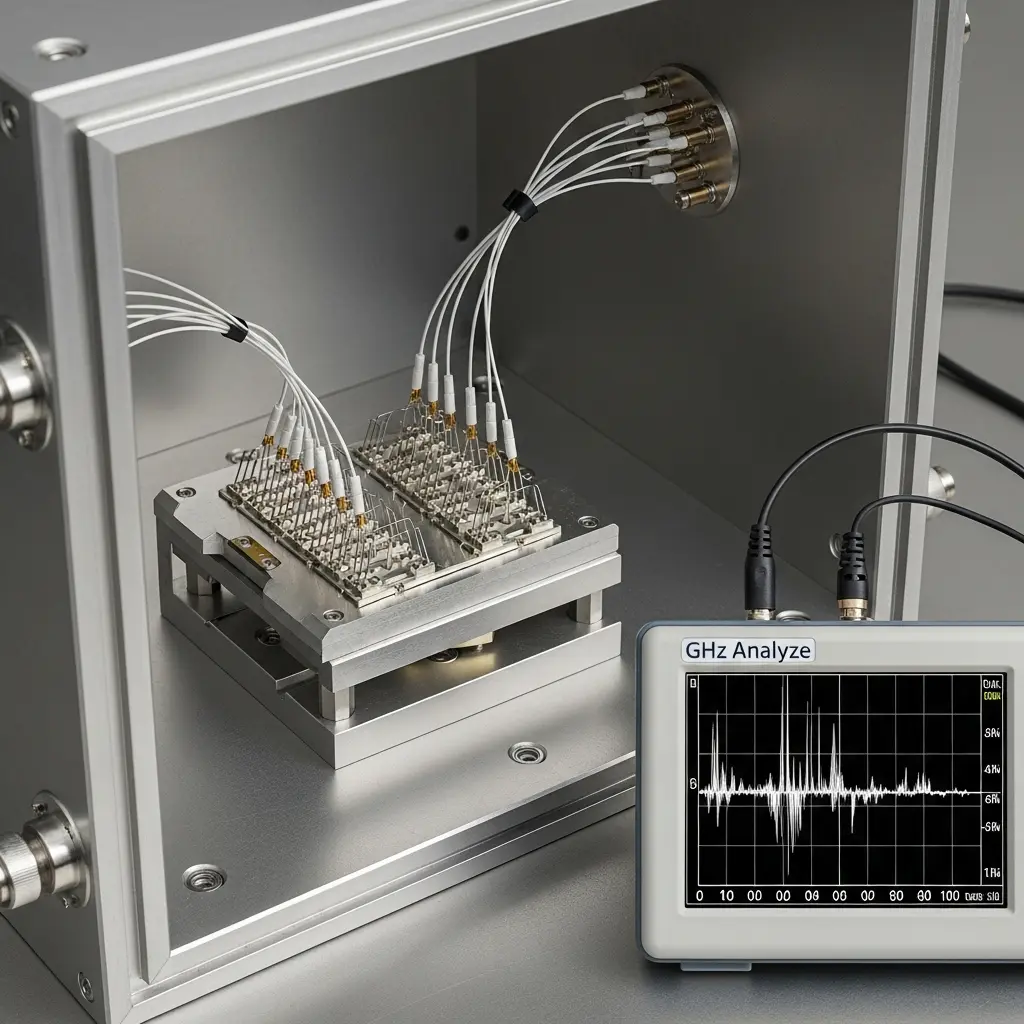
Researchers are actively seeking materials that outperform existing options for high-frequency acoustic devices, and recent work focuses on alloys that enhance piezoelectric properties. Laura I. Wagner, Verena Streibel, and Esperanza Luna, alongside colleagues from Technical University of Munich and Paul-Drude-Institut für Festkörperelektronik, investigate aluminum hafnium nitride (AlHfN) as a cost-effective and potentially CMOS-compatible alternative to existing materials. The team successfully creates AlHfN thin films with significantly enhanced piezoelectric responses, achieving nearly a two-fold increase in the piezoelectric coefficient compared to aluminum nitride. This breakthrough enables the fabrication of high-performance GHz surface acoustic wave resonators and efficient bulk acoustic wave excitation, establishing AlHfN as a promising material for next-generation electromechanical devices and opening avenues for further improvements in piezoelectric performance through advanced film growth techniques.
Flashar, Tsedenia A. Zewdie, Saswati Santra, Ian D. Wagner, Esperanza Luna, Katarina S. Flashar, Walid Anders, Nicole Volkmer, Doreen Steffen, Frans Munnik, Tsedenia A. Zewdie, Saswati Santra, Ian D. Sharp, Mingyun Yuan, Physics Department.
Nitride Thin Films via Reactive Sputtering
Ternary compounds created using reactive sputtering exhibit promising characteristics for piezoelectric thin film applications, particularly in devices that utilise surface and bulk acoustic waves. This research focuses on the synthesis and characterisation of aluminium hafnium nitride, aluminium nitride, and aluminium scandium nitride. Reactive sputtering allows precise control over the composition and structure of the resulting films by introducing nitrogen gas during deposition. Film composition is carefully tuned by adjusting gas flow rates, sputtering power, and substrate temperature. Post-deposition annealing further enhances crystallinity and optimises the piezoelectric properties of the films.
Material characterisation encompasses techniques such as X-ray diffraction to assess crystal structure and phase purity, and energy-dispersive X-ray spectroscopy to determine elemental composition. Piezoelectric properties are evaluated using RF resonator measurements, which determine key parameters like the electromechanical coupling coefficient and resonant frequency. The investigation explores how compositional variations impact the resulting material properties and device performance.
AlN Acoustic Wave Material Properties and Simulations
This research details the theoretical background, material properties, and simulation methods used to model acoustic wave behaviour in materials like aluminium nitride and its alloys. The study employed the finite element method, a numerical technique used to solve equations governing wave propagation, using GetDP and Gmsh software. Simulations distinguish between surface acoustic waves, which remain confined to the surface and propagate at high velocities, and bulk acoustic waves, which penetrate deeper into the substrate and travel at lower velocities. The research team refined crucial material parameters, including stiffness constants, piezoelectric stress constants, dielectric constants, and density, to improve the accuracy of their models.
Hafnium Boosts Piezoelectric Performance in Aluminum Nitride
This research demonstrates that incorporating hafnium into aluminium nitride creates aluminium hafnium nitride, a material with significantly enhanced piezoelectric properties compared to standard aluminium nitride. The team successfully grew thin films of this compound and observed a near two-fold increase in the piezoelectric coefficient, a measure of a material’s ability to generate electricity from mechanical stress. X-ray absorption spectroscopy revealed that the hafnium and nitrogen atoms interact in a way that boosts the material’s electrical charge, contributing to this improved piezoelectric response. Researchers fabricated surface acoustic wave resonators using aluminium hafnium nitride, demonstrating enhanced performance and efficient acoustic wave propagation. These results establish aluminium hafnium nitride as a promising material for next-generation high-frequency devices, offering a potentially scalable and CMOS-compatible alternative to other piezoelectric materials. Despite some structural disorder within the films, the material exhibits substantial performance improvements, suggesting that further refinements in growth techniques could unlock even greater piezoelectric enhancements.
🗞 Al Hf N Thin Films with Enhanced Piezoelectric Responses for GHz Surface Acoustic Wave Devices
🧠 ArXiv: https://arxiv.org/abs/2511.18970