

Optically levitated particles represent a promising avenue for developing highly sensitive sensors and exploring fundamental physics, but achieving precise control over these systems remains a significant challenge. Shah Jee Rahman, Quimey Pears Stefano, and colleagues at multiple institutions now demonstrate a method for manipulating the motion of levitated particles using carefully shaped laser beams. The team systematically investigates how structuring the wavefront of the trapping laser impacts particle stability and frequency control, revealing a trade-off between longitudinal and transversal frequencies. This research establishes a pathway to optimise trapping potential, reduce unwanted disturbances like optical backaction and thermal decoherence, and ultimately enhance the performance of optically levitated particle systems for both precision measurement and fundamental mechanical studies.
Wavefront Control for Stable Optical Levitation
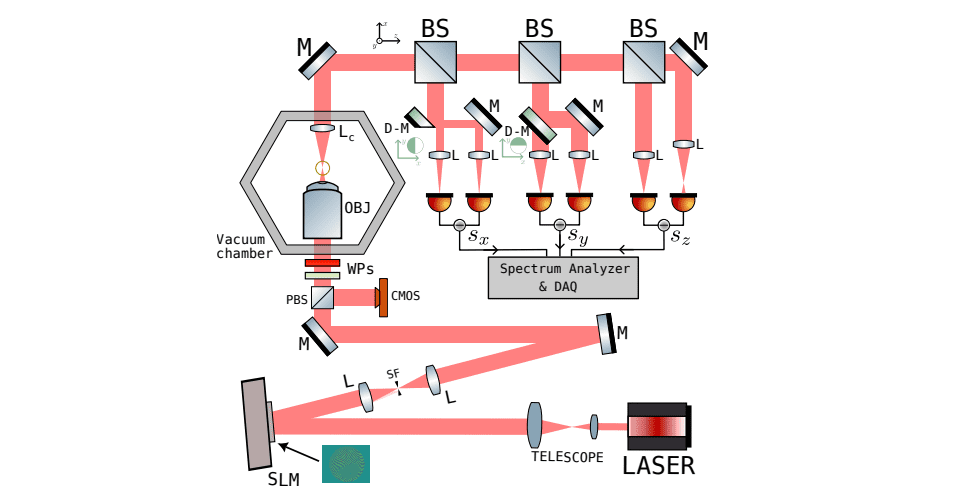
Scientists engineered a sophisticated optical levitation setup to meticulously study and optimize the trapping of single silica nanoparticles in vacuum. The study pioneered a method to control wavefront aberrations, a critical challenge in achieving stable and precise particle manipulation. Researchers implemented a levitation system utilizing a tightly focused infrared laser beam directed through a high numerical aperture objective lens, positioning the trapping force against gravity to ensure stable particle confinement and allow for measurements free from environmental disturbances. To shape the wavefront of the trapping field, the team employed a phase-only liquid crystal on silicon spatial light modulator in an off-axis configuration.
By systematically applying different holograms programmed onto the SLM, scientists independently controlled various wavefront aberrations using Zernike polynomials, a standard method for describing optical distortions. The experimental procedure involved trapping a particle and reducing the chamber pressure to a few hectopascals, then recording the Power Spectral Densities (PSDs) of the particle’s motion to measure the resonant frequencies along each axis. This allowed for a comprehensive exploration of how aberrations influence the optical trap. To complement the experimental work, scientists utilized Generalized Lorentz-Mie Theory to theoretically calculate optical forces, frequencies, and ratios for a range of particle sizes, providing a complete model for complex optical traps and enabling a direct comparison with experimental results.
By comparing theoretical predictions with experimental observations, the team developed a full description of optical aberrations and a method to control or compensate for them. The study revealed that maximizing the longitudinal frequency achieves optimal beam configuration, while the ratio of transverse to longitudinal frequencies serves as a robust figure of merit for assessing trapping beam quality, independent of laser power and particle size. This innovative approach provides a comprehensive overview of aberrations in optical levitation and a practical recipe for achieving optimal beam configurations tailored to specific experimental needs.
Optimized Optical Trap Performance via Frequency Ratios
Scientists have developed a novel method for assessing and optimizing the quality of optical traps used for levitating particles, with implications for enhanced sensing and fundamental studies of mechanics. The research focuses on analyzing the ratios of a particle’s frequencies of motion, allowing for independent evaluation of trap performance regardless of optical power or, for sufficiently small particles, particle size. Through a combination of theoretical calculations and experimental studies using structured wavefronts, the team demonstrated a trade-off between maximizing longitudinal and transverse frequencies within the optical trap. The findings reveal that achieving the highest longitudinal frequency requires a clean, unaberrated wavefront, while maximizing transverse frequency necessitates a slightly aberrated beam. Researchers accurately predicted these frequency ratios using the Generalized Lorenz-Mie Theory, establishing a reliable method for evaluating beam quality and correcting aberrations, starting with astigmatism and progressing through symmetric Zernike polynomials. This work paves the way for well-optimized trapping potentials, particularly for complex materials, and offers a means to tailor beam profiles for diverse quantum applications, including stable levitation in high vacuum, embedding materials with emitters, and exploring quantum superposition.
Wavefront Control Optimizes Levitated Nanoparticle Trapping
Scientists have achieved significant advancements in optically levitated particle technology, demonstrating a method to optimize trapping potential and reduce decoherence. The research focuses on controlling wavefront aberrations, which arise from optical elements and misalignment, and their impact on the quality of optical traps for single silica nanoparticles in vacuum. Experiments reveal that carefully structuring the wavefront of trapping beams allows for optimization of longitudinal frequencies, albeit at the cost of transversal frequencies. The team implemented a levitation setup using an infrared laser beam focused through a high numerical aperture objective lens in vacuum, with the trapping scheme aligned against gravity.
A phase-only liquid crystal on silicon spatial light modulator was used to shape the wavefront, and the Power Spectral Densities of trapped particles were recorded at reduced pressures, typically a few hectopascals. By independently controlling wavefront changes using Zernike polynomials, scientists fully explored the role of aberrations on the optical trap. Measurements demonstrate the ability to precisely control the resonant frequencies of the particle’s center-of-mass motion, achieving a detailed understanding of how aberrations affect the trapping efficiency. This work establishes a method for optimizing optical traps for spherically shaped particles, paving the way for advancements in force sensing, with demonstrated sensitivity up to 10−21N, and fundamental studies of quantum mechanics. The breakthrough delivers a means to reduce optical backaction and thermal decoherence, potentially enabling the realization of quantum superposition of non-Gaussian states and tests of wave-function collapse models.
👉 More information
🗞 Controlling the centre of mass motion of levitated particles using structured wavefronts
🧠 ArXiv: https://arxiv.org/abs/2510.17654


