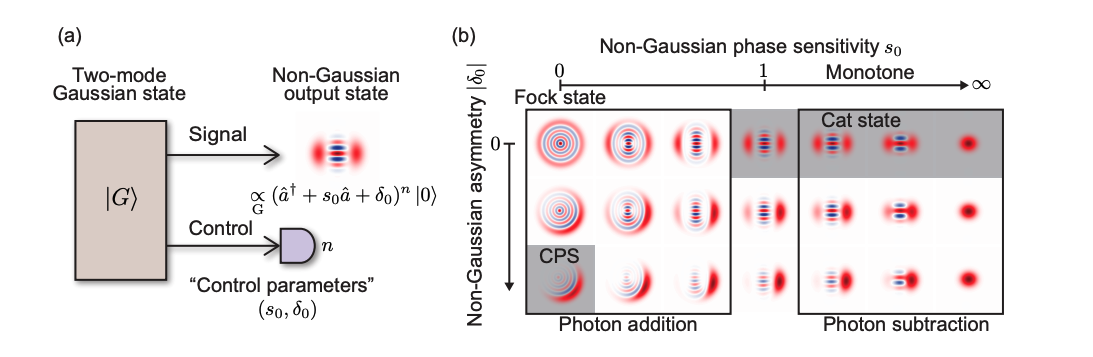
Non-Gaussian states of light represent a crucial component for advancements in quantum technologies, holding immense potential for universal computation, robust error correction, and highly sensitive sensing, yet creating these states remains a significant challenge. Fumiya Hanamura, Kan Takase, and Hironari Nagayoshi, along with their colleagues, now present a new approach to overcome these hurdles, introducing ‘non-Gaussian control parameters’ that offer a more effective way to measure and optimise the generation of these complex states. This method moves beyond traditional benchmarks, such as stellar rank, by providing a continuous and practical measure of non-Gaussianity, and importantly, dramatically reduces the resources needed for successful state creation. Demonstrations across a range of states, including cat states and GKP states, reveal that this technique cuts required photon detections by a factor of three and boosts preparation probability, paving the way for more feasible and scalable quantum technologies and fault-tolerant computation.
Their practical realisation, however, faces significant hurdles, as simulating large multi-mode generators is computationally demanding. Existing benchmarks inadequately capture how effectively photon detections yield useful non-Gaussianity. This research addresses these challenges by introducing non-Gaussian control parameters, a continuous and operational measure designed to improve the characterisation and control of these complex quantum states, potentially enabling more efficient and effective quantum technologies.
Photon-Number Reduction and State Optimisation
Scientists have developed a new method for optimising the generation of several non-classical quantum states, including Schrödinger cat states, Gottesman-Kitaev-Preskill (GKP) states, and random states. The process involves a two-step approach: first, reducing the number of photons needed to create the state, and second, maximising the probability of successfully generating it. This optimisation significantly improves the efficiency and feasibility of quantum experiments. Detailed analysis reveals substantial changes in the parameters used to generate these states after applying the optimisation algorithm, demonstrating its effectiveness.
The results show a dramatic improvement in the probability of generating these states, particularly for complex random states. For example, the probability of creating a random state increased significantly, representing a substantial leap forward. The optimisation process involves carefully tuning multiple parameters, reflecting the complexity of these quantum states, and considers the order of position and momentum quadratures, crucial aspects of continuous-variable quantum information.
Efficient Non-Gaussian State Generation via Optimisation
Scientists have developed a new approach to generating non-Gaussian states of light, essential for advancements in quantum computation, error correction, and sensing technologies. Their work addresses the computational demands of simulating complex multi-mode generators and the limitations of existing benchmarks for assessing non-Gaussianity. Researchers introduced non-Gaussian control parameters, a continuous and operational measure that quantifies how efficiently photon detections contribute to useful non-Gaussianity. The team’s breakthrough centers on a universal optimization method that significantly reduces the number of photons required and greatly enhances the probability of successfully generating these complex states, all while maintaining state quality.
Applying this method to the generation of Gottesman-Kitaev-Preskill (GKP) states, scientists cut the required photon detections by a factor of three and increased the preparation probability by nearly 108, representing a substantial leap forward in efficiency. This optimisation isn’t limited to GKP states; experiments with cat states, cubic phase states, and even random states consistently demonstrate broad gains in experimental feasibility. Results demonstrate that the new non-Gaussian control parameters provide a more complete picture of non-Gaussian resources than traditional benchmarks, effectively capturing how efficiently non-Gaussianity is harnessed during state generation. The optimisation algorithm systematically improves state generators by minimising photon detections and maximising success probabilities, preserving essential non-Gaussian features like squeezing.
Comparable gains were observed across multiple state types, with photon requirements reduced threefold and success rates improved by up to seven orders of magnitude. This research establishes a new design principle for scaling state-of-the-art architectures, paving the way toward practical, fault-tolerant quantum computation and unlocking the full potential of optical quantum technologies. By providing a unifying principle for resource-efficient non-Gaussian state generation, scientists have charted a clear path toward scalable quantum systems with enhanced performance and reduced complexity.
Efficient Generation of Non-Gaussian Quantum States
This research introduces a new framework for generating non-Gaussian states of light, crucial for advanced technologies like quantum computing and sensing. The team developed non-Gaussian control parameters, a method for evaluating and improving the efficiency of generating these states. Applying this framework, they demonstrate a significant reduction in the number of photons required, by up to a factor of three, and a corresponding increase in the probability of successfully creating these states across several key examples, including Schrödinger cat states, cubic phase states, and GKP states. These findings offer a practical pathway to improving existing experiments and enhancing the feasibility of scalable optical quantum technologies. The authors acknowledge that their current analysis focuses on ideal conditions and that accounting for real-world errors like photon loss is an important next step. Future research will also explore the connection between optimising these state generators and the broader question of computational complexity, potentially offering insights into the boundary between classically simulable and quantum-advantageous regimes.
🗞 Beyond Stellar Rank: Control Parameters for Scalable Optical Non-Gaussian State Generation
🧠 ArXiv: https://arxiv.org/abs/2509.06255