

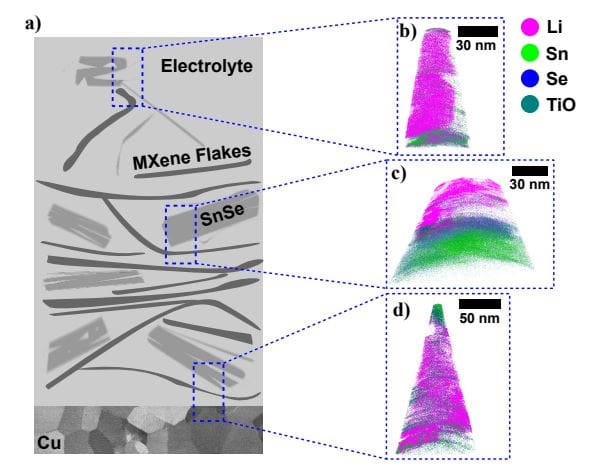
Understanding how lithium-ion batteries degrade remains a central challenge in the pursuit of sustainable energy, and researchers are actively investigating new materials to improve battery lifespan. Lukas Worch, Kavin Arunasalam, and Neil Mulcahy, alongside colleagues from Imperial College London and the Max Planck Institute for Sustainable Materials, have now probed the behaviour of tin selenide, a promising battery anode material, at the nanoscale. Their work reveals previously unseen degradation mechanisms occurring at the interface between the solid electrode and the liquid electrolyte, demonstrating that significant chemical changes, including the surprising corrosion of copper from the current collector and subsequent ion migration, contribute directly to capacity fading. By combining advanced cryogenic focused ion beam imaging with cryogenic atom probe tomography, the team provides critical insights into the complex processes governing battery degradation, paving the way for the design of more durable and stable next-generation battery materials.
Atomic Scale Mapping of Battery Degradation
This research centers around characterizing materials within lithium-ion batteries and emerging technologies at the atomic scale to understand degradation and improve performance. Researchers utilize Atom Probe Tomography, often combined with advanced microscopy, pushing its boundaries with cryogenic conditions, focused ion beam preparation, and new specimen preparation methods. The team studies materials including tin selenide, often combined with titanium carbide MXene as a binder, lithium metal anodes, nickel-manganese-cobalt oxide cathodes, copper current collectors, and lithium-doped network glasses, also investigating electrolyte materials to understand corrosion and degradation. The research aims to identify atomic-scale processes leading to battery degradation, such as corrosion, phase transformations, and solid electrolyte interphase layer formation. By exploring new anode materials like tin selenide and optimizing performance with MXenes, scientists hope to improve battery longevity and performance. In essence, this research utilizes cutting-edge techniques to unravel the complex processes governing battery performance and longevity, at the forefront of materials characterization for advanced battery technologies.
Cryo Microscopy Reveals Battery Degradation Mechanisms
Researchers employed a workflow combining cryogenic focused ion beam microscopy and cryogenic atom probe tomography to investigate degradation mechanisms within lithium-ion battery electrodes. This approach enabled high-resolution, three-dimensional analysis of material redistribution and morphological changes during battery cycling, particularly within composite electrodes consisting of tin selenide nanoparticles embedded within a titanium carbide MXene framework. To achieve nanoscale chemical analysis while preserving beam-sensitive phases, scientists utilized cryo APT, reconstructing a material’s composition atom by atom. Samples were carefully extracted from cycled electrodes, including areas near the current collector and electrolyte interface, then analyzed using APT to map the distribution of elements like tin and oxygen with exceptional spatial resolution.
Reconstruction of needle geometry and identification of ion species created detailed three-dimensional maps of electrode composition. Analysis revealed copper clusters at the bottom of specimens, originating from current collector corrosion, and documented copper ion migration throughout the electrode material. Concentration profiles showed increased tin and titanium oxide at the electrode’s surface, indicating oxidation. The study provided the first direct evidence of copper corrosion and subsequent ion migration, establishing a link between current collector degradation and capacity fading. Comparison of cycled and uncycled electrodes showed loss of layered structure in cycled material, with tin and selenium alloying with lithium and failing to fully recombine.
Electrode Expansion and Degradation Mechanisms Revealed
This work demonstrates significant structural and chemical evolution within lithium-ion battery electrodes during cycling, revealing previously unseen degradation mechanisms. Researchers employed cryogenic focused ion beam slice and view techniques combined with secondary electron microscopy to analyze SnSe/MXene composite electrodes in three dimensions, preserving the native morphology of beam-sensitive materials. Initial analysis of uncycled electrodes confirmed a starting thickness of 10μm, with SnSe nanoparticles uniformly distributed within the MXene framework. Following 30 cycles, slice and view imaging revealed a substantial increase in electrode thickness, reaching approximately 40μm, a fourfold expansion.
Expansion factors ranging from two to tenfold were consistently observed. Detailed analysis of cycled electrodes revealed extensive damage and material redistribution. The majority of SnSe particles were covered in electrolyte, with delaminated material and individual particles suspended within the frozen electrolyte, some elevated more than 10μm above the main electrode mass. These suspended particles were not present in pre-cycled electrodes, indicating their formation due to mechanical stresses induced by cycling. High-magnification imaging showed fraying of particle edges at the electrolyte interface, demonstrating a combination of mechanical degradation and partial chemical dissolution. The study uncovered direct evidence of copper corrosion and ion migration from the current collector into the electrode, a previously unobserved phenomenon contributing to chemical contamination and capacity fading.
SnSe Degradation Mechanisms Revealed at Atomic Scale
This work demonstrates a powerful combination of cryogenic focused ion beam imaging and cryogenic atom probe tomography to investigate degradation mechanisms within SnSe MXene composite electrodes for lithium ion batteries. Through three-dimensional imaging, researchers observed electrode expansion, pore formation, and material redistribution during cycling, revealing that degradation processes vary with depth due to local differences in lithium insertion, mechanical stress, and electrolyte infiltration. Detailed atomic scale analysis revealed incomplete recombination of tin and selenium after cycling, with tin exhibiting clustering and selenium remaining more uniformly distributed, suggesting partial dissolution of the SnSe material into the electrolyte. Critically, the team detected a copper signal throughout all cycled electrodes, even distant from the current collector, establishing, for the first time, direct evidence of copper corrosion and ion migration within this system.
This finding highlights current collector degradation as a previously underestimated source of contamination and performance loss in composite electrodes, alongside electrolyte component penetration contributing to interfacial reactions. The authors acknowledge that further research is needed to fully understand these degradation processes and explore mitigation strategies. However, this integrated multiscale approach establishes a valuable framework for correlating structural evolution with nanoscale chemical transformations at buried interfaces, offering new perspectives on current collector stability and informing the development of more durable and safe energy storage materials.
👉 More information
🗞 Probing the Liquid Solid Interfaces of 2D SnSe MXene Battery Anodes at the Nanoscale
🧠 ArXiv: https://arxiv.org/abs/2511.10278

