

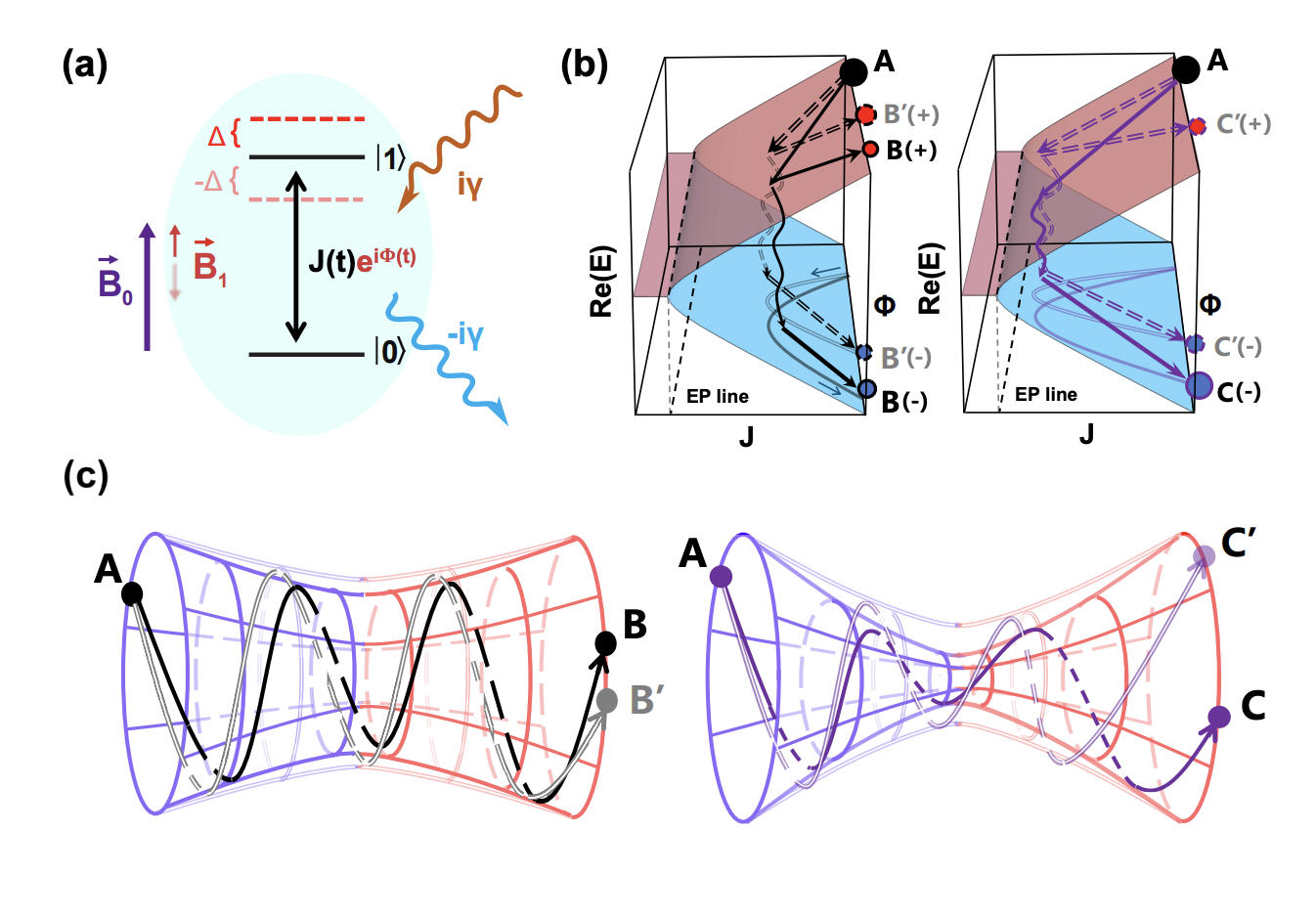
The pursuit of increasingly sensitive sensors drives innovation across diverse fields, and researchers are now exploring the potential of non-Hermitian physics to achieve unprecedented precision. Teng Liu, Xiaohang Zhang, and Jiawei Zhang, along with colleagues at Sun Yat-sen University, demonstrate a new sensing paradigm that overcomes limitations inherent in existing approaches. Their work centres on non-adiabatic sensing, which exploits rapid changes in a system rather than relying on static responses, and leverages a unique form of quantum tunnelling enhanced by criticality. This method not only amplifies external signals but also exhibits a remarkable selectivity, paving the way for practical sensors that operate with exceptional sensitivity and precision using non-Abelian processes.
Non-Hermitian sensing represents an intriguing mechanism that utilises the nonlinear responses near exceptional points (EPs) to amplify external perturbations with unprecedented precision. This research proposes a non-adiabatic sensing paradigm leveraging parameter-sensitive non-Hermitian tunneling, which overcomes limitations of static responses and system instability. The method exploits the dynamics of tunneling, rather than static responses, to achieve enhanced sensing capabilities and mitigate noise, establishing a more robust and sensitive platform for detecting subtle changes in external parameters.
Enhanced Sensing via Non-Hermitian Topology
This research details an experimental demonstration of enhanced quantum sensing using a non-Hermitian quantum system, specifically a single trapped ion. The study addresses limitations in traditional quantum sensing by exploring the potential of non-Hermitian systems, which offer increased response near EPs. Researchers aimed to experimentally demonstrate and characterize this enhanced sensing capability, focusing on the interplay between chiral state transfer, non-reciprocity, and the system’s dynamical topology. The research utilizes a system where the Hamiltonian is not Hermitian, leading to EPs where eigenvalues and eigenvectors coalesce, resulting in unusual behavior.
The system is designed to exhibit chiral state transfer and non-reciprocal behavior, and researchers explore how the system’s topology changes dynamically as parameters are varied, influencing state transfer. A single trapped ion serves as the physical system to realize the non-Hermitian Hamiltonian, demonstrating chiral state transfer and non-reciprocity, and characterizing the system’s dynamical topology by tracing the evolution of eigenvalues and eigenvectors. The experimental results confirm theoretical predictions about the enhanced sensing capabilities of the non-Hermitian system, providing evidence for the potential of non-Hermitian systems for enhanced quantum sensing and highlighting the importance of considering the system’s dynamical topology in designing and optimizing non-Hermitian sensors. This work opens up new avenues for developing highly sensitive sensors for various applications, including precision measurements, materials science, and biological sensing.
Criticality Amplifies Sensing Beyond Static Limits
Researchers have demonstrated a new approach to sensing based on manipulating the behavior of non-Hermitian systems, achieving unprecedented sensitivity through parameter-sensitive tunneling. This method overcomes limitations of previous techniques that relied on static responses and suffered from noise. The team leveraged a non-adiabatic paradigm, focusing on how systems respond to changes rather than existing in a fixed state, to amplify external perturbations with remarkable precision. The core of the breakthrough lies in exploiting criticality near exceptional points, where the system’s metric diverges, effectively magnifying the response to external signals.
This amplification is independent of the signal’s magnitude, offering a significant advantage over conventional sensors. The team achieved this by carefully controlling the rate of parameter change, maximizing sensitivity when the rate approaches zero at the point closest to the exceptional point. Further investigation revealed that the tunneling process exhibits chirality and non-reciprocity, meaning the direction of parameter change significantly impacts the outcome. Specifically, clockwise and counterclockwise parameter variations produce distinct tunneling effects, and reversing the process does not yield the same result. This asymmetry, stemming from the imaginary components of the system’s Hamiltonian, creates a geometric gain or loss depending on the direction of change. The combination of criticality-enhanced amplification and chiral, non-reciprocal tunneling enables a new form of vector sensing, potentially allowing for the detection of weak magnetic fields with exceptional precision.
Enhanced Sensing via Non-Hermitian Tunneling
This research demonstrates a new approach to non-Hermitian sensing, moving beyond traditional methods that rely on static responses and are limited by noise. The team successfully implements a non-adiabatic paradigm, leveraging parameter-sensitive non-Hermitian tunneling to amplify external perturbations with unprecedented precision. This sensitivity arises from geometric amplification, enhanced by criticality near exceptional points and governed by chiral selectivity dependent on the path and state of the system. This work establishes a pathway towards practical applications of non-Hermitian physics, particularly in sensing technologies that require high resolution and discrimination. Researchers acknowledge that exploring higher-order exceptional points represents a promising direction for future research, and note the potential for extending these principles to other physical systems and sensing modalities.
🗞 Non-adiabatic Non-Hermitian Sensing enabled by Criticality-Enhanced Topological Tunneling
🧠 ArXiv: https://arxiv.org/abs/2508.17377


