

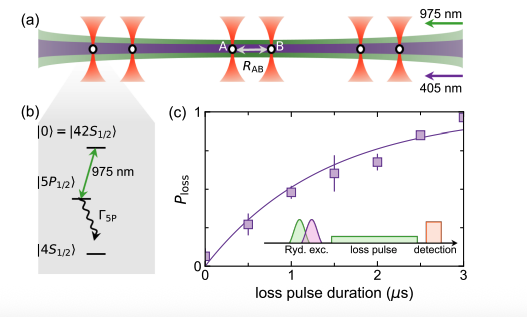
Controlling the behaviour of individual atoms represents a significant challenge in quantum physics, but recent work demonstrates a new method for manipulating these fundamental building blocks. Tao Chen, Chenxi Huang, and Jacob Covey, all from the University of Illinois at Urbana-Champaign, alongside Bryce Gadway from The Pennsylvania State University, have pioneered a technique using engineered dissipation to precisely control interacting Rydberg atoms. Their research reveals how carefully designed loss of atomic state can not only stabilise and prepare quantum systems, but also enhance decay rates through atomic interactions. This innovative approach allows for the freezing of specific atomic spin states and, crucially, suggests a pathway towards distilling desired configurations in larger arrays, opening exciting possibilities for creating complex, correlated quantum systems with unprecedented control.
Shaping Quantum Decay in Rydberg Atom Arrays
Researchers are now demonstrating precise control over the decay of quantum states within complex systems of Rydberg atoms, effectively shaping how these systems evolve over time. Key to this research are Rydberg atoms, which, when excited to high energy levels, exhibit strong, long-range interactions, making them ideal for quantum simulation. The team investigates how these interactions influence the collective excitations of the atom array, and how they relate to phenomena like the quantum Zeno effect, where frequent interactions can suppress quantum transitions. Experiments reveal that interaction dramatically alters atomic dynamics, leading to novel behaviour.
For example, a pair of interacting atoms exhibits nearly frozen dynamics due to the quantum Zeno effect. The researchers demonstrate the ability to stabilize a fully polarized chain of atoms through engineered dissipation, while a chain with a single disruption rapidly decays. This highlights the potential for using dissipation to selectively protect or destroy specific quantum states, with implications for quantum error correction and state preparation. The team demonstrates the ability to selectively decay specific Bloch states within a five-atom chain by carefully tuning the energy difference between the atoms and the dissipation channel, opening possibilities for creating complex quantum states and performing quantum simulations.
These findings provide strong evidence that dissipation can be a powerful tool for controlling quantum dynamics in many-body systems. The researchers have demonstrated the ability to protect quantum states from decay, selectively remove unwanted states, and shape the overall evolution of the system. This has important implications for quantum simulation, quantum error correction, and the development of new quantum technologies, as it opens up new possibilities for creating and manipulating complex quantum states.
Tunable Dissipation in Rydberg Atom Dimer Arrays
Rydberg atom arrays offer a versatile platform for investigating the interplay between strong interactions and dissipation, particularly in systems with few atoms. Scientists have now developed a novel approach to precisely control these phenomena by inducing tunable dissipation in individual Rydberg atoms using laser light. This technique moves beyond relying on spontaneous decay as the primary loss mechanism, instead allowing for precise control over the rate at which atoms lose energy. The team prepared pairs of Rydberg atoms within optical tweezers, using lasers to manipulate their energy levels and tune their interactions.
By applying a carefully controlled laser pulse, they induced dissipation, causing the atoms to decay to their ground state. Measurements of the effective loss rate confirmed the precision of the technique. This controlled dissipation enables exploration of fundamental quantum phenomena, including parity-time symmetry breaking and shifts in exceptional points driven by dipolar exchange interactions. Furthermore, the team observed a configuration-selective two-body Zeno effect, where specific spin states are effectively “frozen” due to interaction-enhanced decay, offering potential for state preparation and spin purification. These findings establish Rydberg atom arrays as a promising system for exploring new frontiers in quantum physics and developing innovative approaches to manipulating correlated quantum states.
Dissipation Controls Rydberg Atom Spin States
Scientists have demonstrated a novel approach to controlling quantum states using engineered dissipation, achieving high-fidelity preparation and stabilization of Rydberg atoms. This research introduces a tunable, state-resolved laser-induced loss channel for individual atoms, both when they are isolated and strongly interacting. The team reveals how interactions shift the boundary between the quantum Zeno and anti-Zeno regimes, states of suppressed or enhanced decay. The team discovered that by exploiting interaction-dependent energy level shifts, they could manipulate dissipation to selectively control atomic configurations.
Data confirms a clear interaction-induced phase transition, with increasing interaction strength directly correlating to increased atom loss, providing direct evidence of interaction-enhanced two-body dissipation. Theoretical modeling, validated by experimental results, predicts that extending this mechanism to chains of atoms allows for the “dissipative distillation” of unwanted spin configurations, effectively purifying the quantum state of the system. Further experiments focused on encoding a spin-1/2 system and introducing correlated loss channels. Results demonstrate that, under specific conditions, the system can be tuned to either decouple a lossy state, allowing for coherent oscillations, or induce a strong quantum Zeno effect, trapping pairs of atoms in their initial spin configuration. Specifically, when the dissipation rate is high and interactions are strong, the team observed a genuinely collective phenomenon, a pair-level Zeno protection, where pairs initialized in a specific state remain trapped due to correlated loss, a behaviour not seen in single atoms. This breakthrough delivers a versatile approach for exploring strongly interacting quantum systems and opens new possibilities for preparing correlated states in Rydberg atom arrays, with potential applications in quantum information processing and simulation.
Dissipation Controls Rydberg Atom Quantum Behaviour
This research expands the study of dissipation engineering within Rydberg atom systems by successfully implementing laser-controlled loss and investigating its interaction with strong atomic interactions. The team demonstrated that carefully tuned dissipation can shift the points at which quantum behaviour changes, and even enhance the rate of atomic decay. Crucially, they observed a configuration-selective effect, where specific spin states are protected from decay via the quantum Zeno effect, potentially allowing for the purification and distillation of spin configurations in extended chains. These findings establish Rydberg atom arrays as a versatile platform for exploring engineered, open quantum systems, opening avenues for research into dissipative phase transitions, collective behaviours induced by loss, and non-Hermitian many-body physics. The demonstrated dissipation engineering scheme also has direct applications in preparing specific quantum states and realizing more complex dissipative spin models. While the current work focuses on specific configurations, the authors note the potential for extending the approach to individual sites, enabling the creation of high-fidelity many-body states and the study of dissipation-enabled topological phenomena.
🗞 Collective dissipation engineering of interacting Rydberg atoms
🧠 ArXiv: https://arxiv.org/abs/2509.06373


