Perovskite oxides hold considerable promise for next-generation energy technologies, but materials with wide energy gaps often limit their performance. Muhammad Imran, Sikander Azam, and colleagues at Riphah International University, alongside Qaiser Rafiq and Amin Ur Rahman from the University of West Bohemia, now demonstrate how carefully introducing rare-earth elements into a sodium aluminate perovskite structure overcomes this challenge. Their calculations reveal that doping with europium, gadolinium, or terbium significantly reduces the material’s energy gap and unlocks a remarkable combination of optoelectronic, thermoelectric, and spintronic properties. This achievement establishes rare-earth-doped sodium aluminate as a versatile platform with potential applications ranging from solar energy harvesting and catalysis to advanced thermoelectric devices and spintronic technologies.
Rare-Earth Doping Modifies Perovskite Oxide Properties
This research investigates the potential of rare-earth-doped perovskite oxides, specifically sodium aluminate, as multifunctional materials for applications like spintronics and optoelectronics. Scientists employed advanced computational methods to explore the structural stability, electronic structure, optical properties, and transport characteristics of these materials. The calculations confirm that sodium aluminate readily accepts rare-earth elements, such as lanthanum and ytterbium, into its structure, creating materials with altered properties. Rare-earth doping significantly modifies the electronic structure of sodium aluminate, introducing localized electronic states that influence conductivity and magnetic behavior.
The extent of this modification depends on the specific rare-earth element used. Furthermore, doping enhances the optical properties, with the rare-earth ions contributing to strong absorption and emission of light in the visible and near-infrared regions, making these materials promising for optoelectronic devices. Calculations also reveal that rare-earth doping can tune the concentration and mobility of charge carriers, impacting electrical conductivity and potentially enabling spintronic functionalities.
Rare-Earth Doped Perovskites, DFT and GGA+U Calculations
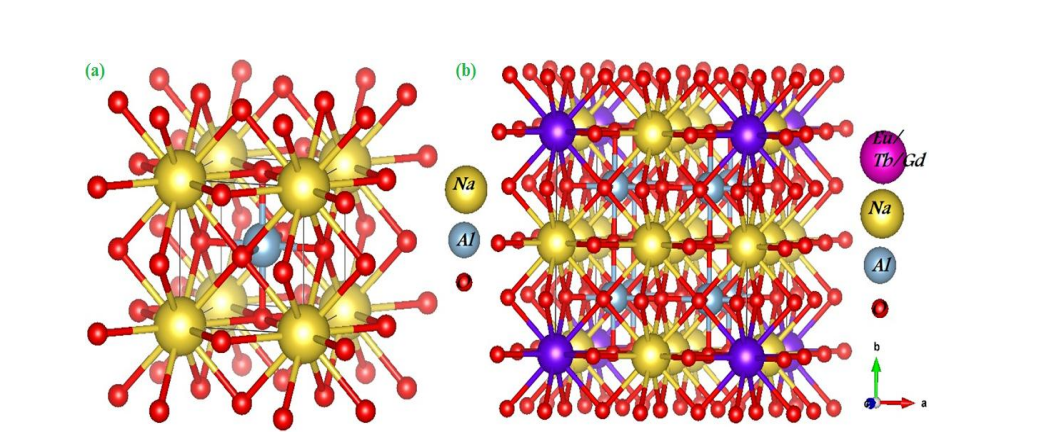
Scientists performed a comprehensive computational study, utilizing density functional theory within a full-potential linearized augmented plane wave framework, to investigate the properties of rare-earth-doped sodium aluminate. The calculations accurately described the interactions between electrons using the generalized gradient approximation, and accounted for the strong interactions between the rare-earth 4f electrons using the GGA+U approach. This builds upon previous studies of lanthanide-doped oxides and incorporates relativistic effects crucial for describing the behavior of f-orbitals and spintronic properties. To model the doping process, researchers created a detailed computational model of the sodium aluminate structure, substituting sodium atoms with europium, gadolinium, or terbium at a concentration of approximately 6.
25%. They then relaxed the structure to its lowest energy state, ensuring accuracy and stability. High-precision calculations were performed using a carefully chosen set of parameters to accurately represent the material’s electronic structure. The team analyzed the electronic structure, determined the optical properties, and assessed the mechanical stability of the doped materials. They also calculated the thermoelectric properties, such as electrical conductivity and the Seebeck coefficient.
Rare Earth Doping Transforms Sodium Aluminate Properties
Scientists have demonstrated a pathway to transform sodium aluminate into a multifunctional platform for advanced technologies through the incorporation of rare-earth elements. This work details a comprehensive investigation of europium, gadolinium, and terbium-doped sodium aluminate, revealing significant alterations to its electronic, optical, elastic, and thermoelectric properties. Calculations confirm that rare-earth substitution is energetically favorable and induces strong interactions between the f-orbitals of the rare-earth ions and the p-orbitals of the sodium aluminate. Notably, terbium doping successfully reduces the band gap, allowing the material to absorb more visible light, while gadolinium doping results in half-metallicity and europium doping induces spin-selective metallicity.
Optical spectra reveal a red-shifted absorption edge and a large increase in the material’s ability to respond to light, indicating enhanced light harvesting capabilities. Furthermore, the material exhibits plasmonic resonances, further supporting its potential in visible-light applications. Elastic analysis demonstrates that doping introduces mild lattice softening while preserving ductility, with a Pugh ratio indicating structural integrity. Thermoelectric performance is significantly enhanced, with Seebeck coefficients exceeding 210 µV/K for both europium and terbium, and a figure of merit reaching approximately 0. 45 at 500 K. These results position rare-earth-doped sodium aluminate as a promising candidate for photovoltaics, photocatalysis, thermoelectrics, and spintronics.
Rare-Earth Doping Creates Tunable Multifunctional Material
This research demonstrates that rare-earth doping transforms sodium aluminate from a wide-gap insulator into a versatile multifunctional material. Through first-principles calculations, scientists investigated europium, gadolinium, and terbium doping, revealing that these substitutions are thermodynamically stable and significantly alter the electronic structure of the host material. Specifically, the introduction of localized 4f states tunes the bandgap and enables spin-dependent conduction, creating materials with markedly different electronic behaviors, including half-metallicity, spin-selective metallicity, and p-type semiconducting characteristics. The optical response of the doped materials is also substantially enhanced, with absorption edges shifting into the visible spectrum, a dramatic increase in dielectric polarizability, and the emergence of plasmonic resonances at energies relevant for technological applications.
Mechanical analyses indicate that doping introduces controlled lattice softening without compromising ductility, ensuring structural integrity. Furthermore, the thermoelectric performance is improved, with europium and terbium-doped materials exhibiting strong Seebeck coefficients and promising ZT values. These combined properties establish rare-earth-doped NaAlO3 as a prototype system integrating optoelectronic, thermoelectric, and spintronic responses within a single perovskite host.
👉 More information
🗞 Rare-Earth Engineering of NaAlO3 Perovskites Unlocks Unified Optoelectronic, Thermoelectric, and Spintronic Functionalities
🧠 ArXiv: https://arxiv.org/abs/2510.08130