

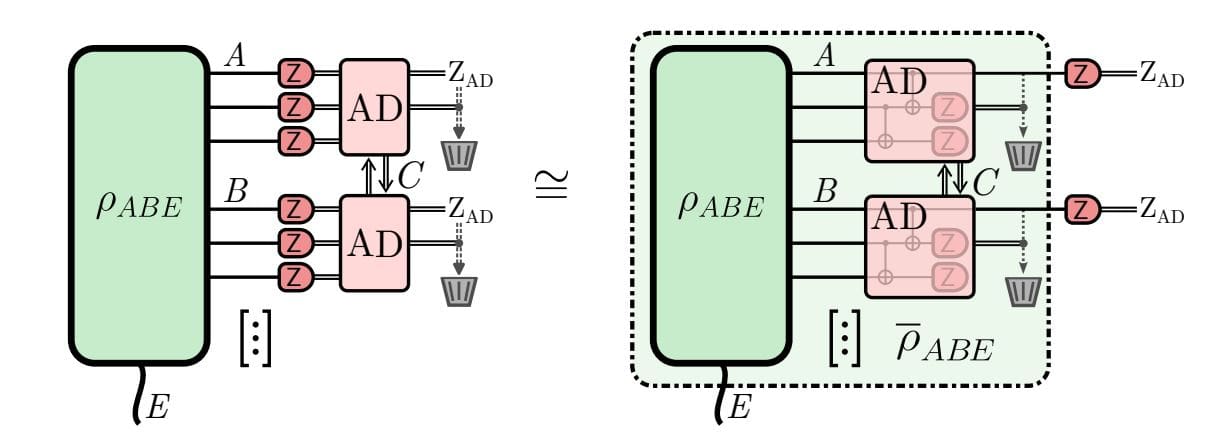
Quantum key distribution promises secure communication, but practical limitations often restrict the distance over which encryption keys can be reliably exchanged. Jonas Treplin, Philipp Kleinpaß, and Davide Orsucci, all from the Deutsches Zentrum für Luft- und Raumfahrt e. V. (DLR), investigate a method to overcome these constraints, focusing on a technique called advantage distillation. Their work presents the first thorough analysis of how advantage distillation improves the performance of a widely used quantum key distribution protocol, BB84, when considering realistic key sizes. The team demonstrates that this post-processing technique significantly increases the acceptable error rate in quantum communication, potentially extending the range of secure key exchange without requiring improvements to the quantum hardware itself, representing a substantial step towards practical, long-distance quantum communication networks.
Quantum Key Distribution, Security and Proofs
Quantum Key Distribution (QKD) utilizes the principles of quantum mechanics to guarantee secure distribution of encryption keys. Extensive research focuses on various aspects of QKD, ranging from fundamental theoretical foundations to practical implementations and rigorous security analyses. This field addresses challenges in proving the security of QKD protocols against diverse attacks, including those exploiting finite key lengths, imperfections in real-world hardware, and side-channel vulnerabilities, as well as collective attacks where an eavesdropper gathers information over multiple key distributions. Practical QKD systems are being developed using diverse technologies, including satellite-based systems for long-distance communication, fiber optic cables for terrestrial networks, and free-space links for flexible deployment.
Crucial areas of development involve characterizing and mitigating imperfections in single-photon detectors and sources, and exploring the potential of high-dimensional quantum states to increase key rates and enhance security. Error correction and information reconciliation are essential steps, with techniques like leftover hashing and specialized reconciliation protocols employed to extract secure keys from noisy channels. The field heavily relies on concepts from information theory, particularly entropy, to quantify uncertainty and establish security bounds. Recent trends demonstrate a strong focus on satellite QKD for extending communication range, addressing implementation security vulnerabilities in real-world systems, and exploring the benefits of high-dimensional QKD. Security certification and standardization are becoming increasingly important to ensure the reliability and trustworthiness of QKD systems.
Advantage Distillation Extends QKD Range and Security
This research significantly enhances Quantum Key Distribution (QKD) through a refined post-processing technique called Advantage Distillation (AD), demonstrably increasing the maximum acceptable Quantum Bit Error Rate (QBER) and extending secure communication distances. Researchers implemented AD by selectively accepting blocks of bits with higher fidelity, effectively reducing the overall QBER and minimizing the information disclosed during information reconciliation. This approach utilizes two-way classical communication, enabling the generation of secure keys even with higher initial QBER values. The team engineered a system where parity check information is exchanged between parties, allowing for selective acceptance or rejection of data blocks, a process fundamentally different from traditional error correction methods.
This allows researchers to discard blocks containing errors, improving the error rate for legitimate parties while simultaneously hindering an adversary’s ability to reconstruct the key. Experiments demonstrate that AD elevates the maximum acceptable QBER to around 17. 3% for realistic key sizes, a substantial performance gain achieved solely through improvements in post-processing. This breakthrough utilizes the decoy-state BB84 protocol, employing readily available coherent states, making the system technologically mature and affordable.
Advantage Distillation Boosts QBER Tolerance in BB84
This work presents a comprehensive finite-key analysis of the BB84 Quantum Key Distribution protocol enhanced with Advantage Distillation, a post-processing technique that improves performance by increasing the acceptable Quantum Bit Error Rate (QBER). Researchers demonstrate that applying Advantage Distillation increases the maximum acceptable QBER to around 0. 6 for realistic key sizes, representing a substantial enhancement achievable through improvements to post-processing alone. This breakthrough allows secure key generation in scenarios where the standard decoy-state BB84 protocol would fail.
The study addresses key security concerns within Advantage Distillation, specifically identifying that blocks mixing single-photon and zero-photon events are insecure, as they allow an eavesdropper to control the distilled bit value. To simplify the security proof, the team applied Entropic Uncertainty Relations to virtual measurements representing Bob’s errors, separating correctness from security aspects. Furthermore, the complex statistical fluctuation analysis resulting from Advantage Distillation post-selection was streamlined using McDiarmid’s inequality, yielding significantly tighter bounds than previously established approaches. Experiments involved a prepare-and-measure QKD protocol where Alice transmits attenuated laser pulses to Bob, encoding information in two mutually unbiased bases.
Advantage Distillation Boosts BB84 Security Bound
This work presents a comprehensive security analysis of the widely used BB84 quantum key distribution protocol when enhanced with Advantage Distillation, a post-processing technique. Researchers demonstrate that applying Advantage Distillation significantly increases the maximum acceptable Quantum Bit Error Rate, approximately doubling it to around 0. 6 for practical key sizes. This improvement stems from the ability of Advantage Distillation to extract high-fidelity bits from the raw data, effectively reducing the amount of information that needs to be exchanged during the reconciliation process.
The analysis establishes a clear security bound for the enhanced protocol, defining conditions under which the generated key is secure against potential eavesdropping attempts. The team rigorously defined security by comparing the actual output state of the protocol with an ideal state where no eavesdropping has occurred, and demonstrated that the difference between these states can be kept below a specified threshold. While the analysis assumes a constant inefficiency factor for simplicity, the authors acknowledge that this factor may depend on the block size used and that decoder efficiency could be further improved with additional information. This research provides a solid foundation for implementing more robust and long-distance quantum communication systems based on the BB84 protocol.
👉 More information
🗞 Finite Size Analysis of Decoy-State BB84 with Advantage Distillation
🧠 ArXiv: https://arxiv.org/abs/2511.21665

