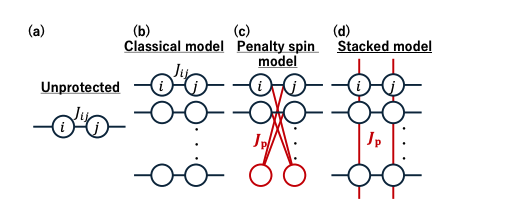
Quantum annealing correction (QAC) models represent a vital strategy for improving the performance of quantum annealers, and researchers are continually seeking ways to enhance their effectiveness. Tomohiro Hattori and Shu Tanaka, from Keio University, investigate novel QAC models that incorporate interactions between replicas of a problem, specifically employing penalty spin and stacked configurations. This work addresses a significant challenge in quantum annealing, namely the difficulty of finding optimal solutions when the energy difference between the ground state and the first excited state is small, a condition that often limits performance. The team demonstrates that these enhanced QAC models can successfully navigate these challenging landscapes, achieving optimal solutions rapidly by leveraging diabatic transitions, and thus offer a promising pathway towards practical, near-term quantum algorithms resilient to hardware limitations and control noise.
This work investigates the effects of QAC models incorporating replicas with additional interactions, specifically the penalty spin model and the stacked model, on problems characterised by a small energy gap between the ground and first excited states during quantum annealing, a well-known challenge in the field. The research focuses on understanding how these replica-based QAC models perform when faced with difficult optimisation problems where distinguishing the true ground state from nearly-optimal solutions is particularly hard. The team systematically explores the performance of both the penalty spin model and the stacked model, comparing their ability to correct errors and identify the true ground state in these challenging scenarios. This investigation provides insights into the strengths and weaknesses of each model, paving the way for improved error mitigation strategies in future quantum annealing experiments.
Quantum Annealing Models Overcome Energy Gap Limitations
This research demonstrates that quantum annealing correction (QAC) models, specifically the penalty spin model and the stacked model, effectively address a key limitation in quantum annealers: problems with small energy gaps between solution states. The team investigated these models using both experiments and numerical simulations, revealing that they can reliably find optimal solutions even when faced with challenging problem structures that typically hinder performance. This success stems from the models’ ability to leverage diabatic transitions, allowing the system to efficiently navigate the energy landscape and avoid getting trapped in suboptimal states. The findings highlight the practical potential of QAC models for near-term quantum algorithms, particularly in scenarios where annealing time and control precision are limited. By incorporating replicas with additional interactions, these models enhance the robustness of the annealing process and improve the probability of finding the true ground state.
Quantum Annealing and Optimization Algorithms Explored
Research in quantum annealing encompasses core topics such as the technique itself, alongside classical optimization algorithms like simulated annealing, providing a point of comparison. The focus is on how quantum annealing can outperform classical methods, and the challenges in achieving that. Research also touches on the underlying principles of quantum computation, including the simulation of open quantum systems using tools like the QuTiP framework. A significant portion of the research addresses errors in quantum annealing devices, a major bottleneck in current technology. Minor embedding, a crucial aspect of mapping problems onto the limited connectivity of quantum annealing hardware, is also extensively covered, including the theory and design of embedding strategies.
Research into techniques like diagonal catalysts and diabatic quantum annealing aims to speed up the optimization process. Performance analysis and benchmarking are also key areas, with work dedicated to understanding how to measure and compare the performance of quantum annealing algorithms against classical algorithms. The overarching goal is to make quantum annealing a practical and effective optimization tool, achieved through error mitigation, algorithm design, and hardware optimization.
🗞 Frustration-Enhanced Quantum Annealing Correction Models with Additional Inter-replica Interactions
🧠 ArXiv: https://arxiv.org/abs/2509.11217