

Room-temperature single-photon emitters, found within defects in hexagonal boron nitride, hold immense promise for advancements in quantum computing and sensing, but their unpredictable nature has previously limited their practical application. Hyeongwoo Lee, Taeyoung Moon, and Hyeonmin Oh, along with colleagues at their respective institutions, now present a breakthrough in controlling and optimising these quantum light sources. The team developed a technique called tip-enhanced spectroscopy, which allows precise positioning of individual emitters within nanoscale cavities, effectively tailoring the enhancement of both excitation and emission. This adaptive control not only reconfigures solid-state single-photon sources for increased brightness and purity, but also enables simultaneous, space- and time-resolved spectroscopic analysis, paving the way for highly sensitive and deterministic interactions with these room-temperature quantum emitters.
HBN Emitters Enhanced by Plasmonic Nanocavities
This research details the creation of a platform for generating and controlling single-photon emitters by coupling hexagonal boron nitride (hBN) with carefully designed plasmonic nanocavities. Researchers successfully coupled naturally occurring point defects in hBN, which act as single-photon emitters, with these nanocavities, demonstrating enhanced and tunable single-photon emission through the Purcell effect. The design allows for tuning the emission characteristics of the single-photon emitters, offering control over their wavelength and efficiency. Tip-enhanced photoluminescence nano-spectroscopy characterized the emission from individual emitters with high spatial resolution, providing detailed insights into their behavior.
Plasmonic coupling substantially increased the brightness of the hBN single-photon emitters, demonstrably achieving the Purcell effect and increasing emission rates. This research has significant implications for quantum technologies, including secure quantum communication, quantum computing, nanoscale quantum sensing, and advanced imaging. Bright and efficient single-photon sources are crucial for secure communication, while these emitters can serve as qubits in quantum computers. The enhanced emission and spatial resolution could be used for nanoscale quantum sensing applications, and the platform could enable high-resolution imaging with single-photon sensitivity.
Deterministic Coupling of Single Photons to Nanocavities
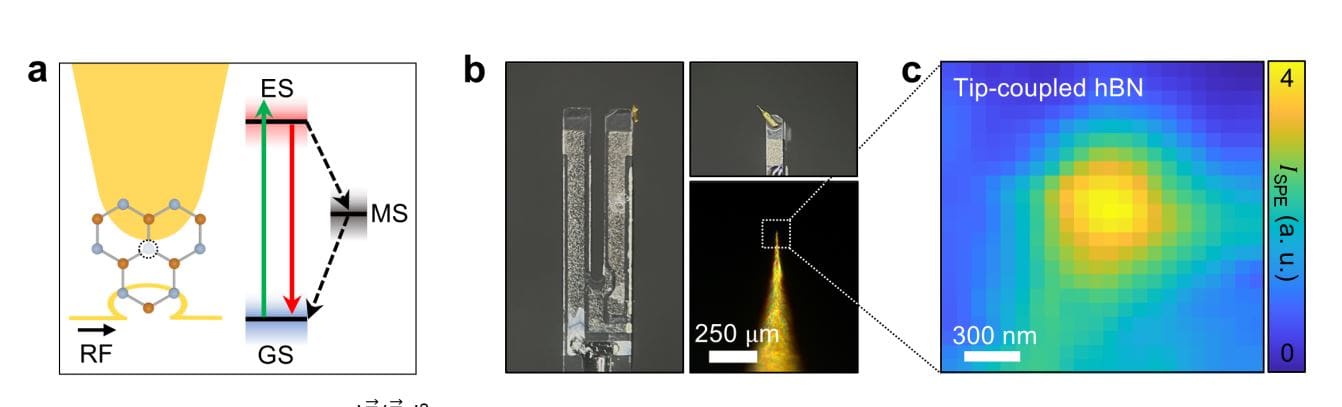
This study pioneers a technique for precisely coupling single-photon emitters in hexagonal boron nitride (hBN) with plasmonic cavities, enabling precise control over their emission characteristics. Scientists engineered a shear-force atomic force microscope system capable of positioning a gold tip with sub-nanometer precision relative to hBN nanoflakes, creating highly localized plasmonic cavities. This system allows for three-dimensional alignment, ensuring high-fidelity coupling between the atomic-scale emitters and the cavity systems, and facilitates dynamic control over light-matter interactions. Researchers characterized both the spectral properties of individual hBN single-photon emitters and the plasmon resonance of the gold tip-cavities.
By precisely matching the plasmon resonance to each emitter’s energy, scientists selectively control excitation and emission rates, comprehensively investigating single-photon emission characteristics. Regulating the van der Waals force between the gold tip and the hBN emitter revealed pronounced changes in emission spectra as the tip approached, with emission intensity increasing exponentially at distances less than 15 nanometers, consistent with near-field coupling in plasmonic systems. This enhancement is attributed to increased excitation rates via localized plasmon and electrostatic effects, and the enhancement of spontaneous emission rates through the Purcell effect. Systematic adjustment of the tip-sample distance identified three distinct regimes of emission enhancement, demonstrating stable and reversible control over coupling strength. A more than ten-fold increase in brightness was observed at a distance of 2 nanometers, representing a significant advance in manipulating quantum emitter-cavity interactions.
Tip-Enhanced Control of Single-Photon Emission
Researchers have achieved deterministic control over single-photon emission from defects in hexagonal boron nitride (hBN) using a novel tip-enhanced spectroscopy technique. This work demonstrates the ability to adaptively tune the enhancement of both excitation and emission rates by precisely positioning individual emitters within plasmonic cavities formed by specialized tips. Through careful selection of tip plasmonic resonances, scientists can reconfigure solid-state single-photon sources and simultaneously analyze their properties with nanoscale spatial and temporal resolution. Selecting tips with low-energy plasmons yields a high enhancement of spontaneous emission, suppressing unwanted photon bunching and improving single-photon purity, as evidenced by a reduction of the g(2)(0) value from approximately 0.
40 to 0. 17. Conversely, tips with high-energy plasmons maximize excitation, boosting the intensity of emitted light. At a crossover energy of approximately 2. 00 eV, both excitation and emission are comparably enhanced, providing a balanced regime for tunable control.
These findings establish design rules for coupling single-photon emitters to cavities, allowing for switching between anti-bunched and bunched photon statistics. The team directly integrated hBN nanoflakes containing single defects onto the apex of the plasmonic tips. Measurements demonstrate a significant polarization dependence, with p-polarized excitation inducing stronger field localization and more intense single-photon emission. Optically detected magnetic resonance (ODMR) experiments performed on these tip-coupled defects reveal an enhanced ODMR contrast of approximately 8. 3% and a photon detection rate of approximately 263 kcts/s, improving the magnetic-field sensitivity to approximately 116 μT/√Hz.
This represents a substantial improvement over the 2. 3% contrast and 188 kcts/s achieved with 45° excitation. These results establish tip-integrated hBN single-photon emitters as a promising platform for nanoscale quantum magnetometry, offering surface-proximal and two-dimensional compatibility that complements existing single nitrogen vacancy (NV)-center probes.
Deterministic Control of Single-Photon Emission and Sensing
This research demonstrates a new method for precisely controlling the properties of single-photon emitters within hexagonal boron nitride, a material with potential for quantum technologies. Scientists achieved deterministic coupling between these emitters and plasmonic tip-cavities, effectively reconfiguring their quantum-optical response through careful spatial and spectral alignment. By manipulating the interaction between the emitters and the cavities, the team selectively enhanced either excitation or spontaneous emission of photons, overcoming limitations imposed by slow radiative decay and enabling brighter, high-purity single-photon sources. Furthermore, this approach extends to quantum sensing, specifically optically detected magnetic resonance with single spin defects. By operating in a regime of accelerated emission, the researchers improved the sensitivity of magnetic field detection while maintaining.
👉 More information
🗞 Tip-enhanced quantum-sensing spectroscopy for bright and reconfigurable solid-state single-photon emitters
🧠 ArXiv: https://arxiv.org/abs/2511.21127

