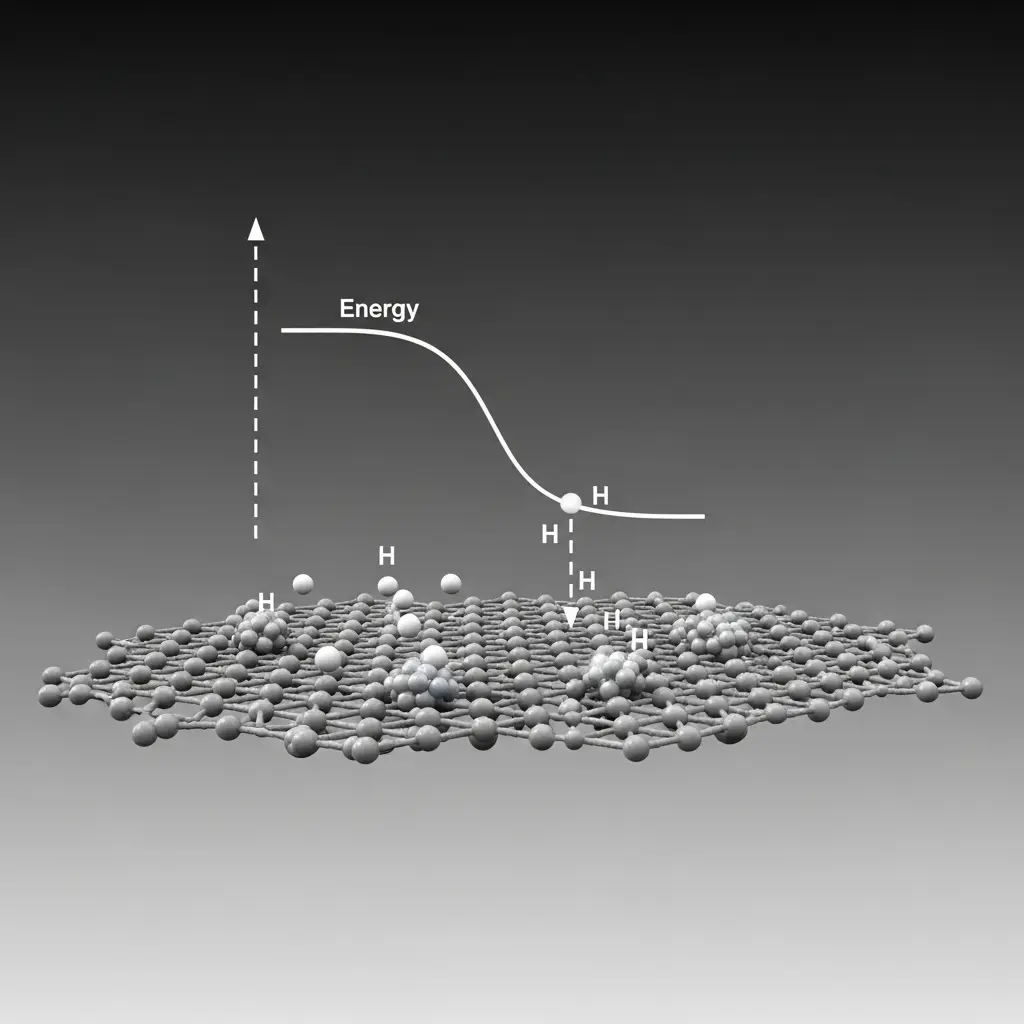
Graphene, a single layer of carbon atoms arranged in a honeycomb structure, continues to fascinate scientists with its remarkable potential in fields ranging from energy storage to advanced electronics. Researchers led by Chien-Hsu Chen, Huan Niu, and Hung-Kai Yu from National Tsing Hua University and the National Atomic Research Institute now present a detailed investigation into how hydrogen interacts with graphene enhanced by platinum atoms. The team employed a sophisticated technique, known as Elastic Recoil Detection Analysis, to measure the amount of hydrogen attaching to the platinum-decorated graphene surface, and importantly, to determine how deeply that hydrogen penetrates the material. This precise measurement of hydrogen coverage delivers crucial information for optimising graphene-based materials designed for efficient hydrogen storage, bringing practical applications of this wonder material closer to reality.
Graphene possesses exceptional electronic, mechanical, and quantum properties, making it highly attractive for energy storage, spintronics, and microelectronics. Functionalizing graphene with platinum adatoms can further enhance its properties, particularly for hydrogen storage applications. Hydrogen is widely regarded as a key energy carrier, and its efficient storage remains a significant challenge.
Hydrogen Uptake in Platinum-Decorated Graphene
Scientists conducted a detailed investigation into hydrogen adsorption on platinum-decorated graphene, establishing a hydrogen baseline using a pristine silicon wafer. Experiments revealed that both bare graphene and graphene subjected to carbon-ion irradiation exhibited negligible hydrogen adsorption, consistently mirroring the hydrogen concentration of the silicon reference. However, the team observed a significant increase in hydrogen concentration when examining graphene decorated with platinum, immediately after exposure to hydrogen gas. This demonstrates that platinum dramatically enhances hydrogen adsorption, confirming the importance of catalytic mechanisms.
The data shows that hydrogen adsorption is substantially enhanced by the presence of platinum, with the hydrogen signal continuing to increase with repeated hydrogen exposure cycles. The team recorded a saturation level of hydrogen uptake, indicating a defined adsorption capacity. Quantitative analysis reveals a high hydrogen areal density following exposure, translating to an apparent hydrogen storage capacity of approximately 18.5 weight percent. These measurements provide a foundation for future material design and characterization in hydrogen-storage applications, offering insights into the mechanisms governing hydrogen interaction with graphene surfaces.
The researchers acknowledge that the measurement technique provides a depth-integrated signal, meaning the reported hydrogen weight percentage represents an upper-bound value and does not solely reflect hydrogen stored within the graphene itself. The findings suggest that platinum facilitates hydrogen dissociation into atomic hydrogen, which then migrates and bonds with defect sites within the graphene lattice, a process known as hydrogen spillover. Future work could focus on refining measurement techniques to isolate the hydrogen uptake specifically within the single-atom-thick graphene layer, providing a more accurate assessment of its intrinsic storage capacity and furthering the development of graphene-based hydrogen storage materials.
👉 More information
🗞 Surface Hydrogen Coverage on Pt/Graphene Measured by Carbon Ion ERDA
🧠 ArXiv: https://arxiv.org/abs/2512.23261