

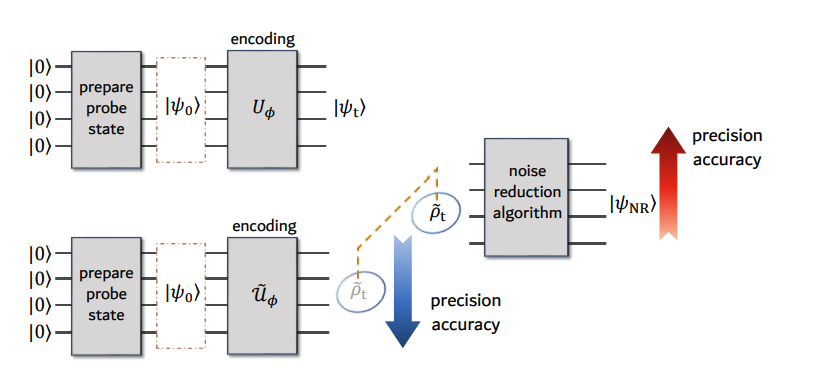
Quantum metrology, the science of precision measurement, faces a significant challenge in overcoming the limitations imposed by real-world noise, hindering its potential for practical applications. Xiangyu Wang, from the Shenzhen Institute for Computing, along with Chenrong Liu and Xinqing Wang, addresses this issue by shifting the focus from encoding classical data to directly processing it within a quantum computer. The team develops a method where the computer optimises information gathered from sensing tasks, improving performance even in noisy environments and bypassing the need to load large amounts of classical data. Through experiments using nitrogen-vacancy centres in diamond and simulations of superconducting processors, they demonstrate that this approach enhances the accuracy of sensing estimates and substantially increases sensitivity, paving the way for utilising near-term quantum computers for impactful, real-world metrology.
Quantum computing continues to advance rapidly, demonstrated by achievements in quantum supremacy and the creation of high-fidelity, fault-tolerant gates. However, a significant challenge remains: efficiently loading classical data into quantum processors hinders the development of practical real-world applications. Researchers are now exploring alternative strategies that shift the focus from encoding classical data to directly processing quantum information, circumventing this bottleneck. This work targets quantum metrology, a practical quantum technology where precision is often limited by realistic noise, offering a promising route to demonstrate a clear quantum advantage and enhance the performance of quantum sensors in noisy environments.
Nitrogen-Vacancy Centers: Platform for Quantum Sensing
Nitrogen-Vacancy Centers for Quantum Sensing
Nitrogen-vacancy (NV) centers in diamond are emerging as a powerful platform for quantum sensing due to their unique properties. These defects in the diamond lattice exhibit spin characteristics that make them exceptionally sensitive to magnetic fields, electric fields, temperature, and other physical quantities. Current research focuses on harnessing these properties to build sensors with unprecedented sensitivity and precision, pushing the boundaries of what is measurable in various scientific and technological applications.
Combining Metrology with Quantum Computational Power
Combining Metrology and Quantum Computation Techniques
Quantum Sensing Enhanced by Quantum Computing
Researchers have developed a novel strategy that integrates quantum metrology and quantum computing to significantly enhance the accuracy and precision of sensing, overcoming limitations imposed by noise and inefficient data handling. This approach shifts the focus from directly measuring noisy quantum states to processing information with a quantum computer, boosting performance in practical applications. Experiments utilizing NV centers in diamond demonstrate a remarkable 200-fold improvement in measurement accuracy, even under strong noise conditions. The team’s method addresses a critical challenge in quantum metrology: the vulnerability of highly entangled probe states to environmental noise, which degrades measurement quality.
Quantum Information Transfer and Noise Filtering Protocols
Instead of directly measuring the output of a quantum sensor, the researchers transfer the quantum information to a more stable quantum processor. This processor then employs quantum principal component analysis (qPCA), a quantum algorithm designed to filter noise and refine the data. Simulations using a two-module distributed superconducting quantum system further validate the approach, revealing a substantial 52. 99 dB improvement in the quantum Fisher information, a key indicator of precision, bringing the results much closer to the theoretical maximum precision achievable. These findings demonstrate that combining quantum metrology with quantum computing offers a promising pathway to practical, noise-resilient sensing and expands the potential applications of quantum computers in real-world scenarios.
Machine Learning to Boost Sensing and Mitigation
Leveraging Quantum Machine Learning for Precision
Quantum Machine Learning Boosts Sensing Precision
This research demonstrates a new quantum sensing protocol that leverages quantum machine learning to enhance precision and overcome limitations in data loading. By employing qPCA for state purification, the team successfully mitigated the effects of decoherence, environmental noise that typically degrades sensing accuracy. Experimental validation using NV centers in diamond, combined with numerical simulations, confirms that qPCA significantly improves both the fidelity and quantum Fisher information, leading to more reliable parameter estimation. This approach bypasses a major bottleneck in current quantum sensing techniques and achieves a superior signal-to-noise ratio compared to conventional methods. While the method currently requires increased quantum projection measurements, presenting a practical limitation, the demonstrated robustness and improved sensitivity suggest its potential for real-world applications in precision measurement and quantum information processing.
🗞 Noise-Resilient Quantum Metrology with Quantum Computing
🧠 ArXiv: https://arxiv.org/abs/2509.00771
Implementing Advanced Quantum Error Mitigation Techniques
The core mechanism underpinning this noise resilience involves implementing quantum error mitigation techniques directly within the quantum circuit architecture. Instead of relying solely on physical error correction codes, the processing framework utilizes optimized quantum state estimation algorithms, which effectively suppress the impact of localized decoherence events. This algorithmic approach allows the system to extract meaningful parameters even when the measured quantum state deviates significantly from its ideal theoretical representation.
Furthermore, the utility of this integrated platform extends to various types of quantum sensing beyond magnetic fields, including minute strain measurements and detection of specific environmental vibrations. For solid-state qubits like NV centers, the sensitivity is intrinsically linked to the zero-field splitting parameter and the coherence time, demanding sophisticated pulse sequences—such as dynamical decoupling—to maintain quantum information integrity against environmental coupling.
Addressing the quantum limited precision of metrology requires entanglement generation between the sensing probe and the quantum processor itself. By leveraging entanglement, the measurement process transitions from a collection of independent measurements to a collective quantum estimation, theoretically reducing the measurement uncertainty scaling from the classical standard quantum limit ($\propto 1/\sqrt{N}$) toward the ultimate Heisenberg limit ($\propto 1/N$).
A significant remaining architectural challenge is achieving scalable, high-bandwidth quantum interconnects. For practical deployment, the quantum information must be reliably transferred between disparate physical components—such as the diamond substrate and external classical control electronics—while maintaining qubit coherence and minimizing crosstalk interference across the integrated quantum chip.


