

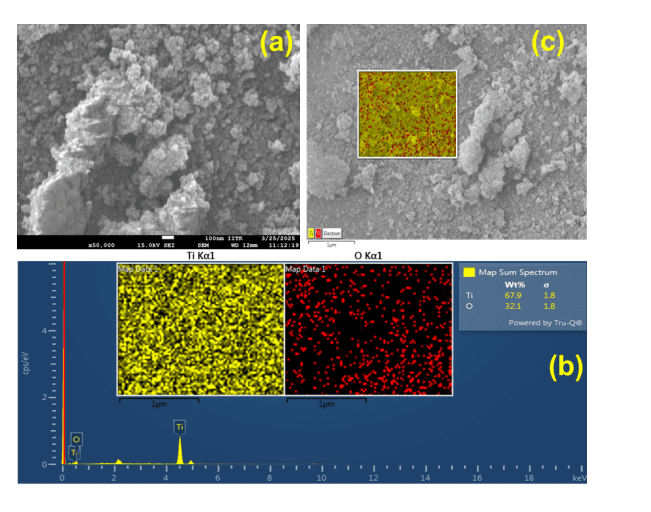
Titanium dioxide nanoparticles, widely used in applications from solar cells to photocatalysis, gain enhanced properties through careful control of their composition and structure, a challenge that researchers led by Latika Mishra of Ranchi University, Vinod Kumar Dwivedi from Tel Aviv University, and Vishal Kumar Chakradhary of RF Nanocomposites Pvt Ltd, have now addressed. The team synthesises these nanoparticles using an environmentally friendly ‘green’ method, employing the whole plant extract of Phyllanthus niruri instead of traditional chemical routes. This innovative approach yields oxygen-deficient titanium dioxide particles exhibiting both improved magnetic behaviour and altered optical characteristics, potentially opening new avenues for their use in spintronics and advanced optical devices. The resulting nanoparticles demonstrate a unique combination of ferromagnetic properties at room temperature and a reduced optical band gap, stemming from the presence of oxygen vacancies and mixed titanium oxidation states, a significant advancement in materials science.
This innovative approach focuses on creating oxygen-deficient nanoparticles, influencing their magnetic and optical characteristics for applications in areas like photocatalysis, magnetic storage, and sensing. The team’s method avoids harsh chemicals, employing the plant extract as both a reducing and capping agent to control nanoparticle size, shape, and oxygen vacancy concentration. Thorough characterisation of the resulting nanoparticles confirms their unique characteristics, revealing the emergence of induced magnetic behaviour directly linked to the presence of oxygen vacancies. This work demonstrates a simple and eco-friendly route to synthesising oxygen-deficient titanium dioxide nanoparticles with tunable magnetic and optical properties, opening possibilities for novel spintronic devices and improved performance in environmental remediation and energy conversion.
TiO2 Nanoparticles and Oxygen Vacancy Magnetism
This research explores the relationship between the structure, defects, and magnetic properties of titanium dioxide (TiO2) nanoparticles. A central theme is the intentional creation of defects, specifically oxygen vacancies, within the TiO2 structure to modify its properties. The team investigates how these vacancies influence the electronic conductivity and magnetic behaviour of the material, leading to surprising results. Researchers have discovered that introducing oxygen vacancies can significantly alter the electronic structure of TiO2, reducing its optical bandgap and increasing its conductivity.
This is particularly evident in the creation of ‘black TiO2’, a material with enhanced light absorption and conductivity due to a high concentration of oxygen vacancies. Importantly, the team observes room-temperature ferromagnetism in TiO2, a property not typically found in this material, and attributes it to the presence of oxygen vacancies creating localized magnetic moments. Investigations also extend to related materials, exploring how doping affects their magnetic and electronic properties and revealing complex phenomena like magnetic frustration and the magnetocaloric effect. This work highlights the crucial role of defects in controlling material properties and understanding the interplay between structure, electronic structure, and magnetism.
Green Synthesis of Oxygen Vacant Titania Nanoparticles
This study successfully synthesised oxygen-deficient titanium dioxide nanoparticles using a green chemistry approach, employing the whole plant extract of Phyllanthus niruri. Detailed structural characterisation confirms the formation of approximately 35 nanometer tetragonal anatase phase nanoparticles, with spectroscopic analysis confirming the presence of surface oxygen vacancies and a coexistence of both titanium(III) and titanium(IV) oxidation states. These oxygen vacancies correlate with a reduced optical band gap energy, potentially due to the creation of donor levels within the material’s electronic structure. Furthermore, the nanoparticles exhibit room temperature ferromagnetism, with a magnetic moment significantly enhanced compared to nanoparticles synthesised using other plant extracts. This magnetic behaviour is attributed to the virtual hopping of electrons between titanium ions with different oxidation states, facilitated by the presence of oxygen vacancies. The authors suggest that utilising the whole plant extract proves to be a more effective reducing agent for this synthesis, establishing a promising pathway for creating titanium dioxide nanoparticles with tailored magnetic and optical properties for diverse applications.
👉 More information
🗞 Enhanced magnetic and optical properties of oxygen deficient TiO nanoparticles synthesized by environment-friendly green route using whole plant extract of Phyllanthus niruri
🧠 ArXiv: https://arxiv.org/abs/2510.22296


