Photonic systems exhibiting exceptional points, where fundamental properties of light coalesce, are attracting considerable attention due to their potential for enhanced sensitivity and novel device applications. B. M. Rodriguez-Lara, H. Ghaemi-Dizicheh, and S. Dehdashti, alongside colleagues including A. Hanke, A. Touhami, and J. Nötzel, present a new theoretical framework for understanding these systems, specifically focusing on three-mode couplers. This research overcomes limitations in existing studies by providing a general algebraic structure applicable to a wide range of designs, both in classical and quantum regimes. The team’s approach reveals a crucial connection between local and dynamic spectral properties, enabling precise control over light propagation and offering a systematic method for analysing and designing non-Hermitian optical components with tailored characteristics.
Non-Hermitian Physics and Exceptional Point Theory
This extensive collection of research papers focuses on non-Hermitian physics, a field exploring systems where energy is not necessarily conserved, and exceptional points, unique points where standard rules of quantum mechanics break down. The compilation covers a broad range of topics, including topological phases of matter and symmetry, suggesting a comprehensive investigation into the fundamental properties of these unusual systems and their potential applications. Researchers are exploring how non-Hermitian physics modifies established physical phenomena and how these modifications can be harnessed for new technologies. The collection also highlights potential applications in quantum control, computation, and metrology, including using Berry phases for quantum gates and exploiting exceptional points for enhanced measurement sensitivity. The research draws heavily on advanced mathematical tools, including differential equations and algebraic geometry, demonstrating a rigorous approach to understanding these phenomena. Applications in areas like photonics and condensed matter physics are also evident, suggesting an interest in translating theoretical insights into real-world devices and materials. This collection represents a comprehensive and well-curated resource for anyone interested in the rapidly developing field of non-Hermitian physics.
Coupler Dynamics and Geometric Phase Control
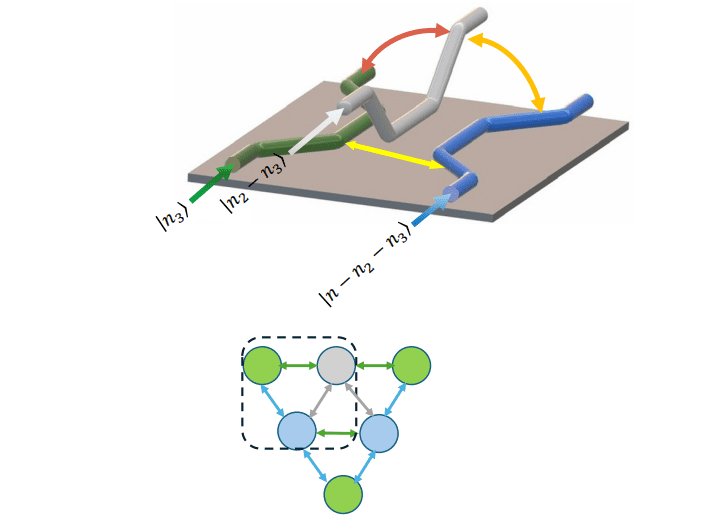
Researchers have developed a new framework for analyzing multi-mode couplers, essential components in photonic systems that exhibit exceptional points. Their approach applies to both classical and quantum systems, focusing on three-mode couplers to demonstrate a powerful algebraic diagonalization technique. This process aligns the local and dynamical spectra, revealing a geometric phase that governs how light propagates through the system, allowing for precise control of light flow. To fully capture the system’s dynamics, the team employed an exact mathematical tool, the Wei-Norman propagator, which illustrates how signals behave as they cross exceptional points.
This methodical approach enabled the classification of different coupler families, concentrating on those displaying both symmetric and non-Hermitian cyclic characteristics. The researchers identified exceptional points embedded within a continuum of other points, demonstrating a departure from simple encircling behavior. The experimental foundation supporting this work draws parallels with recent observations of exceptional points and the non-Hermitian skin effect in coupled photonic lattices. These experiments demonstrated that exceptional points can compress eigenvalue spectra and modulate skin localization, reinforcing the theoretical model developed in the three-mode coupler system. This combination of theoretical innovation and experimental validation provides a systematic route for analyzing non-Hermitian mode couplers and guiding the design of advanced photonic and quantum platforms.
Non-Hermitian Couplers Reveal Geometric Phase Dynamics
Scientists have developed a comprehensive framework for understanding non-Hermitian mode couplers in both classical and quantum regimes. This work introduces a new algebraic approach using Lie group theory to analyze the behavior of these couplers, revealing connections between their spectral structure and actual state evolution. The team demonstrated that by carefully choosing a mathematical gauge, they could align local and dynamical spectra, effectively revealing the geometric phase that governs propagation and distinguishing between gradual and abrupt changes in the system. Experiments and analysis show that the three-mode coupler exhibits diverse propagation dynamics, ranging from compact periodic oscillations to unbounded polynomial or hyperbolic growth, depending on the system’s parameters.
The researchers constructed an explicit propagator, a mathematical tool for predicting the system’s evolution, which yielded a hierarchy of differential equations that can be solved analytically under specific conditions. Measurements confirm that the classical behavior of the system is accurately captured by the quantum model, particularly in the single-excitation limit. Detailed analysis of the system’s response to different initial states reveals that propagation is highly correlated, meaning the initial state is neither fully recovered nor transferred, but its components are intricately linked during evolution. The team identified specific parameter regimes where exceptional points emerge and influence the system’s behavior, and they constructed chiral families of couplers that exhibit unique spectral properties. By employing a gauge renormalization technique, the team successfully removed global phase and uniform gain or loss, simplifying the analysis of these complex systems and revealing underlying algebraic structures. This approach yielded traceless matrices in the classical regime and a bosonic embedding preserving excitation number in the quantum regime, allowing for a unified treatment of both. The team specifically developed this framework for three-mode couplers, representing the system using concepts from isospin and hypercharge representation and constructing an explicit propagator based on a Wei-Norman decomposition. This enabled the identification of exceptional points and a detailed understanding of the geometric phase governing propagation. The researchers demonstrated how a propagation-dependent gauge aligns local and dynamical spectra, distinguishing between adiabatic and exact propagation scenarios.
👉 More information
🗞 Non-Hermitian three-mode couplers
🧠 ArXiv: https://arxiv.org/abs/2510.24047