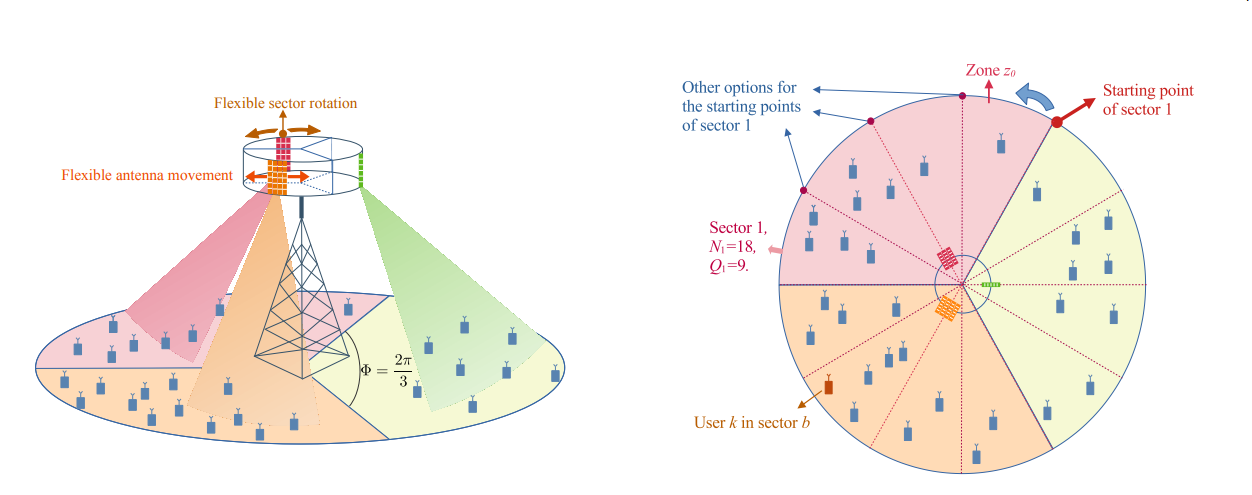
Future wireless networks stand to benefit significantly from six-dimensional movable antenna (6DMA) technology, which dynamically adjusts antenna positioning for improved performance, and Yunli Li, Xiaoming Shi from The Chinese University of Hong Kong, Xiaodan Shao from University of Waterloo, and colleagues now present a cost-effective 6DMA base station architecture they term the ‘flexible-sector’ base station. This innovative design allows antennas to rotate and move along circular tracks, enabling adaptable sector rotation and efficient antenna allocation to match user distribution. The team models user distribution using an angular-domain approach, capturing spatial clustering effectively, and demonstrates that optimising both sector rotation and antenna allocation maximises the average data rate for users. Results show that the flexible-sector base station achieves substantial gains in data rate, particularly with a large number of antennas and sectors, and outperforms traditional fixed-sector base stations and those employing only single optimisation strategies.
This document explores advanced wireless communication systems, focusing on movable antennas, intelligent reflecting surfaces (IRS), and stochastic geometry to optimize network performance, coverage, and capacity. Scientists are leveraging these technologies to address the growing demands of next-generation wireless networks, including 6G and beyond. The work centers on six-dimensional movable antennas, which dynamically adapt to changing network conditions. Researchers are also investigating IRS to intelligently reflect wireless signals, enhancing coverage and capacity. Stochastic geometry provides a mathematical framework for modeling random node placement and analyzing network performance in realistic scenarios. The research aims to improve network performance metrics such as coverage, capacity, throughput, and energy efficiency, and explores the potential of movable antennas for wireless sensing applications.
Dynamic Sector Rotation with Movable Antennas
Researchers have developed a flexible-sector base station architecture utilizing six-dimensional movable antennas (6DMA) to enhance wireless network performance. This system dynamically adjusts antenna position and rotation, adapting to varying user distributions and improving spatial efficiency, while maintaining compatibility with existing infrastructure to reduce costs and complexity. To accurately model user distribution, scientists introduced a new angular-domain model based on a two-dimensional Poisson point process, effectively capturing spatial clustering and hotspot formations. This model differs from conventional distance-based models and greatly facilitates the design of sector rotation and antenna allocation strategies.
Researchers implemented a zero-forcing receiver coupled with channel-inversion-based power control to decode multi-user signals, ensuring a common data rate for all users within a sector. They then analyzed the average sum rate achievable by all users as a function of sector rotation and antenna allocation, developing a two-step optimization algorithm to maximize the sum rate. Results demonstrate that the optimal number of antennas allocated to each sector increases linearly with the number of users.
Dynamic Antennas Boost Wireless Network Capacity
Researchers have developed a flexible-sector base station architecture utilizing six-dimensional movable antennas (6DMA) to enhance wireless network performance. This system dynamically adjusts both the position and rotation of antennas, adapting to varying user distributions and improving spatial efficiency. Experiments reveal that the optimal number of antennas allocated to each sector linearly increases with the number of users present in that sector. Under favorable user distribution conditions, the achievable sum rate gain increases proportionally to the number of sectors as the number of antennas increases.
Numerical results demonstrate that the flexible-sector base station consistently achieves a higher sum rate compared to traditional fixed-sector base stations. The team developed a two-step algorithm to jointly optimize both the common sector rotation and antenna allocation, maximizing the average sum rate for all users. Measurements confirm that this approach delivers significant gains in spectral efficiency, particularly in scenarios with heterogeneous user distributions and dynamic channel conditions.
Joint Sector Rotation and Antenna Allocation
This research introduces a novel flexible-sector base station architecture designed to enhance performance in future wireless networks. The team demonstrates that allowing antennas to both rotate and move, adapting to user distribution, significantly improves data transmission rates. Results indicate that the optimal number of antennas assigned to each sector increases linearly with the number of users present in that sector, demonstrating efficient resource use. The flexible-sector base station proves particularly beneficial in scenarios with unevenly distributed users, such as clustered environments. The authors acknowledge that the performance gains from sector rotation diminish as the total number of antennas increases, suggesting that antenna allocation becomes the dominant factor in very large antenna systems. Future work could explore extending this architecture to more complex scenarios, further solidifying its potential for next-generation wireless networks.
🗞 Flexible-Sector 6DMA Base Station: Modeling and Design
🧠 ArXiv: https://arxiv.org/abs/2509.26086