

The quest for efficient energy conversion drives innovation in thermodynamics, and recent research explores a novel approach using exotic particles called anyons. Mohit Lal Bera, from Universidad de Valencia-CSIC and ICFO, along with Armando Pérez from Universidad de Valencia-CSIC, and Miguel A. García-March from Universitat Politècnica de València, alongside Ravindra Chhajlany, Tobias Grass, and Maciej Lewenstein, demonstrate a theoretical thermal machine that harnesses the unique properties of these particles. Their work details a ‘hybrid anyon-Otto’ cycle capable of converting excess energy from anyonic behaviour into usable work, revealing that interactions between anyons actually enhance performance beyond what is achievable with conventional bosons or fermions. This discovery suggests a new pathway for designing highly efficient engines that exploit the subtle interplay between quantum statistics and particle interactions, potentially offering advantages in nanoscale energy harvesting and quantum technologies.
Anyons, Quantum Heat, and Thermodynamics
This collection of research explores the fascinating intersection of thermodynamics, quantum mechanics, and the unique properties of anyons, exotic particles exhibiting unusual statistical behavior. A central theme is the application of quantum principles to the design and analysis of heat engines, moving beyond traditional models to leverage quantum phenomena. Research encompasses both theoretical foundations and experimental efforts, with investigations into anyons in various systems including ultracold atomic gases, two-dimensional electron gases, and engineered optical lattices. The fractional quantum Hall effect emerges as a key platform for studying these particles, and their potential for building robust quantum computers, protected from errors by their unique properties, is a significant area of investigation.
Researchers are actively exploring the design of heat engines that utilize anyonic statistics to enhance efficiency or achieve novel functionalities, and investigating how topological protection can improve the robustness of these engines. Ongoing efforts focus on developing new experimental platforms for creating and manipulating anyons, improving techniques for detecting their behavior, and exploring different types of anyons and their properties. Recent advances highlight experimental progress in realizing anyons in quantum gases and semiconductor heterostructures, suggesting rapid advancements in the field. There is growing interest in utilizing chiral edge states to create robust qubits, and researchers are actively exploring new materials to host anyons with desirable properties. This comprehensive collection of research paints a picture of a vibrant and rapidly evolving field, with the potential to unlock exciting new discoveries in quantum thermodynamics and computation.
Anyonic Statistics Drive Quantum Heat Engine
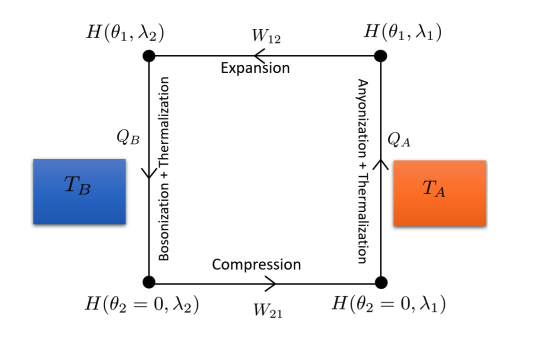
Researchers have developed a novel thermal machine, the Hybrid Anyon-Otto (HAO) cycle, designed to extract energy from the unique properties of anyons at low temperatures. This cycle builds upon the established quantum Otto cycle, but replaces traditional thermalization strokes with processes that manipulate the statistical properties of anyons, particles exhibiting neither purely bosonic nor fermionic behavior. The team developed this approach to investigate how quantum statistics impact the performance of thermal machines. The HAO cycle operates by continuously tuning the system between boson-like and pseudo-fermion-like states, leveraging the energy difference arising from anyonic statistics, analogous to the Pauli energy observed in fermionic systems.
Experiments employ unitary work strokes, expansion and compression, implemented by altering parameters within the system, coupled with statistical tuning achieved through changes in a parameter governing the anyonic behavior. This innovative design allows researchers to investigate the potential for extracting finite work even at vanishingly low temperatures, a regime where traditional Otto cycles fail. The method achieves a unique operational mode stemming from the inherent energy associated with anyons at low temperatures, enabling work production where conventional cycles would not. In the absence of interactions, the HAO cycle operates in an inverse accelerator mode, exhibiting heat transfer from a colder to a hotter reservoir alongside net work output, a phenomenon linked to the anyonization process. Furthermore, weak interactions between anyons can significantly enhance the low-temperature work output, surpassing the performance of both bosonic and pseudo-fermionic systems. The recent experimental realization of the anyon Hubbard model suggests the feasibility of constructing and testing this novel thermal machine in the near future.
Anyonic Statistics Enhance Thermal Machine Performance
Researchers have developed a novel thermal machine based on the unique properties of anyons, quasiparticles exhibiting exotic exclusion statistics, and demonstrated its ability to convert energy into useful work. This machine, termed the Hybrid Anyon-Otto (HAO) cycle, functions by carefully manipulating the statistical properties of anyons at low temperatures to extract energy and perform work, offering a new paradigm for thermodynamic cycles. The team discovered that the HAO cycle’s performance is maximized when anyons most closely resemble free fermions, but surprisingly, introducing even weak interactions shifts this peak performance to intermediate statistical angles, demonstrating a synergistic effect between interactions and anyonic statistics. Experiments reveal that the HAO cycle operates through four distinct strokes: unitary expansion, thermalization with a heat bath, unitary compression, and a final thermalization step.
By precisely controlling the phase parameter governing anyonic statistics and modulating interactions with heat baths, the cycle generates work and exchanges heat, analogous to a conventional engine. The researchers found that the cycle can function as both an engine and a refrigerator, adapting its operation based on temperature differences, and identified a novel “inverse accelerator” mode emerging at low temperatures when anyonic statistics are non-trivial. Data confirms that the HAO cycle can produce work even when operating between two heat baths at the same temperature, a result stemming from the finite energy associated with anyons at low temperatures. Numerical simulations demonstrate that the work output per particle increases monotonically with the anyonic statistical angle, highlighting the potential for maximizing energy extraction. The team’s findings show that the HAO cycle surpasses the performance of conventional engines operating with bosons or fermions, and importantly, the anyon Hubbard model used to realize this cycle has already been experimentally demonstrated, paving the way for potential real-world applications in low-temperature energy conversion and nanoscale devices.
Anyonic Thermal Machine Beats Bosons and Fermions
This research proposes a thermal machine, a four-stroke cycle, based on the behaviour of anyons, exotic particles governed by unique exclusion statistics, to extract energy at low temperatures. The team demonstrates that, without interactions between anyons, the cycle’s work output increases as the anyons behave more like fermions. However, the introduction of even weak interactions dramatically alters this behaviour, with maximum work output achieved at intermediate statistical angles, demonstrating that anyonic statistics, combined with interactions, can outperform both purely bosonic and fermionic systems. Notably, the cycle exhibits a novel ‘inverse accelerator’ mode, a behaviour not seen in conventional engines, which arises from the finite energy of anyons at low temperatures.
The researchers clarify that this mode does not violate fundamental laws of thermodynamics by redefining how work is accounted for within the cycle, ultimately revealing an engine mode with peak efficiency in the anyonic limit. The authors acknowledge that their model is based on a one-dimensional system, and future work could explore the behaviour of this cycle in higher dimensions. Importantly, the underlying anyon Hubbard model has already been experimentally realised, suggesting that.


