Huygens’ metawaveguides offer a revolutionary approach to controlling light, and a team led by M. Saad Bin-Alam from the National Research Council Canada, Yunus Denizhan Sirmaci of Friedrich-Schiller-University Jena, and Alejandro Fernández-Hinestrosa from the University of Málaga now demonstrates a significant advance in this field. The researchers present the first integrated Huygens’-based microring resonators and directional couplers, designed to operate at the crucial 1550nm telecommunication wavelength, and achieve efficient light coupling with remarkably high-quality resonators. This work unlocks enhanced performance for compact add-drop filters, and explores how these structures manipulate light’s speed and behaviour, paving the way for breakthroughs in nonlinear optics and information technologies. Crucially, the team also introduces a novel coupler that enables light to travel backwards within the system, significantly broadening the range of frequencies that can be precisely controlled and opening new possibilities for advanced photonic devices.
Silicon Photonics and Dielectric Metamaterials
This collection of research comprehensively explores the rapidly evolving fields of nanophotonics, metamaterials, and silicon photonics. A dominant theme is silicon photonics, with many studies focusing on silicon-on-insulator waveguides and ring resonators, encompassing their fabrication, characterization, and design. A significant portion of the research investigates metamaterials constructed from high-index dielectric materials like silicon, exploring their unique properties, including negative refraction, enhanced light-matter interaction, and precise control of electromagnetic fields. The research strongly emphasizes nanoscale structures, such as nanodisks and nanoparticles, to control light, utilizing Mie resonances and resonant scattering to achieve specific optical characteristics.
Many studies investigate nonlinear optical phenomena within these structures, including pulse compression, all-optical switching, frequency comb generation, and soliton formation. A central focus lies on guiding light within nanoscale waveguides and integrating photonic components onto a single chip. Growing interest surrounds Kerker effects and generalized Kerker conditions, which enable highly directive scattering and precise control of light using specific nanoparticle arrangements. Some research explores silicon nitride as an alternative material to silicon for integrated photonics, offering advantages in terms of lower losses and a wider transparency window.
The collection also investigates fast light and superluminal propagation, and the development of integrated Huygens’ meta-waveguides for efficient light guiding and manipulation. Overall, this body of work demonstrates a clear trend towards miniaturization, integration, and functionalization of photonic devices, with a strong emphasis on novel materials and innovative designs to achieve unprecedented control over light. Potential research directions include hybrid metamaterials, tunable metamaterials, nonlinear meta-optics, integrated quantum photonics, on-chip optical computing, and advanced silicon nitride photonics.
Huygens Metawaveguide Integration and Fabrication Validation
Researchers engineered a novel platform for integrated photonics based on Huygens’ metawaveguides, demonstrating unprecedented control over light propagation at the 1550nm telecommunication wavelength. This work pioneered the integration of Huygens’-based microring resonators with directional and contra-directional couplers, structures designed to efficiently manipulate light at the nanoscale. The team meticulously fabricated these devices using advanced lithographic techniques, creating structures with precise geometries critical for achieving desired optical properties. Scanning electron microscopy characterized the fabricated structures, confirming the accuracy of the fabrication process and validating the design parameters.
Scientists constructed couplers consisting of adjacent Huygens’ waveguides, carefully controlling the gap between them to optimize energy transfer. The team discovered that the coupling efficiency is highly sensitive to this gap, with variations significantly affecting the mode index of the waveguide in the coupling region. Notably, the Huygens’ scatterers, designed to suppress back-scattering, effectively reduced propagation losses, maintaining signal integrity even in coupled structures. Comparisons with conventional subwavelength grating metawaveguide couplers revealed substantially lower backward coupling in the Huygens’ waveguides.
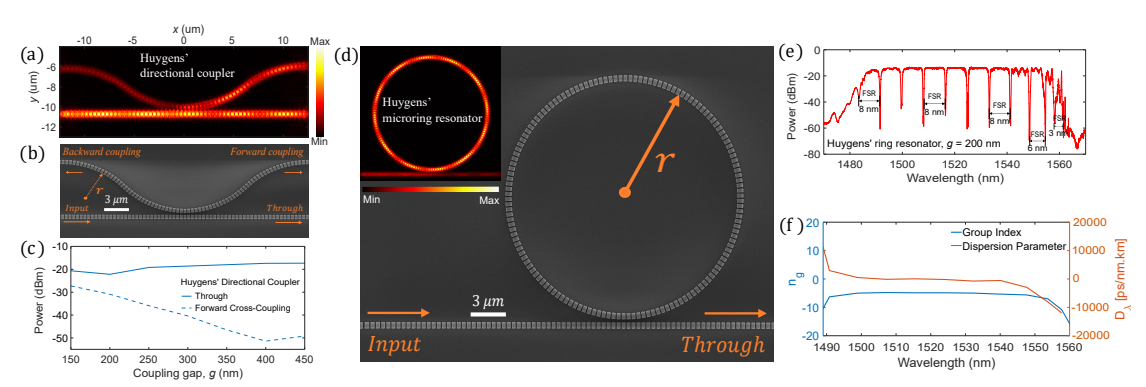
Further innovation involved substituting a straight Huygens’ metawaveguide with a curved one to create a straight-bend directional coupler. Simulations and fabrication yielded structures where the team analyzed cross-coupling characteristics by varying the coupling gap while maintaining a fixed bend radius. Results demonstrated that the cross-coupling efficiency decreased as the gap increased, indicating the need for sufficient coupling length to facilitate efficient energy exchange between the straight and curved waveguides. This configuration was then used to construct a Huygens’ ring resonator, with transmission spectra revealing a unique relationship between free-spectral range and wavelength.
The team extracted the metawaveguide group index, averaging -4. 65 in the central zone of the Huygens’ band, and determined that the dispersion parameter exhibited near-zero dispersion in the same region, a characteristic not observed in conventional or subwavelength grating ring resonators. These findings establish a new pathway for developing compact, high-performance add-drop filters and other photonic devices.
Huygens’ Metawaveguides Enable Compact Optical Filters
This research presents a significant advance in integrated photonics through the development of Huygens’ metawaveguides, structures that provide unprecedented control over light propagation. Researchers successfully integrated these Huygens’-based microring resonators and directional couplers, specifically designed for operation at the crucial 1550nm telecommunication wavelength. The core of this achievement lies in the unique properties of resonant Huygens’ waveguides, which exhibit negative group index and near-zero dispersion, characteristics critical for enhancing performance in compact, high-performance add-drop filters. Scientists demonstrated that single-crystal silicon nano-cuboids function as unidirectional forward Huygens’ scatterers at 1550nm when embedded in a silica cladding.
This behavior arises from the simultaneous excitation of electric and magnetic dipole resonances, achieving comparable magnitudes and spectral overlap. By carefully tuning the antenna dimensions and periodicity, researchers constructed a Huygens’ metawaveguide with a periodicity of 430nm, maximizing forward-directional scattering efficiency. Calculations of the dispersion band revealed two guided modes separated by a photonic band gap, with the fundamental TE mode operating in a region where the antenna dimensions are considerably smaller than the wavelength of light. Notably, the researchers positioned the Huygens’ band within the 1550nm range, and confirmed the existence of a negative group index within this band.
Experiments using a 150nm coupling gap in a directional coupler demonstrated efficient evanescent coupling between Huygens’ waveguides and high-Q resonators. Furthermore, a novel subwavelength grating-Huygens’ contra-directional coupler achieved backward coupling between resonant and non-resonant metawaveguides, delivering a broad spectral rejection bandwidth. These findings pave the way for innovative applications in communications, photonics, and sensing systems.
Huygens Resonators Enable Compact Optical Control
This research introduces a new class of integrated photonic components based on Huygens’ resonant microring resonators and directional and contra-directional couplers, all designed to operate at the 1550nm telecommunication wavelength. By carefully engineering these structures, scientists demonstrate efficient evanescent coupling within micro-ring resonators, a key feature for developing compact and high-performance add-drop filters. The unique dispersion and group velocity properties of Huygens’ waveguides are exploited to achieve this enhanced performance, opening possibilities for advanced control of light propagation. A significant innovation is the development of a hybrid subwavelength grating, Huygens’ contra-directional coupler, which enables backward coupling between resonant and non-resonant metawaveguides. This advancement allows for the creation of racetrack resonators with broad spectral rejection bandwidths and facilitates new approaches to spectral engineering. This work lays a foundation for incorporating Huygens’ waveguides into future integrated photonic platforms, with potential applications spanning classical and quantum optical communication, computing, and sensing.
🗞 Directional and contra-directional coupling in Huygens’ metawaveguide microring resonators
🧠 ArXiv: https://arxiv.org/abs/2510.15845