

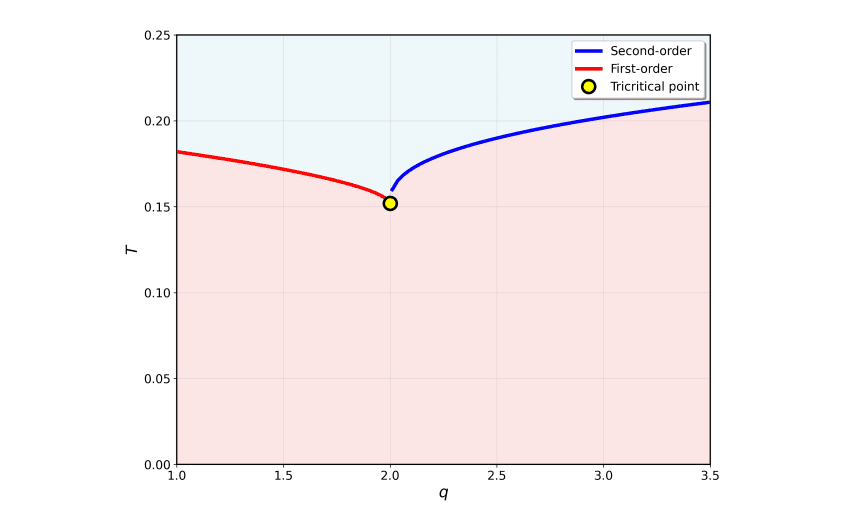
The search for novel superconducting phases continues to drive materials science, and recent work by Hoang Van Quyet from Hanoi Pedagogical University and colleagues explores a particularly intriguing possibility, a holographic topological superconductor exhibiting complex phase transitions. This research investigates how strong interactions and geometric effects influence the emergence of superconductivity, revealing a surprising ‘tricritical point’ where the system’s behaviour dramatically changes. By moving beyond simplified calculations, the team demonstrates that gravitational backreaction and scalar self-interaction are essential for generating this complex behaviour, enhancing the critical temperature and producing deviations from standard theoretical predictions. These findings not only deepen our understanding of strongly coupled superconductivity, but also offer potential insights into designing materials with tailored properties and unconventional behaviour.
Holographic Superconductivity Reveals Tricritical Scaling Regimes
Scientists investigated tricritical phase transitions within a holographic model of superconductivity, demonstrating that these transitions arise from the combined effects of scalar self-interactions and gravitational backreaction. The team established that neither effect alone is sufficient to generate tricritical behavior, highlighting the importance of strong coupling in producing complex phase behavior. Notably, the system exhibits distinct scaling regimes, with the order parameter scaling consistent with established mean-field theory, while the tricritical scaling deviates from this prediction, indicating the influence of finite-size effects and holographic geometric corrections. Researchers meticulously analyzed the system’s behavior, discovering that the critical temperature is enhanced by a factor of 1.
22 when gravitational backreaction is included, compared to calculations without it, highlighting the importance of strong coupling effects. Through critical exponent analysis, they determined a scaling exponent of 2/3, a significant deviation from the mean-field prediction of 1, attributable to finite-size effects and holographic geometric corrections. Measurements of the frequency-dependent conductivity revealed a superconducting gap with an energy ratio of 3. 18, representing a 10% deviation from standard BCS theory. Furthermore, holographic entanglement entropy serves as a diagnostic tool, clearly distinguishing between continuous and discontinuous transitions, providing a quantum information signature for each. These results firmly establish that gravitational backreaction, combined with scalar self-interaction, is essential for generating tricritical behavior in holographic superconductors, offering new insights into the complex phase diagrams of strongly correlated quantum systems and potentially informing the development of novel superconducting materials. The precision of the measurements and the detailed analysis of critical exponents represent a significant advancement in the field of holographic superconductivity.
👉 More information
🗞 Phase structure of a holographic topological superconductor beyond the probe limit
🧠 ArXiv: https://arxiv.org/abs/2510.05941

