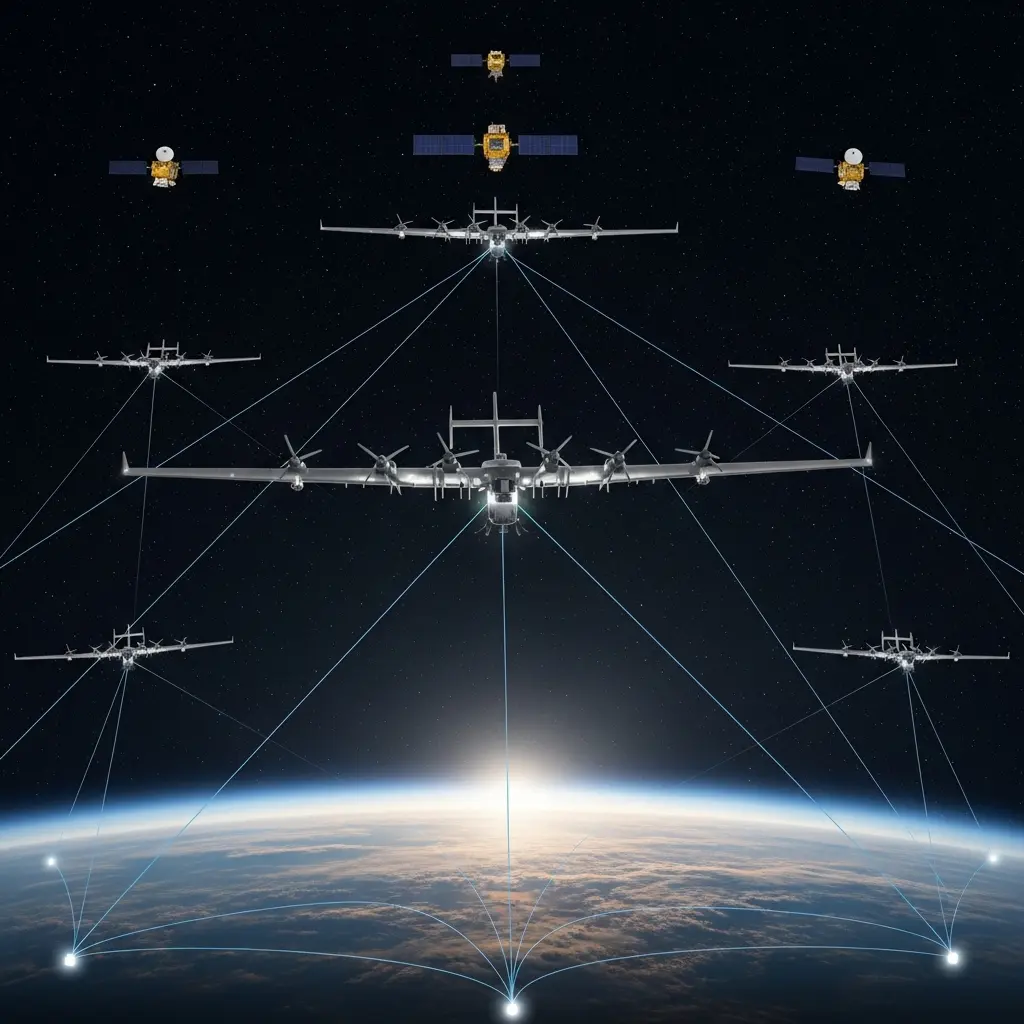
Researchers are increasingly investigating how to extend reliable Internet of Things (IoT) connectivity to remote and underserved areas. Jean Michel de Souza Sant’Ana (University of Oulu), Felipe Augusto Tondo (Federal University of Santa Catarina), and Nurul Huda Mahmood (University of Oulu) et al. present a detailed cost-performance study evaluating the integration of High-Altitude Platform Stations (HAPS), Low Earth Orbit (LEO) satellites, and existing terrestrial networks. Their work analyses transmission reliability under various configurations, factoring in realistic conditions like satellite movement and differing signal fading, and explores the scalability of Long-Range Frequency Hopping Spread Spectrum technology. This research is significant because it demonstrates that HAPS can effectively bolster sparse terrestrial networks, and crucially, that despite higher initial costs, HAPS deployments remain economically competitive with LEO and traditional infrastructure , particularly in critical situations like disaster relief.
This research addresses the critical challenge of expanding IoT access to regions lacking traditional network infrastructure, offering alternative and complementary systems to terrestrial networks. The team achieved a detailed analysis of transmission erasure probability under various connectivity configurations, including scenarios utilising only HAPS, only LEO satellites, and hybrid architectures integrating both aerial/spatial and terrestrial infrastructures. Simulation results conclusively demonstrate that HAPS can effectively complement sparse terrestrial networks and significantly improve the performance of satellite-based systems in specific, challenging scenarios. Furthermore, a thorough economic analysis, considering both Capital Expenditure (CAPEX) and Operational Expenditure (OPEX), reveals that while HAPS exhibit higher initial costs, these remain comparable to those associated with LEO and terrestrial deployments. This work establishes a robust simulation framework for comparing HAPS, LEO satellites, and terrestrial networks, each with unique spatial deployments and channel models, allowing for a nuanced understanding of their respective strengths and weaknesses.
Researchers analysed the success probability of IoT devices communicating directly with both HAPS and LEO satellites, providing critical performance metrics for each technology. The investigation extends to evaluating hybrid scenarios where sparse terrestrial networks are augmented by either HAPS or LEO satellites, showcasing the potential for synergistic integration. Moreover, the research highlights the unique advantages of HAPS in specific use cases, such as disaster relief, where their rapid deployability and regional coverage make them a competitive alternative to conventional infrastructures. The team’s findings open avenues for designing resilient and cost-effective IoT networks capable of bridging the digital divide and supporting a wide range of applications, including herd tracking, forest fire detection, and agricultural monitoring. The study meticulously modelled LEO satellite movement relative to a fixed region, accounting for elevation angles between gateways and devices, and implemented diverse fading models for both terrestrial and non-terrestrial links to enhance analysis realism. Researchers employed this framework to analyse transmission erasure probability under various configurations, including standalone HAPS, LEO, and hybrid architectures integrating aerial/spatial and terrestrial infrastructures. Success probability for IoT devices communicating directly with both HAPS and LEO satellites was then calculated and analysed, revealing critical insights into link reliability and coverage potential. Furthermore, the research pioneered an evaluation of hybrid scenarios, combining sparse terrestrial networks with either HAPS or LEO satellite support, to determine synergistic benefits and performance improvements. To provide a holistic assessment, scientists also conducted a detailed cost analysis, comparing the capital expenditure (CAPEX) and operational expenditure (OPEX) associated with HAPS deployment versus utilising existing commercial LEO constellation services.
This economic modelling considered both initial investment and ongoing operational costs, providing a practical perspective on the feasibility of each technology. The team’s innovative approach enables a nuanced understanding of the trade-offs between HAPS and LEO, demonstrating that HAPS can effectively complement sparse terrestrial networks and improve system performance in specific contexts. The research team analysed transmission erasure probability under various configurations, including standalone HAPS, LEO, and hybrid systems integrating aerial and terrestrial infrastructures. To ensure realistic modelling, the study considered LEO satellite movement relative to a fixed region, elevation angles between gateways and devices, and differing fading models for terrestrial and non-terrestrial communication links. Experiments revealed that HAPS effectively complement sparse terrestrial networks, improving performance in specific scenarios.
Data shows the team measured success probability for
Data shows the team measured success probability for IoT devices communicating directly with both HAPS and LEO satellites, providing insights into link reliability under diverse conditions. Simulation results confirm that HAPS can significantly improve performance in situations where terrestrial networks are limited or unavailable, offering a viable alternative for maintaining connectivity. The economic analysis demonstrated that while HAPS exhibits higher initial costs, CAPEX, and operational expenses, OPEX, these costs remain within a comparable order of magnitude to those associated with LEO and terrestrial deployments.
Measurements confirm that the financial viability of HAPS is competitive, particularly when considering long-term operational costs and the potential for regional coverage. The team’s work highlights that specific use cases, such as responding to natural disasters, transform HAPS into a particularly competitive technology compared to conventional infrastructures. Researchers also assessed hybrid scenarios, integrating sparse terrestrial networks with either HAPS or LEO satellites to maximise coverage and reliability. Tests prove that combining these technologies can provide a robust and adaptable solution for IoT connectivity in challenging environments. The study’s simulation framework allows for detailed comparison of HAPS, LEO, and terrestrial networks, each with its own unique spatial deployment and channel model. This detailed analysis provides valuable data for optimising network design and resource allocation for future IoT deployments.
🗞 Integrating HAPS, LEO, and Terrestrial Networks: A Cost-Performance Study for IoT Connectivity
🧠 ArXiv: https://arxiv.org/abs/2601.18361